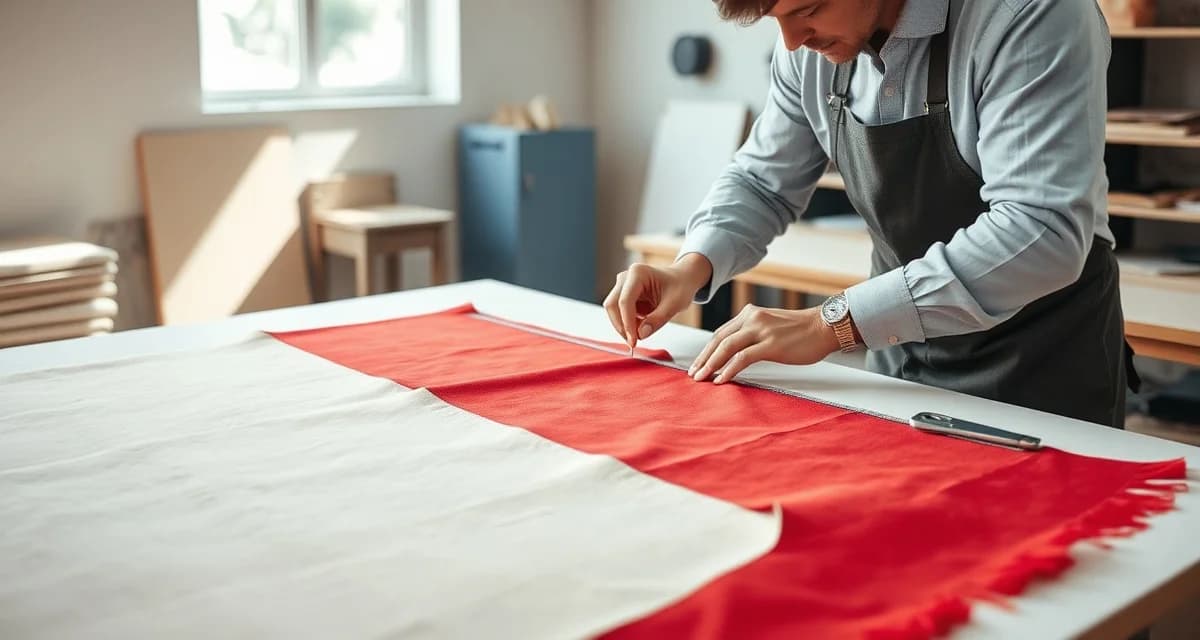
Two-Tone Upholstery Fabric Yardage: Two Orders One Job
Two-tone jobs with wrong seam line placement require full fabric remakes. The seam location isn't something you can adjust after cutting. If the client approves one seam position and you cut for another, or if you and the client have different mental pictures of where Fabric A ends and Fabric B begins, the result is a piece that doesn't match the expectation and has to be redone.
Always confirm seam location in writing before cutting. This guide covers the calculation side and the documentation practices that prevent costly two-tone errors.
TL;DR
- Two Tone Upholstery yardage depends on fabric width, construction details, pattern repeat, and nap direction.
- Plain 54-inch fabric requires a baseline calculation plus 10-15% waste allowance for a standard two tone upholstery job.
- Patterned fabric adds 20-35% to base yardage depending on repeat size and the number of cutting zones that must align.
- Directional fabrics add 15-25% over plain fabric because layout optimization is restricted by nap direction.
- Always verify fabric width before finalizing yardage; COM fabric often comes in non-standard widths.
- Calculating yardage at the quote stage, not mid-job, eliminates reorders and protects your profit margin.
Planning the Two-Fabric Seam
The most common two-tone upholstery configurations:
Seat vs back: The seat and seat cushions use one fabric; the back panels and back cushions use another. The seam runs along the front edge of the seat platform.
Inside vs outside: The inside panels (inside back, inside arms, seat) use a primary fabric; the outside panels (outside back, outside arms, kick panel) use a secondary or contrast fabric. Seams run along the top of the back rail and along the top of each arm.
Front vs side: The front face of the sofa uses one fabric; the side and back surfaces use another. Seams run at the corners where front meets side.
Cushion inserts vs frame: Cushion centers use a primary fabric with contrasting welts and cushion borders. This is especially common on box cushions and T-cushions.
Center panel vs border: A decorative center panel on the back or seat uses a contrast fabric surrounded by a field of the primary fabric.
Calculating Yardage for Each Fabric
Calculate each fabric zone independently. Don't try to combine them. Treat it as two separate jobs that happen to be on the same piece.
Fabric A zones: List every panel that uses Fabric A. Measure each panel and calculate yardage as you would for a single-fabric job.
Fabric B zones: Do the same for Fabric B.
Add up each fabric total separately. That's what you order for each fabric.
Example: Seat-vs-back two-tone sofa
Fabric A (seat): seat cushions (3 cushions), deck, seat boxing strips, seat welts
- Seat cushions: 3 x ~0.8 yards = 2.4 yards
- Deck: 1 yard
- Welts for seat zone: 0.5 yards
- Fabric A total: ~4 yards
Fabric B (back): inside back panel, outside back panel, inside arms, outside arms, back cushions, kick/skirt, arm panels, back welts
- Back panels: 2.5 yards
- Arms (4 panels): 2 yards
- Back cushions (3): 2 yards
- Kick: 0.5 yards
- Welts for back zone: 0.75 yards
- Fabric B total: ~8 yards
Total order: 4 yards Fabric A + 8 yards Fabric B.
Without separating them, a single-fabric template would give you a combined number that you'd have to guess how to split. That guessing produces wrong orders.
Seam Placement Documentation
Before you order fabric, get written confirmation of seam placement from the client. This doesn't have to be formal, a photo with a line drawn on it and an email saying "here's where Fabric A ends and Fabric B begins, let me know if this is correct" works fine.
What to confirm in writing:
- Which fabric goes on which surface
- Where exactly the seam runs (on the top rail? at the front seat edge? at the arm front?)
- Whether the seam is covered with welt cord (and which color)
- Whether the outside back matches inside back (Fabric B) or uses a different fabric altogether
Confirming seam location in writing protects both you and the client. If the client comes back saying "I thought the arms would be in Fabric A," you have documentation showing they approved Fabric B arms.
Welt Cord Coordination in Two-Tone Jobs
Welt cord (piping) at the seam between two fabrics can be cut from either fabric or from a third accent fabric. The welt decision affects both the look and the yardage:
- Welt from Fabric A: Requires extra yardage for Fabric A piping strips. Typically adds 0.3-0.75 yards to Fabric A order.
- Welt from Fabric B: Same additional requirement from Fabric B.
- Contrast welt from Fabric C: A third fabric ordered specifically for piping. A full sofa's piping requires 15-25 yards of strip cut on bias or straight, which from a 54-inch fabric at 1.5-inch cut strips translates to 0.5-1 yard of Fabric C.
Specify and calculate welt separately from both main fabrics. It's easy to forget, and welt cord running out partway through installation is an expensive delay.
Order Timing for Two-Fabric Jobs
Order both fabrics at the same time from the same call to the supplier. This matters for two reasons:
- If either fabric is on backorder or out of stock, you'll know before you've started (or ordered) the other.
- You can confirm dye lot status on both while you have the supplier on the phone.
Don't start the job with only one fabric received. Two-tone jobs need both fabrics in hand before cutting begins, because the seam placement and panel sizing decisions affect both fabrics simultaneously.
For complete quote generation that handles dual-fabric jobs, use the StitchDesk upholstery quote generator. The sofa fabric yardage calculator can be run twice (once for each fabric zone) to get separate fabric totals.
Frequently Asked Questions
How do I calculate yardage for two fabrics on one piece?
Treat each fabric as a separate calculation. List every panel that uses Fabric A, calculate their yardage total, then do the same for Fabric B. Sum each total independently and order them separately. Don't use a combined yardage estimate and try to split it, this produces guessing errors. Welt cord yardage should be calculated separately from both main fabrics and added to whichever fabric color it matches.
Where do I place the seam on a two-tone sofa?
The most common and visually clean seam placements are along natural furniture lines: the front seat edge (seat vs back divide), the top rail edge (inside vs outside divide), or the arm front (front-to-side divide). The seam should follow a structural line of the furniture wherever possible. Seams placed in the middle of a flat panel without a structural reference look arbitrary and are harder to execute cleanly. Always confirm seam placement with the client in writing before cutting.
Can I mix fabric types in a two-tone upholstery job?
Yes, but with some limitations. The two fabrics should have similar weight and thickness where they meet at a seam, a heavy brocade meeting a lightweight linen creates a seam that's harder to join cleanly. Similarly, mixing a stretchy knit-backed fabric with a rigid woven creates tension issues at the seam line. For most residential two-tone jobs, mixing two decorative woven fabrics in similar weights works well. Mixing different material categories (like velvet seat with vinyl outside back) works fine because those fabrics meet at natural structural breaks rather than a sewn seam.
What is the biggest factor in yardage variation for this piece?
Pattern repeat is the biggest source of yardage variation. On plain fabric, the baseline calculation plus a 10-15% waste buffer is usually sufficient. Add a 13-inch pattern repeat and you may need 15-20% more. Add a 27-inch pattern repeat and the additional yardage can be 25-35% over the plain fabric calculation. Nap direction is the second-largest factor, typically adding 15-25% over plain fabric because layout optimization is restricted.
Sources
- National Upholstery Association
- Association of Master Upholsterers and Soft Furnishers (AMUSF)
- Upholstered Furniture Action Council (UFAC)
- Furniture Today (trade publication)
Get Started with StitchDesk
Getting yardage right on yardage two tone upholstery jobs is the difference between a profitable quote and an expensive reorder. StitchDesk's fabric calculator accounts for all the variables that cause errors: pattern repeat by zone, nap direction, fabric width, and cushion configuration. Start a free trial and see how accurate yardage calculation affects your bottom line.