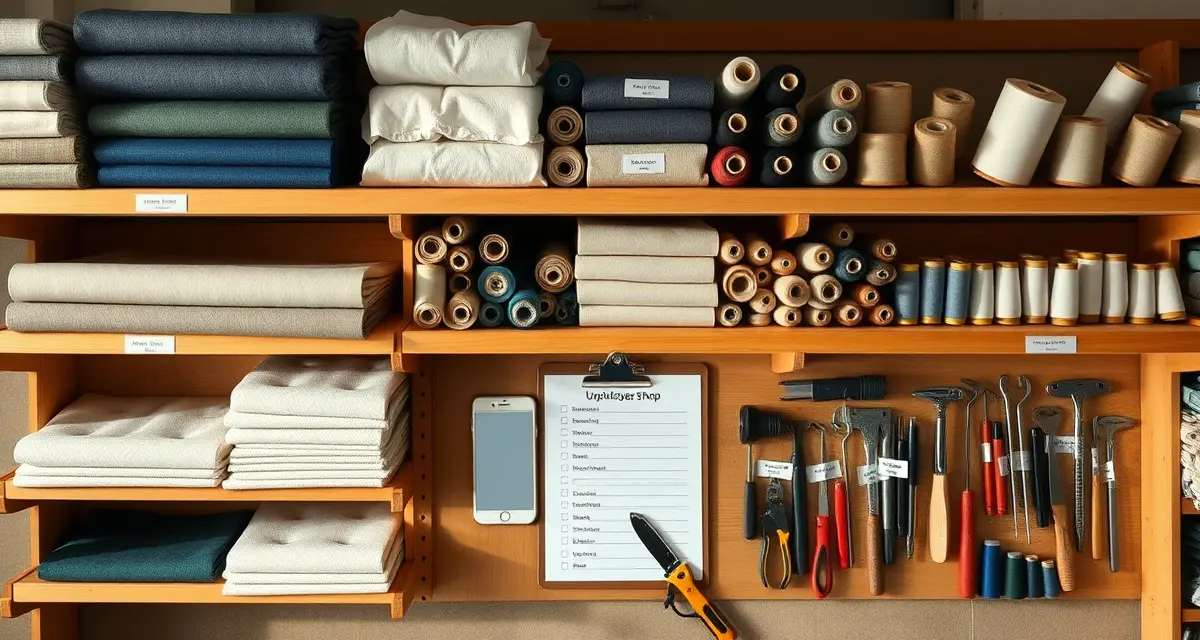
Upholstery Shop Inventory Management: Fabric Supplies and Tools
Running out of foam on a job day costs 2 to 4 hours and often requires a customer callback to reschedule. That's not an inventory problem, it's a par level problem. A par level system specifies the minimum quantity of each supply you should have before placing a reorder. When stock drops below the par level, it goes on the order list. You reorder on a fixed schedule, not when you're out.
This guide covers the three types of inventory an upholstery shop manages, fabric (per-job orders), consumable supplies (stock items), and tools, and the systems that keep each from causing job delays.
TL;DR
- This guide covers the specific techniques, measurements, and decisions that determine quality outcomes in upholstery work.
- Planning and preparation before cutting begins is the most reliable way to avoid costly errors on any upholstery job.
- Fabric selection, yardage calculation, and structural assessment are the three decisions that most affect the final result.
- Experienced upholsterers develop consistent workflows that ensure quality and efficiency across every job type they handle.
- Documenting job details, material specifications, and client approvals protects both the shop and the client.
- The right tools, materials, and techniques for each job type make a measurable difference in quality and profitability.
Fabric Inventory: Per-Job Tracking
Fabric is not stocked in bulk in most upholstery shops. You order fabric per job, tied to a specific client and job number. The inventory management challenge is tracking what's been ordered, when it's expected, and which job it belongs to.
The fabric order log:
For every fabric order, record:
- Job number
- Client name
- Fabric name, colorway, and vendor
- Purchase order number
- Yards ordered
- Order date
- Expected arrival date
- Actual arrival date (filled in when fabric arrives)
Whether this lives in a spreadsheet or in job management software, the log gives you a single view of all outstanding fabric orders. Without it, you're tracking orders in your head, in email threads, and in vendor confirmations, a system that breaks down at 15+ active jobs.
In StitchDesk: Each job record includes a fabric tracking section. When you create a fabric order for a job, you enter the vendor, PO, yardage, and expected arrival. When fabric arrives, you mark it received in the job record. The client portal automatically updates to show "fabric received" when this changes. The order log is the job record, no separate spreadsheet needed.
What to do when fabric is delayed:
Check the log daily against expected arrival dates. When a fabric is overdue, contact the vendor proactively before the client calls you. If the delay is notable, contact the client: "Your fabric was expected to arrive by [date], the vendor has notified us it's running [X days] late. Your new estimated pickup date is [date]. We'll contact you as soon as production is complete."
Proactive delay communication is always better than a client calling to ask why their piece isn't ready.
Consumable Supply Inventory: Par Levels
Consumable supplies are the materials used on every job that you stock in bulk: staples, foam, batting, cambric, welt cord, thread, and miscellaneous fasteners and adhesives.
Setting par levels:
A par level is the minimum quantity you should have before reordering. It's calculated from your weekly usage and your supplier lead time.
Formula: Par level = (weekly usage × supplier lead time in weeks) + safety buffer
Example: You use 2 boxes of #7 staples per week. Your supplier has a 1-week lead time. Safety buffer = 1 week.
Par level = (2 × 1) + 1 = 3 boxes minimum before reordering.
Par levels for common supplies at a 15-20 job/month shop:
| Supply | Par Level |
|---|---|
| #7 staples (5,000 ct box) | 2 boxes |
| #8 staples (5,000 ct box) | 1 box |
| Seat foam, 1.8lb/36 ILD (54×108 sheet) | 1 sheet |
| Back/medium foam, 1.8lb/25 ILD | 0.5 sheet |
| Dacron batting 1-inch (25-yard roll) | 1 roll |
| Dacron batting 2-inch | 0.5 roll |
| Cambric (10-yard roll) | 2 rolls |
| Welt cord #100 (25-yard roll) | 1 roll |
| Welt cord #200 (25-yard roll) | 0.5 roll |
| Upholstery thread, natural (spool) | 2 spools |
| Fabric adhesive spray | 1 can |
| Cardboard tack strips | 1 box |
The par level check:
Walk the supply area once per week. Any supply at or below par level goes on the order list. Place the order the same day. Don't wait until the list grows, weekly ordering prevents the stockout scenario.
The Weekly Supply Order Routine
Weekly ordering is the most effective cadence for most upholstery shops. It's regular enough to prevent stockouts without requiring daily attention.
The routine:
- Monday morning: walk the supply area, note anything at or below par level
- Add to order list (a simple phone note, a whiteboard, or a supply tracker in your shop management software)
- Place the order by Monday afternoon
If you have two suppliers for critical items (foam, in particular), alternate or compare pricing on each weekly order. A 5-minute price check can save $20-40 on a single foam order.
Tool Inventory and Maintenance
Tools aren't consumables, but they require tracking and maintenance to prevent job delays caused by tool failure.
Tool inventory list:
Keep a written list of every tool in the shop with:
- Tool name and model
- Purchase date
- Last service date
- Next service date
- Any known issues
This takes 20 minutes to create initially and 2 minutes to update when something changes.
Maintenance schedule:
| Tool | Maintenance Interval |
|---|---|
| Pneumatic staple gun | Daily oil (2-3 drops before use); weekly magazine clean |
| Air compressor | Monthly drain tank; check belt tension quarterly |
| Sewing machine | Clean bobbin area after each use; oil per manufacturer schedule; professional service annually |
| Scissors | Sharpen every 6-12 months (fabric scissors only) |
| Foam cutter blade | Replace when cuts become rough or drag |
The most common tool failure causing job delays: a jammed or broken pneumatic stapler. Daily oiling prevents 90% of jams. Keeping a backup manual staple gun for emergencies prevents a jammed stapler from stopping production.
Fabric Remnant Tracking
Fabric remnants, leftover fabric from completed jobs, accumulate quickly in upholstery shops. An untracked remnant pile is a source of both waste and potential savings.
Track remnants by:
- Fabric name and color
- Approximate yardage remaining
- Job it came from (in case the client needs a match later)
Remnants over 1 yard are potentially usable on small jobs (dining chairs, ottoman covers). Remnants under 1 yard can be used for welt cord, test cuts, and samples.
For the broader picture of how inventory management connects to the shop workflow, the upholstery shop management guide covers scheduling, workflow, and client communication as a system. For the supplies you're managing, the upholstery shop supplies guide covers par level recommendations by supply type and job volume.
Frequently Asked Questions
How do I manage fabric inventory in my upholstery shop?
Manage fabric as per-job orders rather than bulk stock. For every fabric order, record the job number, vendor, purchase order, yardage, and expected arrival date in a fabric order log (spreadsheet or job management software). Check the log daily against expected arrival dates. When fabric arrives, mark it received and link it to the job record. Proactively contact clients when fabric is delayed before they call you. For remnants from completed jobs, track pieces over 1 yard by fabric name, color, and yardage, they're usable on small future jobs.
What supplies should I always have in stock?
At a minimum: #7 and #8 staples (the most commonly forgotten supply that causes job stoppage), standard seat foam (1.8lb/36 ILD), cambric dust cover fabric, Dacron batting in 1-inch and 2-inch thicknesses, welt cord in standard (#100) and jumbo (#200) sizes, heavy upholstery thread in natural and black, cardboard and metal tack strips, and fabric adhesive spray. Set par levels for each of these and check stock weekly against the par levels. Order on a fixed weekly schedule so you're never reordering in a panic.
How do I track upholstery supply usage?
A simple par level system is more effective than formal usage tracking for most shops. Walk the supply area weekly. Any item at or below its par level (the minimum quantity before reordering) goes on the order list. The par level for each item is based on weekly usage and supplier lead time. This passive system doesn't require recording usage on every job, it just requires a weekly visual check and a consistent order schedule. For shops that want more granular tracking, recording supplies used per job type for 30 days gives you enough data to set tighter par levels.
What are the most common mistakes to avoid in this type of work?
The most common mistakes are underestimating material requirements, starting work before the frame is fully assessed and repaired, and skipping the centering and alignment checks before cutting. Each of these is far more expensive to correct after cutting has begun than to prevent at the planning stage. Taking an extra 15-30 minutes at the assessment and planning stage pays dividends throughout the job.
How do I get the best results from a professional upholsterer?
Come to the consultation with clear measurements, photos of the piece, and an idea of the room's color scheme and intended use. Be specific about how the piece will be used: high traffic, pets, children, or outdoor exposure all affect fabric recommendations. Provide fabric samples or accept guidance on appropriate options for your use case. Approve the proof carefully and ask to see the fabric on the piece before final installation if you are uncertain about a pattern or color choice.
Sources
- National Upholstery Association
- Association of Master Upholsterers and Soft Furnishers (AMUSF)
- Upholstered Furniture Action Council (UFAC)
- Furniture Today (trade publication)
Get Started with StitchDesk
Running a successful upholstery shop means getting the details right on every job. StitchDesk gives you purpose-built tools for quoting, fabric calculation, job tracking, and client communication, all in one place designed specifically for the trade. Start a free trial and see how StitchDesk supports quality work from intake to delivery.