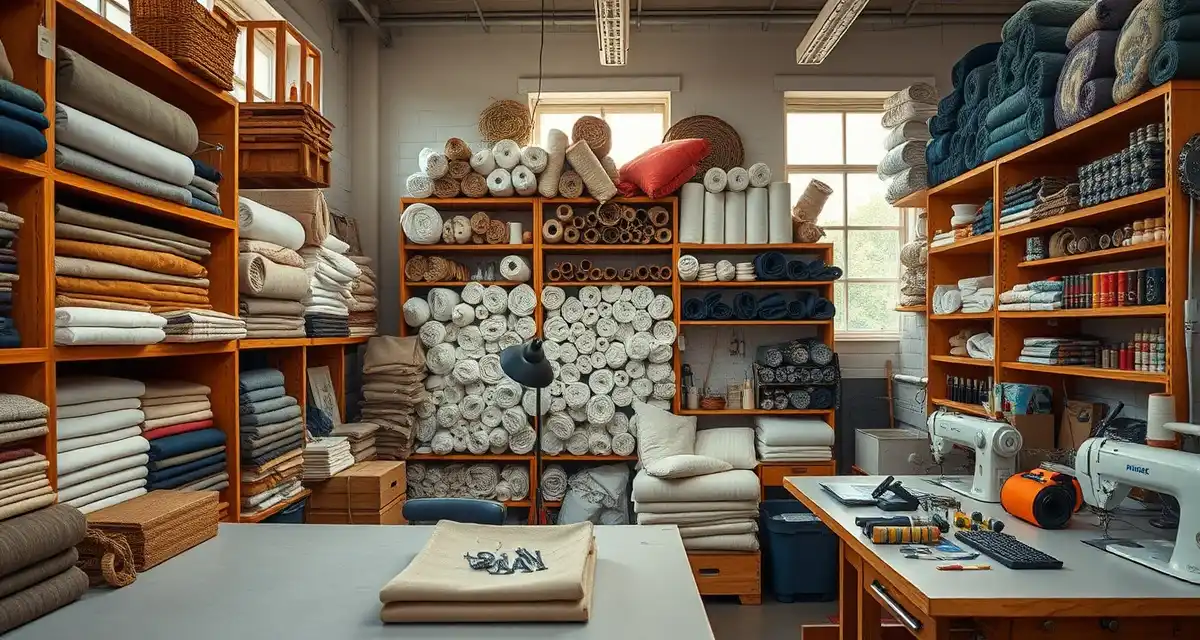
Upholstery Shop Supplies: What You Need for Every Job Type
Shops that stockout of #7 staples or decking on a job face a 2 to 4 hour delay, and if the client has a hard pickup deadline, that delay becomes a delivery failure. A par level supply system prevents stockouts without tying up cash in excessive inventory. The par level is simply the minimum quantity you should have on hand before placing a reorder.
This guide organizes upholstery supplies by job type and provides practical stocking recommendations for shops at different production volumes.
TL;DR
- A well-managed upholstery shop tracks every job from intake to delivery with documented status at each stage.
- Fabric management, including ordering, receiving, storing, and allocating by job, is operationally the most complex part of running an upholstery shop.
- Client communication (status updates, completion photos, delivery scheduling) reduces inbound calls and increases repeat business.
- Shops that document their workflow can train new employees faster and maintain consistent quality during growth periods.
- Measuring key metrics (jobs per week, average ticket, fabric waste rate) is the foundation of informed business decisions.
- Professional shop management tools pay for themselves through reduced errors and faster quoting, typically within the first quarter.
Core Supplies: Every Job
These supplies are used on virtually every residential upholstery job. You should never run out of them.
Staples:
- #7 staples (3/8 inch, 20-22 gauge): the workhorse staple for most fabric attachment. Used on the majority of residential jobs.
- #8 staples (1/2 inch, 20 gauge): for attaching heavier materials to solid wood frames.
- Pneumatic staple strips in both sizes: buy in boxes of 5,000-10,000.
- Par level recommendation: 2 full boxes of each type at all times.
Thread:
- Heavy upholstery thread, bonded nylon, natural color and black: for all machine sewing (welt, cushion seams).
- Button twine / hand-stitching thread: for hand-stitching, spring tying, and tufting.
- Par level: 2 spools of each color/weight at all times.
- #100 (standard) and #200 (jumbo) welt cord: cotton twisted cord for piping. Have both sizes, job requirements vary.
- Par level: 2 rolls of each size.
Foam:
- 1.8 density, 36 ILD (firm seat): standard seat foam.
- 1.8 density, 25 ILD (medium): standard back cushion and softer seat foam.
- High-resilience HR foam, 2.0 density: for high-end residential and commercial seating.
- Par level: one sheet (54"x108") of each density at all times. Reorder at half a sheet.
Dacron batting:
- 1-inch and 2-inch thickness: for cushion wrapping, arm softening, and inside back padding.
- Par level: one roll of each thickness.
Cambric (dust cover fabric):
- Black cambric, 54-inch width: for dust cover installation on every piece.
- Par level: 5-10 yards.
Webbing:
- Jute webbing (3.5 inch): for traditional seat bases and back support.
- Sinuous spring wire (11 gauge): for sinuous (serpentine) spring replacement.
- Par level: one 5-yard roll of jute, one roll of sinuous wire.
Adhesives:
- Fabric adhesive spray: for batting attachment and spot applications.
- Contact cement: for leather and vinyl bonding.
- Par level: one can of each, reorder at 25% remaining.
Supplies by Job Type
Sofa and Loveseat Jobs
Beyond the core supplies, sofas and loveseats typically require:
- Tack strips (cardboard and metal): For blind-tacking outside panels. Stock both types.
- Decking fabric: Cambric or muslin for seat deck platforms. Keep 10 yards minimum.
- Buttoning supplies: Button forms, backing buttons, and twine if you do tufted work. Have button forms in sizes 16-36 (the most common range).
Dining Chair Jobs
Dining chair batches (4-12 chairs at a time) use:
- High quantities of seat foam (standard density, pre-cut or easy-to-cut sheets)
- Staples in volume, a full set of 8 chairs uses 200-400 staples
- Speed-cut corner foam or foam wedges for tapered seats
Commercial Jobs (Restaurant, Hotel)
Commercial jobs require supplies not commonly stocked for residential:
- Commercial-grade foam: 2.5 density, 45-50 ILD for restaurant seats and waiting room chairs. Higher density handles the wear.
- FR (fire-resistant) batting: Required for commercial public space seating in most jurisdictions.
- High-strength staples (#8 or equivalent): Commercial framing is often harder wood than residential.
- Heavy nylon thread: For commercial fabric seaming (contract-weight fabric is heavier than residential).
Automotive and Marine Jobs
Specialty vehicle upholstery requires different supplies:
- Hog rings and hog ring pliers: For automotive seat cover attachment to wire frames.
- Closed-cell foam: Marine applications require foam that doesn't absorb water.
- UV-resistant thread (polyester or stainless monofilament): Standard thread degrades in UV and moisture.
- Marine-grade adhesive: Resistant to moisture and temperature extremes.
Supply Organization
The fastest way to lose 30 minutes a day is a disorganized supply area. A simple bin system works:
Label bins by material type (staples, foam, thread, batting, etc.)
Front-face the bins so you can see remaining quantities at a glance
Assign a par level to each bin, write it on a label on the bin, not just in your head
When a bin drops below par level, it goes on the order list. Order weekly, not when you're out.
Supplier Relationships
Having two suppliers for critical supplies reduces your stockout risk. If one is backordered, you have a fallback. The two categories where backorders cause the most pain:
- Foam: Supply constraints on specific foam grades happen seasonally. Have two foam suppliers.
- Fabric: Not a supply you stock in bulk, but having two fabric distributors prevents the scenario where one is out of a fabric grade the client has chosen.
For the larger tool investment decisions (pneumatic staplers, sewing machines, foam cutters), the upholstery shop tools guide covers when to buy each tool relative to production volume. For broader shop management, the upholstery shop management guide addresses scheduling, workflow, and client communication alongside supply management.
Frequently Asked Questions
What supplies does an upholstery shop need?
The core supplies used on every residential job are: #7 and #8 staples, heavy upholstery thread (bonded nylon), welt cord in standard and jumbo sizes, seat foam (1.8 density in firm and medium ILD), Dacron batting in 1-inch and 2-inch thickness, cambric dust cover fabric, jute webbing, tack strips (cardboard and metal), decking fabric, fabric adhesive spray, and contact cement. Commercial and specialty jobs add FR batting, commercial-grade foam (2.5 density), hog rings (automotive), closed-cell foam (marine), and UV-resistant thread.
How do I manage upholstery supply inventory?
Set a par level for each supply, the minimum quantity you should have on hand before reordering. Write the par level on the bin or storage location. When quantity drops below par, add to the weekly order list. Order weekly on a fixed schedule rather than reactively when you run out. Keep two suppliers for high-risk items (foam, critical thread) so one backorder doesn't stop production. The most common stockout-caused delays are #7 staples (highest usage), cambric dust cover, and standard-density seat foam.
What are the most commonly forgotten upholstery supplies?
The supplies most often forgotten on jobs are: cambric dust cover (discovered missing when you get to the last step), tack strips for outside back blind-tacking (requires a hardware run mid-job), decking fabric for seat platforms (often used up faster than anticipated), and button forms for tufted work (size mismatch discovered during installation). A job-start checklist helps: before starting any new piece, verify you have all supplies needed for that job type, including the finishing supplies used at the end of production.
How do I track multiple jobs at different stages simultaneously?
A job tracking system, whether paper-based or software-based, should give you a clear view of every active job's current stage at a glance. The minimum useful stages are: intake received, fabric ordered, fabric received, work in progress, quality check, ready for pickup/delivery, completed. Software that shows all active jobs on a single dashboard with current stage and due date eliminates the mental overhead of tracking multiple jobs manually.
Sources
- National Upholstery Association
- Association of Master Upholsterers and Soft Furnishers (AMUSF)
- Upholstered Furniture Action Council (UFAC)
- Furniture Today (trade publication)
Get Started with StitchDesk
A well-run upholstery shop is built on consistent processes, accurate information, and clear client communication. StitchDesk gives you the tools to manage all three from intake to delivery, without the overhead of paper systems or generic software that does not understand the trade. Start a free trial and see how StitchDesk fits your workflow.