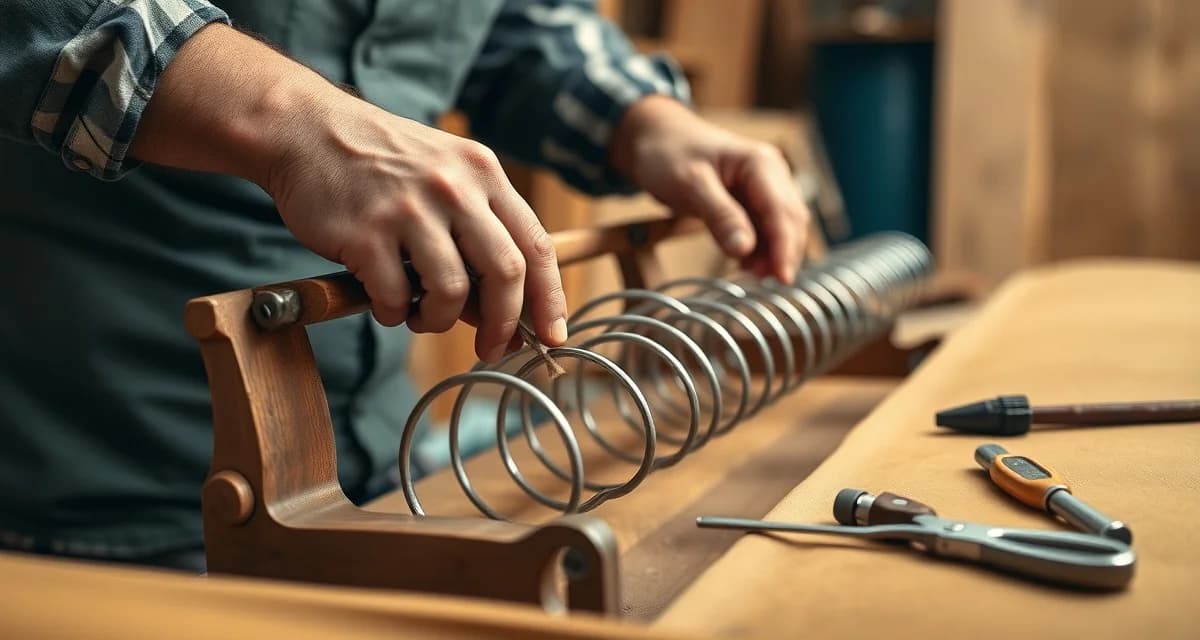
Upholstery Spring Repair Guide: Coil Serpentine and No-Sag Springs
Repairing 8-way coil springs instead of replacing them with serpentine saves $150 to $300 on a traditional sofa job. The labor to retie coil springs is less than the combined cost of new serpentine springs, clips, and the installation time difference. On any sofa with original coil springs worth preserving, retying is the professional choice for both cost and character.
This guide covers assessment, repair, and replacement decisions for all three main spring types.
TL;DR
- A well-managed upholstery shop tracks every job from intake to delivery with documented status at each stage.
- Fabric management, including ordering, receiving, storing, and allocating by job, is operationally the most complex part of running an upholstery shop.
- Client communication (status updates, completion photos, delivery scheduling) reduces inbound calls and increases repeat business.
- Shops that document their workflow can train new employees faster and maintain consistent quality during growth periods.
- Measuring key metrics (jobs per week, average ticket, fabric waste rate) is the foundation of informed business decisions.
- Professional shop management tools pay for themselves through reduced errors and faster quoting, typically within the first quarter.
The Three Spring Types
8-way hand-tied coil springs: The original high-quality residential spring system. Individual coil springs arranged in rows, each spring tied to its neighbors in 8 directions using spring twine. Provides the classic bounce and support associated with traditional furniture.
Serpentine (sinuous or no-sag) springs: S-curved wire springs running front-to-back in parallel rows, clipped to the seat rails. Standard in residential furniture since the 1960s. Less expensive to install than coil springs but produces a different (flatter) seating feel.
Grid spring systems: Connected grid of welded steel springs. Found in some commercial and mid-grade residential furniture. Similar support profile to serpentine but pre-engineered as a unit.
Coil Spring Assessment
Remove the cambric dust cover from the sofa bottom. Flip the sofa or look directly at the spring deck from below.
What to look for:
Broken ties: The spring twine runs in 4 directions across the deck (front-to-back, side-to-side, and two diagonals). Look for missing or broken twine. A single broken tie on an otherwise intact deck is a 5-minute repair. Multiple broken ties indicate deterioration of the full twine system.
Fallen springs: A spring that has come completely detached from the deck or fallen out of alignment is visible as a gap or a spring leaning considerably to one side.
Damaged springs: Visually inspect each spring. A broken spring has a visible separation in the coil. A spring that has "set" (permanently compressed) is shorter than its neighbors when measured unstressed.
Tipping springs: Push down on each spring individually. Any spring that tips or topples rather than compressing vertically has lost its base attachment.
Assessment decision:
- Under 20% of springs or ties need attention: Repair (retie and restore)
- 20-50% need attention: Discuss with client. Repair is viable but time-intensive. Replacement with new coil springs may be more cost-effective.
- Over 50% need attention: Full spring deck replacement is typically the right call.
Coil Spring Retying
Retying is the repair that restores original functionality with original materials.
Materials: Spring twine (cotton or polyester, not nylon cord). 8-gauge spring twine is standard for most residential coil springs.
Retying sequence:
- Knot the twine to the seat frame rail at the starting end
- Tie the top of the first spring in the row with a clove hitch
- Run twine to the next spring in the row, tie, continue to the end of the row
- Knot to the frame rail at the far end
- Run the second direction (side-to-side) crossing the first
- Run both diagonal directions last
Tying direction: Each spring gets tied in 8 directions when all 4 runs are complete (each run ties the spring in 2 directions: the run toward the previous spring and the run toward the next spring, each at 180 degrees = 2 ties per run x 4 runs = 8 ties).
At the frame edge: The springs adjacent to the frame rails are typically tied to the rails themselves with separate clips or staples. Check these attachments and re-secure any that have pulled loose.
Serpentine Spring Assessment and Repair
Serpentine springs are simpler to assess. Look for:
Broken spring wire: A serpentine spring that has cracked or separated at any point. The crack is usually visible as a gap in the spring wire, often at a clip attachment point or at a kink.
Detached clips: The spring wire clips attach to the seat rails and to the spring deck support. Loose clips allow the spring to shift, which causes uneven support and eventually fabric contact issues.
Severely kinked springs: A serpentine spring that has kinked (bent beyond its normal S-curve) loses spring tension. Push on each spring section and feel for sections that don't rebound properly.
Replacement vs repair for serpentine springs: Serpentine springs are difficult to repair, the wire is under tension and a repaired break point is a weakness. Replace broken serpentine springs with matching new springs. Reattach loose clips and check all clips for secure seat frame attachment.
Measuring for replacement: Serpentine springs are sized by gauge (the wire diameter, typically 9 or 10 gauge) and by the width of the seat space they span. The spring is cut slightly shorter than the span and clips at each end provide the tension that bows the spring slightly.
Grid Spring Assessment
Grid spring systems fail at weld points and at frame attachment clips. Inspect welds visually. A failed weld shows as a separated wire junction. Broken wire in a grid shows as a gap.
Grid springs are harder to partially repair. If multiple failures exist, replacement of the full grid unit is usually more practical than attempting to repair individual elements.
Replacement Spring Sourcing
Coil springs: Available from upholstery suppliers by height (usually 7-9 inches for standard residential seats), gauge (the wire thickness, typically 10-12 gauge), and coil count (typically 6-8 coils per spring). Match replacements as closely as possible to existing springs in height, gauge, and coil count.
Serpentine springs: Available in standard gauges from upholstery suppliers, sold by the foot or as pre-cut strips. Clips are sold separately.
Important: Never mix coil spring heights in the same deck. A spring that's 1/2 inch taller than its neighbors creates a visible high spot in the finished seat. If you can't exactly match the original spring height, it may be worth replacing the full deck to maintain consistency.
The traditional furniture reupholstery guide covers how spring repair fits into the full traditional furniture workflow. For the complete sofa reupholstery process including spring assessment, see the how to reupholster a sofa guide.
Frequently Asked Questions
How do I fix upholstery springs?
For coil springs: identify broken twine lines by inspecting from below with the dust cover removed. Retie broken runs using spring twine in a clove hitch pattern, working in sequence (front-to-back runs first, then side-to-side, then diagonals). Replace broken or failed coil springs with matching units before retying. For serpentine springs: replace broken wire sections with matching new springs and re-clip loose attachment points.
What type of spring should I use to replace old coil springs?
Match the replacement to the original as closely as possible: same gauge wire, same coil count, same height. Using different spring heights in the same deck creates visible high spots in the finished seat. If original springs are unavailable or considerably degraded, consult with your spring supplier for a matching specification. Only consider replacing the full deck with sinuous springs as a last resort, as this changes the fundamental character of the piece.
How do I retie 8-way hand-tied springs?
Work one direction at a time. Start by knotting spring twine to the front seat rail. Tie each spring in the first row (front to back) with a clove hitch, then knot at the rear rail. Run side-to-side ties next, then both diagonals. Each spring should have 8 tie points total when all four runs are complete. Use cotton spring twine, not nylon cord, which doesn't have the right elasticity for spring tying applications.
How do I track multiple jobs at different stages simultaneously?
A job tracking system, whether paper-based or software-based, should give you a clear view of every active job's current stage at a glance. The minimum useful stages are: intake received, fabric ordered, fabric received, work in progress, quality check, ready for pickup/delivery, completed. Software that shows all active jobs on a single dashboard with current stage and due date eliminates the mental overhead of tracking multiple jobs manually.
Related Articles
Sources
- National Upholstery Association
- Association of Master Upholsterers and Soft Furnishers (AMUSF)
- Upholstered Furniture Action Council (UFAC)
- Furniture Today (trade publication)
Get Started with StitchDesk
A well-run upholstery shop is built on consistent processes, accurate information, and clear client communication. StitchDesk gives you the tools to manage all three from intake to delivery, without the overhead of paper systems or generic software that does not understand the trade. Start a free trial and see how StitchDesk fits your workflow.