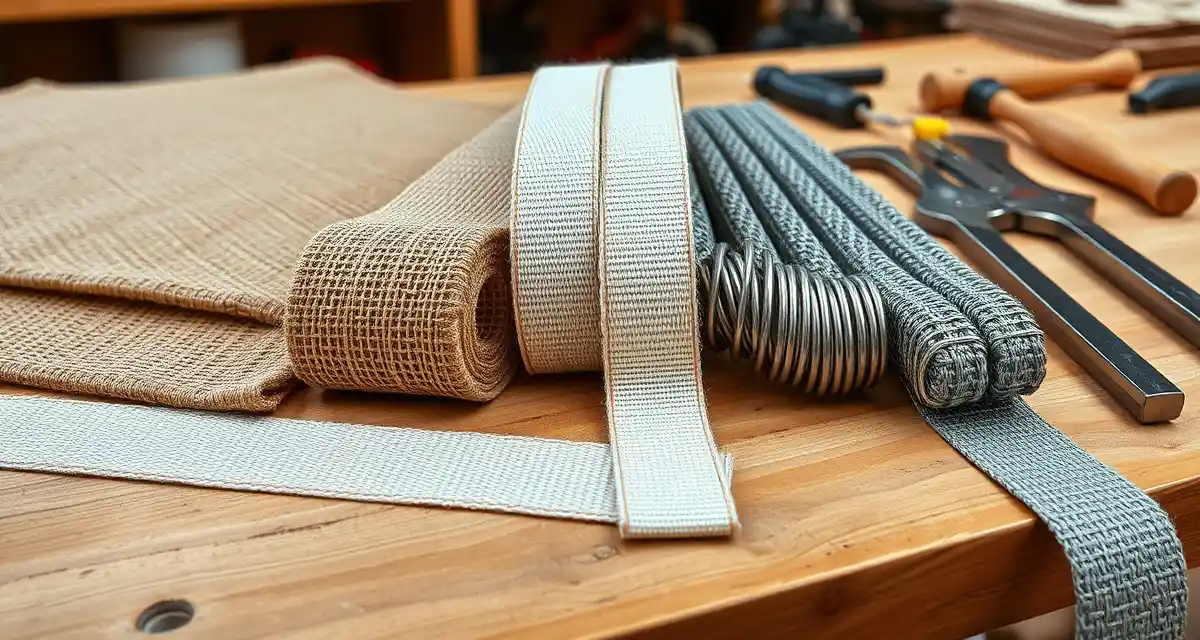
Upholstery Webbing: Jute Nylon and Spring Types Compared
Jute webbing compresses 20-30% within 3 years under heavy use. Professional shops use polypropylene for longevity. That's the practical reason the industry has shifted from traditional jute to synthetic webbing, not because jute is wrong, but because polypropylene performs better under the use conditions most residential and commercial furniture actually sees.
Webbing is the foundational support layer of any upholstered seat or back. When webbing fails or compresses significantly, everything above it, foam, batting, fabric, sinks with it. A good reupholstery job built on poor webbing won't hold its form for long.
TL;DR
- A well-managed upholstery shop tracks every job from intake to delivery with documented status at each stage.
- Fabric management, including ordering, receiving, storing, and allocating by job, is operationally the most complex part of running an upholstery shop.
- Client communication (status updates, completion photos, delivery scheduling) reduces inbound calls and increases repeat business.
- Shops that document their workflow can train new employees faster and maintain consistent quality during growth periods.
- Measuring key metrics (jobs per week, average ticket, fabric waste rate) is the foundation of informed business decisions.
- Professional shop management tools pay for themselves through reduced errors and faster quoting, typically within the first quarter.
Why Webbing Selection Matters
Webbing provides the tensioned, flexible support base that sits between the frame and the foam. It absorbs and distributes the compression load of sitting, spreading it across the frame rather than concentrating it at a single point.
The webbing's job is to hold that tension over years of repeated compression and decompression cycles. Different webbing materials perform differently under this repeated stress.
Jute Webbing
Jute is a natural fiber webbing, the traditional material used in upholstery for over a century. It's sold in widths of 2, 3, and 3.5 inches, and is woven in a plain weave that gives it moderate stretch resistance.
Properties:
- Natural fiber (plant-derived) with appropriate vintage aesthetic for period restoration
- Absorbs moisture, which can cause shrinkage or loosening in humid climates
- Compresses under prolonged use, loses 20-30% of its tension over 3 years of heavy use
- Appropriate for pieces with light to moderate use
When to use jute:
- Period restoration projects where authenticity is prioritized
- Antique pieces where modern webbing would be anachronistic
- Light-use furniture (decorative chairs, rarely sat-upon pieces)
When to avoid jute:
- Any seating with heavy daily use
- Humid climate applications (moisture absorption degrades tension)
- Commercial applications where durability is primary
Polypropylene Webbing
Polypropylene (also called elastic upholstery webbing) is a synthetic webbing made from extruded polypropylene strips. It's sold with a specific stretch percentage (typically 15-25%) built into the material, which provides the tension support.
Properties:
- Synthetic fiber, doesn't absorb moisture, doesn't degrade in humid conditions
- Maintains tension significantly longer than jute under equivalent use
- The stretch built into polypropylene is consistent and recovers predictably
- Available in widths from 2 to 4 inches
When to use polypropylene:
- Any residential seating with daily use
- Commercial applications
- Outdoor or marine applications where moisture resistance matters
- Any piece where long-term support retention is a priority
Polypropylene elastic webbing is now the default choice for most professional upholstery shops for exactly the reason the data supports: it holds its support characteristics substantially longer than jute under normal use conditions.
Spring Webbing (Sinuous Springs / No-Sag Springs)
Sinuous springs are not traditional fabric webbing, they're S-shaped metal springs installed in parallel rows across the seat frame, stapled or clipped at each frame rail. They're called "spring webbing" in some contexts because they perform the same support function as traditional fabric webbing, but with a spring mechanism.
Properties:
- More durable than either jute or polypropylene for very heavy use
- Provides a specific spring "feel" that many clients prefer
- Common in commercial seating and high-end residential furniture
- Replacement requires more technical knowledge than fabric webbing
When to use sinuous springs:
- When restoring a piece that originally had sinuous springs (maintain the original spring system)
- Commercial applications requiring maximum durability
- When the client specifically wants a springier seat feel
Installation: Tension and Spacing
Whether you're using jute or polypropylene, the installation principle is the same: webbing must be installed under correct tension and with correct spacing.
Tension:
For polypropylene elastic webbing, stretch the webbing by approximately 10-15% of its natural length when installing. This creates the pre-tension that provides support when weight is applied. Webbing installed without tension provides soft, insufficient support from day one.
For jute, install with light tension, jute doesn't have the same elasticity as polypropylene, so you're tensioning to remove slack rather than creating pre-stretch.
Spacing:
Web spacing depends on the seat depth and the foam thickness above it. Standard spacing for residential seating: webbing strips 1.5-2 inches apart (gap between strips). Too widely spaced creates support gaps that are felt as soft spots in the finished seat.
Attachment:
Secure webbing with a minimum of 5 staples on a folded-back end (approximately 1.5-2 inches folded over, then stapled through both layers). A single-layer stapled end pulls free under use. The folded double-layer distributes the pull load across more staples.
For jute specifically, traditional tack attachment (magnetic tacks through the webbing into the frame) is appropriate for period restoration. Staples are faster and equally secure for modern webbing applications.
Webbing Over the Back
Back webbing supports the back cushioning against the force of leaning. Back webbing doesn't bear the same compression load as seat webbing, but it does bear repeated backward-lean forces over years of use.
Polypropylene webbing is appropriate for both seat and back applications. Jute is acceptable for back webbing in light-use pieces.
For inside back panels that attach to webbing, use the same spacing guidelines as seat webbing: 1.5-2 inch gaps between strips.
See the how to reupholster sofa guide for how webbing installation fits into the full sofa reupholstery process.
Related Articles
- Upholstery Staple Gun Guide: Manual Pneumatic and Electric Compared
- Automotive Upholstery Guide: Seats Headliners and Door Panels
FAQ
What type of webbing should I use for upholstery?
For any seating with regular daily use, use polypropylene elastic webbing. It maintains its tension significantly longer than jute, polypropylene holds its support characteristics for 10+ years under normal use while jute compresses 20-30% within 3 years under heavy use. Jute is the appropriate choice only for period restoration projects where authenticity is the priority, or for very light-use decorative pieces. For outdoor or marine applications, polypropylene's moisture resistance makes it the only practical choice.
Is jute or polypropylene webbing better?
Polypropylene is better for durability and long-term performance. Jute is better only where period authenticity is the requirement. The durability comparison is significant: polypropylene maintains consistent tension for a decade or more; jute compresses substantially within 3 years under regular sitting load. For any piece that clients will use daily, polypropylene is the professional recommendation. The cost difference is minimal relative to the performance difference.
How do I install upholstery webbing?
For polypropylene elastic webbing: attach the first end with the webbing folded back 1.5-2 inches, secured with 5 staples through both layers. Stretch the webbing by 10-15% of its natural length across the frame and attach the second end the same way. Work in parallel rows with 1.5-2 inch gaps between strips. For seats, run strips front-to-back first, then side-to-side over the first layer in a woven pattern. The woven pattern provides more consistent support than parallel-only rows. For jute, same spacing but without the stretch, install taut rather than pre-tensioned.
How do I track multiple jobs at different stages simultaneously?
A job tracking system, whether paper-based or software-based, should give you a clear view of every active job's current stage at a glance. The minimum useful stages are: intake received, fabric ordered, fabric received, work in progress, quality check, ready for pickup/delivery, completed. Software that shows all active jobs on a single dashboard with current stage and due date eliminates the mental overhead of tracking multiple jobs manually.
Sources
- National Upholstery Association
- Association of Master Upholsterers and Soft Furnishers (AMUSF)
- Upholstered Furniture Action Council (UFAC)
- Furniture Today (trade publication)
Get Started with StitchDesk
A well-run upholstery shop is built on consistent processes, accurate information, and clear client communication. StitchDesk gives you the tools to manage all three from intake to delivery, without the overhead of paper systems or generic software that does not understand the trade. Start a free trial and see how StitchDesk fits your workflow.