Wool Upholstery Guide: Natural Fiber with Special Requirements
Wool puckers at seams when pressed too hot. This is the most common wool complaint, not because the fabric was handled incorrectly during cutting or sewing, but because the final pressing used the wrong temperature. A professional wool seam pressed at the correct temperature lies flat and clean. The same seam pressed too hot develops permanent puckering that no amount of re-pressing corrects.
Wool is having a design renaissance. Plaid wool, herringbone wool, and solid bouclé wool are appearing in residential interiors at a rate not seen since the early 2000s. The clients choosing wool are often choosing it specifically for its traditional craft associations, which means they have elevated expectations for the quality of the finished work.
TL;DR
- Wool has specific performance characteristics that make it well-suited for certain applications and less suitable for others.
- Always check the double-rub count before specifying wool for a particular use; ratings vary widely between products.
- The cleaning code (W, S, WS, X) for wool determines what maintenance clients can safely perform and should be communicated at delivery.
- Pattern repeat, nap direction, and fabric width all affect yardage requirements and should be verified before calculating a quote.
- COM wool from clients should be inspected for rub count, cleaning code, and width before acceptance.
- Proper installation technique for wool differs from standard fabric; follow manufacturer guidance for any specialty material.
Why Wool Is Worth Learning
Wool is a protein fiber with unique structural properties that make it genuinely superior to synthetic alternatives in some applications:
Natural resilience: Wool fiber returns to its original shape after compression. A wool cushion that's been sat on all day recovers overnight. This fiber-level resilience reduces long-term cushion deformation compared to many synthetic fibers.
Natural temperature regulation: Wool breathes and regulates heat in a way that synthetic fabrics don't. A wool sofa doesn't feel sticky in summer the way vinyl or some synthetics do.
Natural stain resistance: Lanolin (natural wool fiber oil) provides a degree of natural stain resistance. Liquid stains tend to bead on the surface long enough to blot, rather than immediately absorbing as with cotton.
Durability: Well-woven upholstery wool tests at 25,000-50,000 double rubs, appropriate for moderate to heavy residential use.
Wool Types for Upholstery
Worsted wool: Tightly spun, fine-fiber wool. Produces a smooth, firm surface without the hairiness of woolen fabrics. Worsted wool is appropriate for clean-lined contemporary upholstery.
Woolen (loosely spun): Produces a softer, hairier surface, the character of traditional tweed or herringbone. Requires more care with seam finishing as the looser fiber frays more readily.
Wool flannel: Brushed wool with a slightly fuzzy surface. The brushed finish adds warmth visually and tactually. Directional brushing means flannel should be treated like a pile fabric for cutting consistency.
Wool plaid and tartan: Woven patterned wool where the plaid pattern is created by the color sequence in warp and weft threads. Plaid matching is a distinct technical challenge addressed below.
Wool blend: Wool blended with nylon, polyester, or cotton. Blends improve durability and reduce cost while maintaining the visual character of wool. Many upholstery wools are 80/20 or 70/30 wool-nylon blends.
Pre-Shrinking Wool
Wool shrinks between 4-8% when exposed to heat and moisture. This is a significant shrinkage potential for an upholstered piece, 5% shrinkage across a 90-inch sofa is 4.5 inches, which would cause visible tension and seam puckering.
Pre-shrink every wool upholstery fabric before cutting. The wool pre-shrinking protocol differs from linen because wool is more sensitive to agitation and extreme temperature.
Protocol:
- Prepare a cool bath (room temperature, not hot) in a clean container or tub.
- Submerge the wool fabric completely and allow it to soak for 15-20 minutes without agitation.
- Remove gently without wringing. Support the full weight of the wet fabric.
- Lay flat or hang on a rod to air dry. Do not machine dry.
- Allow to dry completely, then rest in the shop for 24 hours before cutting.
Hot water + agitation = felting. Felted wool has irreversibly matted fibers and loses its structure. Keep the process gentle throughout.
Plaid Matching
Plaid wool presents the same matching challenges as any large pattern, with the added difficulty that the pattern is formed by the thread colors in the weave rather than printed on the surface. This means mismatches show differently, not as a print offset, but as a line discontinuity in the woven structure.
The plaid matching approach by scale:
Small windowpane plaid (repeat under 3 inches): Matching is visible only at close inspection. Center the repeat horizontally on major panels and maintain vertical continuity. Yardage premium: 10-15%.
Medium plaid (repeat 3-8 inches): Matching is visible at conversational distance. Center the dominant color bar horizontally and match across all vertical seams. Yardage premium: 15-25%.
Large tartan or plaid (repeat over 8 inches): Matching is visible from across the room. Centering decisions, which color bar lands at the center of the panel, which color falls at the seam, are design decisions that should be confirmed with the client before cutting. Yardage premium: 25-40%.
The wool fabric yardage calculator accounts for plaid repeat dimensions in the yardage estimate.
See also the plaid matching upholstery yardage guide for the detailed step-by-step centering and offset calculation process.
Seam Technique for Wool
Seam allowance: ⅝ inch for worsted and blend wools. ¾ inch for loosely woven woolens and tweeds.
Thread: Use wool or strong cotton thread. Polyester thread, being less flexible than wool fiber, can create stress concentrations at stitch holes under the wool's natural movement with humidity and temperature.
Stitch length: 3-4 stitches per inch for worsted. 2-3 stitches per inch for loosely woven wool to avoid perforation between holes.
Seam pressing (the critical step):
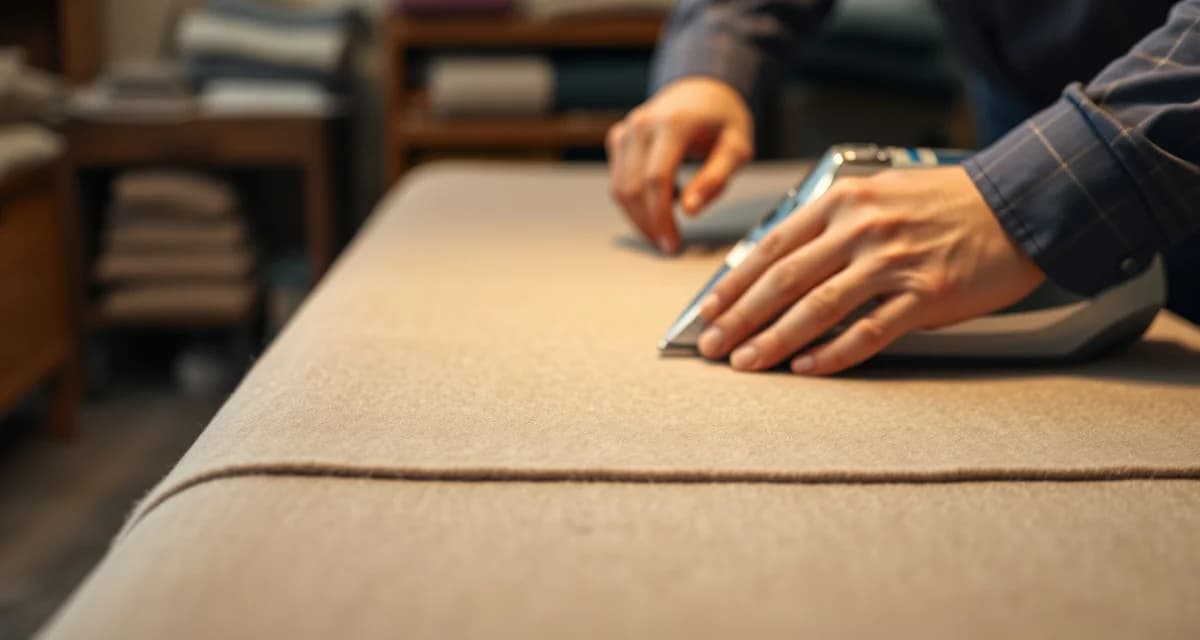
Pressing temperature for wool is wool setting on your iron: approximately 300°F with steam. Above 320°F, wool fiber begins to permanently distort, creating the puckering that's the most common wool complaint.
Press seams with a pressing cloth between the iron and the wool. Even at the correct temperature, direct iron contact on wool can create a shine or scorch the fiber.
Press from the reverse side of the seam onto a tailor's ham for curved seams, or on a hard pressing surface for straight seams.
After pressing, allow the seam to cool completely under a weighted cloth before removing it. This sets the press while the fiber is cooling and reduces the risk of the seam re-opening under its own tension.
Care Instructions for Wool Upholstery
Every wool job should include a care card. Wool-specific guidance:
- Vacuum regularly with a low-suction head (not a beater bar attachment)
- Spot clean with cold water and mild wool-safe detergent; blot, don't rub
- Professional cleaning only for significant soiling
- Protect from prolonged direct sunlight (wool fades with UV exposure over time, though more slowly than most fibers)
FAQ
How do I upholster with wool fabric?
Pre-shrink first: soak the fabric in cool water without agitation, lay flat to dry, and rest 24 hours before cutting. Confirm grain direction and mark all pieces on the reverse with chalk. For plaid wool, confirm the centering approach and match requirements before cutting. Use ⅝ to ¾ inch seam allowance and cotton or wool thread. Press seams at wool-iron setting (approximately 300°F) with a pressing cloth and allow to cool completely under weight before removing. These steps address wool's specific requirements: shrinkage, grain sensitivity, plaid matching, and seam pressing.
Does wool fabric shrink when used for upholstery?
Untreated wool can shrink 4-8% when exposed to heat and moisture. This makes pre-shrinking essential before cutting any wool upholstery job. The pre-shrink process, soaking in cool water without agitation and air drying flat, removes approximately 75-80% of the shrinkage potential. The residual risk is absorbed by seam allowance and installation tension. Without pre-shrinking, wool upholstered in a humid climate will develop seam puckering and surface tension within 6-12 months as the fiber cycles through humidity absorption and release.
How do I match plaid wool across sofa cushions?
Match plaid wool using the same approach as other large-scale patterns: cut the outside back first with the plaid centered horizontally, then calculate the vertical offset for each cushion face to maintain visual continuity. For large tartan plaids (repeat over 8 inches), confirm the centering decision with the client before cutting, which color bar falls at center affects the overall visual character significantly. Use the pattern repeat dimensions to calculate the yardage premium and offset for each piece. Check all cut pieces arranged in installed position before sewing to confirm the plaid reads correctly across the assembled piece.
How durable is this fabric for everyday residential use?
Durability depends on the specific product's double-rub count. For everyday residential use, look for a minimum of 15,000 double rubs for light use and 30,000+ for heavy residential use. Always check the manufacturer's specification rather than the fabric category alone, as durability varies significantly within any fabric type depending on construction and finishing.
What is the yardage impact of using this fabric with a pattern?
Pattern repeats add yardage proportional to the repeat size and the number of cutting zones on the piece. A 13-inch repeat adds roughly 10-20% over plain fabric on most pieces. A 27-inch repeat can add 25-35% or more depending on the piece type and number of cushions. Calculate yardage zone by zone for any patterned fabric rather than applying a generic percentage buffer.
Sources
- National Upholstery Association
- Association of Master Upholsterers and Soft Furnishers (AMUSF)
- Upholstered Furniture Action Council (UFAC)
- Furniture Today (trade publication)
Get Started with StitchDesk
Helping clients choose the right fabric is a core part of the job, and having accurate yardage calculations and fabric records at hand makes those conversations faster and more confident. StitchDesk keeps fabric data, yardage calculations, and client records in one place so you spend less time on paperwork and more time on the work itself. Try StitchDesk free.