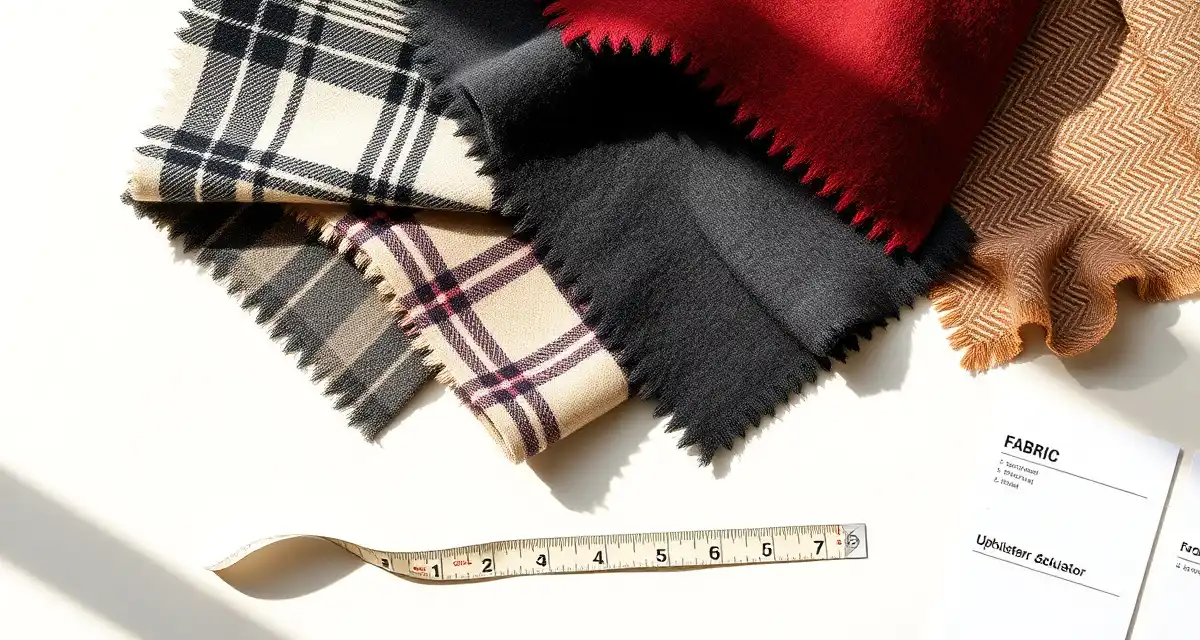
Wool Upholstery Yardage Calculator: Shrinkage and Nap Direction
Wool plaids require 20-35% more yardage than solid wool for pattern matching. That's the single biggest yardage variable on a wool upholstery job, and it's widely underestimated. A shop that orders a solid-wool quantity for a tartan plaid client is almost certainly going to run short.
The wool fabric yardage calculator for upholstery has to account for nap direction on wool plush, shrinkage risk, and pattern-specific waste for plaid and herringbone. No competitor calculator addresses all three of these wool-specific factors together.
TL;DR
- Accurate yardage calculation for wool fabric jobs prevents costly fabric shortfalls and over-ordering that erode margin.
- Pattern repeats are the most common source of yardage errors; always calculate each cutting zone separately, not as a flat percentage.
- Nap-direction fabrics (velvet, chenille, mohair) require 15-25% more yardage than the same job in plain fabric.
- Fabric width significantly affects yardage: the difference between 54-inch and 60-inch fabric can be 1-2 yards on the same piece.
- Always add a 10-15% buffer on plain fabric and 15-20% on patterned fabric to account for cutting waste.
- Entering measurements accurately at the quoting stage eliminates the need to reorder mid-job.
Wool in Upholstery: What You're Actually Working With
Wool upholstery fabric comes in several distinct types, and they behave very differently:
Solid wool weaves (wool tweed, plain-weave wool): minimal nap, low shrinkage risk, pattern matching not required. Closest to working with a standard woven fabric.
Wool plush or wool velvet: has a directional nap similar to velvet pile. Must be cut with nap running consistent direction across all pieces.
Plaid wool (tartan, windowpane, check): requires pattern matching on all visible seams. The larger the plaid scale, the more yardage waste from matching.
Herringbone and twill wool: has a directional weave that can appear to shift color or shade if cut in inconsistent directions. Should be treated as directional.
Shrinkage Risk in Wool Upholstery
Wool is a natural fiber and it shrinks. But unlike linen, which shrinks primarily due to humidity, wool shrinks mainly from heat and moisture together. Steam, cleaning, or warm humid environments can all trigger shrinkage.
Pre-treating wool before upholstering is the best approach for high-risk situations. Steam the fabric from a distance before cutting to trigger any shrinkage potential before the fabric is sewn to the piece. Let it cool and dry completely before cutting.
Add a 3-4% shrinkage buffer to your yardage calculation on any wool job where the client's environment is warm and humid or where the piece might be steamed during cleaning.
Pattern Matching on Plaid Wool: The Math
Plaid wool requires pattern matching at every visible seam. The extra yardage comes from the need to position each cut piece so the plaid lines up precisely with the adjacent piece.
The formula for plaid extra yardage is:
- Small plaid (2-6 inch repeat): add 15-20% to base yardage
- Medium plaid (7-14 inch repeat): add 20-30% to base yardage
- Large plaid/tartan (15+ inch repeat): add 30-40% to base yardage
For a sofa with a base yardage of 14 yards in solid fabric:
- Small plaid version: 14 × 1.18 = 16.5 yards
- Large tartan version: 14 × 1.35 = 18.9 yards, order 19 yards
The pattern-type selector in a proper yardage calculator distinguishes solid wool from plaid and adds correct repeat waste automatically. Don't apply a generic 15% pattern adder. The scale of the plaid determines the actual waste.
Herringbone and Directional Twill
Herringbone has a V-shaped weave pattern that can look different when cut in different orientations. It doesn't require matching the same way plaid does (there's no repeat to align), but you do need all pieces cut in the same direction to prevent the herringbone chevron from appearing to flip on adjacent panels.
Add 10-12% to base yardage for herringbone wool to account for directional cutting waste.
Nap Direction on Wool Plush
Wool plush and wool velvet have a directional nap just like other pile fabrics. The approach is identical to velvet: determine the nap direction before cutting, mark it, and cut all pieces consistently.
The nap direction rules are: downward on vertical surfaces, toward the sitter on horizontal surfaces (same as velvet). Inconsistent nap on wool plush shows as color and sheen variation between panels.
Use the wool upholstery guide for specific cutting protocols on different wool types.
Wool Yardage Reference Table
| Fabric Type | Sofa (3-cushion) | Loveseat | Armchair |
|---|---|---|---|
| Solid wool weave | 13-14 yards | 9-10 yards | 5-6 yards |
| Wool herringbone | 14.5-16 yards | 10-11 yards | 5.5-6.5 yards |
| Wool plush (nap) | 15-17 yards | 10.5-12 yards | 6-7 yards |
| Small plaid | 16-17 yards | 11-12 yards | 6.5-7.5 yards |
| Large tartan | 19-22 yards | 13-15 yards | 8-10 yards |
All figures at 54-inch width. For fabric yardage calculator accuracy, always input the specific wool type and plaid scale separately.
FAQ
How much wool fabric do I need for upholstery?
For solid or herringbone wool on a standard 3-cushion sofa, plan for 13-16 yards at 54-inch width. For plaid wool, the range extends considerably based on plaid scale. A large tartan on a sofa can need 19-22 yards. Always specify whether your wool is solid, directional, or patterned before calculating. The yardage can vary by 5-8 yards on a sofa job.
Does wool fabric shrink after upholstery?
Wool can shrink when exposed to heat and moisture together. Unlike linen, which shrinks from humidity alone, wool requires both heat and moisture to shrink noticeably. Steam cleaning or high-humidity environments in warm rooms carry the most risk. Pre-treating the fabric by steaming it before cutting eliminates most shrinkage potential. Add a 3-4% shrinkage buffer to your yardage if skipping pre-treatment.
How do I match a plaid wool pattern in upholstery?
Identify the repeat size in both horizontal and vertical directions before calculating yardage. Then align the first piece (typically the sofa back center) with the dominant plaid line centered or at a natural break point. Each subsequent piece must be positioned on the cutting table so its plaid lines up with the reference piece. This alignment process wastes the fabric between where one piece ends and where the next usable match point begins, which is where the 20-40% extra yardage goes.
Should I add a buffer to calculated yardage?
Yes. A 10-15% buffer is standard on plain fabric to account for cutting waste and minor errors. On patterned fabric, use 15-20% above the pattern-adjusted calculation. For COM fabric that cannot be reordered if you run short, some upholsterers increase the buffer to 20-25%. The cost of a modest buffer is far lower than the cost of sourcing additional fabric after cutting has begun.
Sources
- National Upholstery Association
- Association of Master Upholsterers and Soft Furnishers (AMUSF)
- Upholstered Furniture Action Council (UFAC)
- Furniture Today (trade publication)
Get Started with StitchDesk
Getting yardage right on wool jobs is the difference between a profitable quote and an expensive reorder. StitchDesk's fabric calculator accounts for all the variables that cause errors: pattern repeat by zone, nap direction, fabric width, and cushion configuration. Start a free trial and see how accurate yardage calculation affects your bottom line.