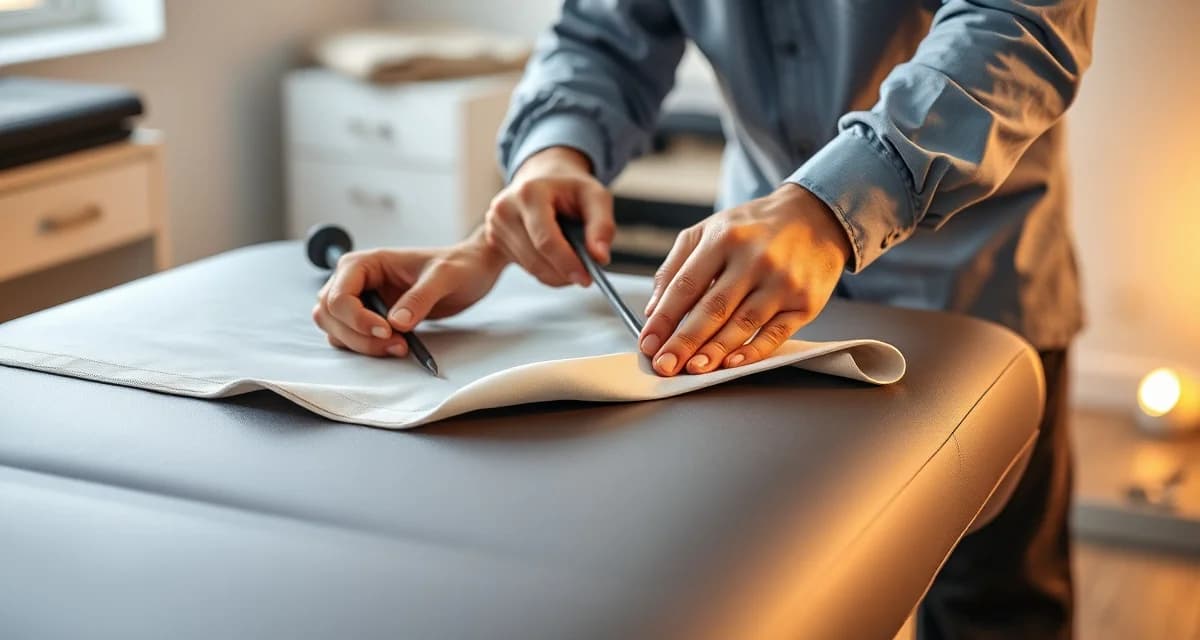
Medical and Massage Table Fabric Yardage Calculator
Massage and treatment table reupholstery is a steady commercial job for shops that pursue it. Spas, wellness centers, physical therapy clinics, and medical offices all need their treatment tables reupholstered regularly, typically every 2 to 3 years for tables in regular use, as the vinyl wears and cracks under repeated patient contact and cleaning.
The job is specialized but not difficult once you understand the panel layout. The main difference from residential furniture is the materials: almost all treatment table work uses vinyl (not woven fabric), and the joints and edges need to be well-sealed because the table will be cleaned with disinfectants repeatedly.
TL;DR
- For Medical Massage Table yardage depends on fabric width, construction details, pattern repeat, and nap direction.
- Plain 54-inch fabric requires a baseline calculation plus 10-15% waste allowance for a standard for medical massage table job.
- Patterned fabric adds 20-35% to base yardage depending on repeat size and the number of cutting zones that must align.
- Directional fabrics add 15-25% over plain fabric because layout optimization is restricted by nap direction.
- Always verify fabric width before finalizing yardage; COM fabric often comes in non-standard widths.
- Calculating yardage at the quote stage, not mid-job, eliminates reorders and protects your profit margin.
Treatment Table Construction
A standard massage or treatment table has these upholstered surfaces:
Table top: The main padded surface where the client lies. Typically 28 to 30 inches wide and 72 to 78 inches long. This is the primary upholstered panel.
Table top sides: The padded edge surfaces on the long sides of the table, typically 3 to 5 inches in depth. These see notable wear from people climbing on and off the table.
Table end panels: Short side panels at the head and foot ends. May or may not be padded depending on table design.
Face cradle: The removable padded oval with a hole for the face when the client is face-down. This is a separate piece from the main table and has its own vinyl covering. Face cradles crack and wear independently of the main table surface and are often replaced more frequently.
Bolster cover (if included): A cylindrical bolster used under the client's knees or ankles. If the shop is recovering the bolster, it needs its own yardage calculation.
Arm shelf/face cradle extension: Some tables have a padded arm shelf at the head end. Additional panel if present.
Yardage Calculation for a Standard Table
For a standard 30 x 73-inch massage table in vinyl (typically 54-inch width):
Table top: 31 x 74 inches = 2.3 linear yards
Long side panels (2 sides x 4-inch depth x 73 inches): 0.6 yards
Short end panels (2 ends x 4-inch depth x 30 inches): 0.2 yards
Face cradle: approximately 0.5 yards (oval with hole, cut from bounding rectangle)
Total for standard table without bolster: approximately 3.6 to 4 yards
Add for bolster (10-inch diameter x 24-inch long): 0.75 yards
Full table package with face cradle and bolster: approximately 4.5 to 5 yards
Vinyl Selection for Treatment Tables
Not all vinyl is appropriate for treatment table use. Requirements:
Fluid resistance: The vinyl must be impermeable, no wicking through the material. Standard upholstery vinyl is impermeable; fabric-backed vinyl is. Paper-backed vinyl is not appropriate.
Chemical resistance: The surface must withstand repeated cleaning with disinfectants including alcohol-based cleaners, quaternary ammonium compounds, and sometimes bleach dilutions. Test your vinyl against the client's standard cleaning products before specifying.
Durability: Treatment tables see abrasive contact with skin and clothing repeatedly throughout the day. Specify vinyl with a double-rub count appropriate for commercial use, 100,000+ for heavily used clinical settings.
Anti-fatigue surface texture: A slightly textured surface prevents client slippage when the table is slightly inclined.
Common appropriate vinyl types: Commercial healthcare vinyl, naugahyde-type expanded vinyl, coated polyester vinyl.
Seam Construction for Longevity
The seams on a treatment table are a critical failure point. When seams fail, moisture and cleaning products wick into the foam below and cause deterioration. To maximize table life:
Use double-stitched seams. Consider heat-welding the seam allowance on critical edges (head and foot ends where stress concentrates). Use vinyl thread or polyester thread, cotton thread will wick moisture and break down.
At the face cradle, the seam around the oval opening gets more stress than any other seam on the table because of repeated face pressure and cleaning. Reinforce this seam with seam tape on the underside if possible.
Recurring Treatment Table Business
Clients with multiple treatment tables create natural recurring revenue. A small spa with 5 massage tables will typically replace vinyl on all of them in the same 2 to 3-year cycle. Offer a package price for complete spa sets and you build a relationship that brings the contract back to you next time.
Document the vinyl used on each job, pattern name, color, supplier, dye lot. When the client calls for reupholstery in 2 years, you can immediately quote the same vinyl and ensure a consistent look across their facility.
Frequently Asked Questions
How much vinyl for a massage table?
A standard massage table (approximately 30 x 73 inches) with face cradle needs approximately 3.5 to 4.5 yards of vinyl depending on table depth and whether you're also recovering the bolster. Add 0.5 yards for the face cradle and 0.75 yards for a standard bolster.
What vinyl is best for massage tables?
Commercial healthcare vinyl with fluid impermeability and resistance to the disinfectants your client uses. Expanded vinyl (naugahyde-type) is the most common choice, soft surface, impermeable, durable. Specify it in a commercial grade with 100,000+ double rubs for clinical settings with high daily use. Always verify chemical compatibility with the client's cleaning products before finalizing the specification.
How do I calculate yardage for a massage table face cradle?
A face cradle is an oval panel with a central hole. The bounding rectangle is typically about 10 x 12 inches. In 54-inch vinyl, you can fit approximately 4 face cradles per yard with efficient nesting. For a single face cradle with its padding cover: approximately 0.4 to 0.5 yards allows for the main oval panel plus seam allowance and any underside covering.
What is the biggest factor in yardage variation for this piece?
Pattern repeat is the biggest source of yardage variation. On plain fabric, the baseline calculation plus a 10-15% waste buffer is usually sufficient. Add a 13-inch pattern repeat and you may need 15-20% more. Add a 27-inch pattern repeat and the additional yardage can be 25-35% over the plain fabric calculation. Nap direction is the second-largest factor, typically adding 15-25% over plain fabric because layout optimization is restricted.
What should I do if I run short on fabric mid-job?
Stop cutting immediately when you realize you may run short. Calculate exactly how much additional fabric you need before contacting the supplier or client. If reordering from the same dye lot is possible, do so as quickly as possible because dye lots change. If a dye lot match is not available, contact the client before proceeding; visible dye lot differences on the same piece are unacceptable and must be disclosed. Document the situation and response in writing.
Related Articles
Sources
- National Upholstery Association
- Association of Master Upholsterers and Soft Furnishers (AMUSF)
- Upholstered Furniture Action Council (UFAC)
- Furniture Today (trade publication)
Get Started with StitchDesk
Getting yardage right on yardage for medical massage table jobs is the difference between a profitable quote and an expensive reorder. StitchDesk's fabric calculator accounts for all the variables that cause errors: pattern repeat by zone, nap direction, fabric width, and cushion configuration. Start a free trial and see how accurate yardage calculation affects your bottom line.