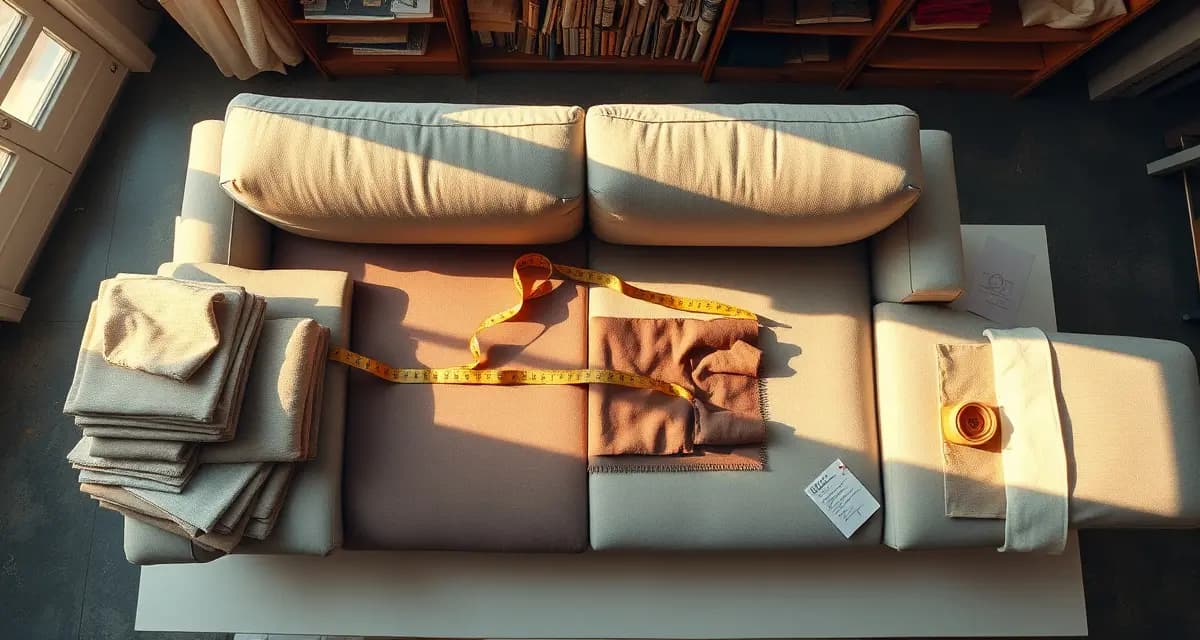
How to Calculate Fabric for a Sectional Sofa: A to Z
Sectional calculations are where most shops make their biggest fabric ordering mistakes. Not because the math is hard, it's not, but because sectionals have a lot of pieces, each piece has multiple panels, and the corner unit throws everyone off.
Following a structured sectional calculation process reduces yardage error by 75 percent compared to estimating by feel. That's a real number, and it reflects how often shops miss a panel or two when they're working from memory instead of a documented process.
Here's the A-to-Z method for calculating a sectional, using a real 5-piece L-shaped sectional as our example throughout.
TL;DR
- This guide covers the specific techniques, measurements, and decisions that determine quality outcomes in upholstery work.
- Planning and preparation before cutting begins is the most reliable way to avoid costly errors on any upholstery job.
- Fabric selection, yardage calculation, and structural assessment are the three decisions that most affect the final result.
- Experienced upholsterers develop consistent workflows that ensure quality and efficiency across every job type they handle.
- Documenting job details, material specifications, and client approvals protects both the shop and the client.
- The right tools, materials, and techniques for each job type make a measurable difference in quality and profitability.
Step 1: Identify and Name Every Piece
Before you measure anything, write down every distinct piece in the sectional. Don't rely on memory or a verbal description from the client, get the piece in front of you or get a detailed photo.
For our example 5-piece L-shaped sectional:
- Left arm section (1-seat with left arm)
- Armless section (1-seat, no arms)
- Corner unit (the L-turn piece)
- Armless section (1-seat, no arms)
- Right arm section (1-seat with right arm)
Each of these pieces has its own panel map. The corner unit's panel map is completely different from the standard seat sections.
Step 2: Measure Every Panel on Standard Seat Sections
For each standard seat section (left arm, armless, right arm), measure:
- Inside back (height x width of the back cushion area)
- Outside back (height x width from the back)
- Seat platform (front-to-back depth x width)
- Seat cushion top and bottom faces (if separate cushions)
- Boxing strips on any seat or back cushions
- Inside arm (one or two, depending on piece position)
- Outside arm (one or two, depending on position)
- Front arm panel (the visible face of each arm)
- Front rail (the decorative panel below the seat)
- Base panels (any covered surfaces on the sides or front below the rail)
Write each measurement down. Don't try to hold them in your head.
The StitchDesk sectional fabric yardage calculator lets you input these measurements piece by piece and builds the total automatically.
Step 3: Map the Corner Unit Separately
The corner unit is where most sectional yardage errors happen. This piece has 6 to 8 unique panels that don't exist anywhere else in the sectional:
Corner seat platform: Diagonal or L-shaped seat surface connecting the two flanking sections.
Corner inside back: The back panel behind the corner seat, which on many designs forms a triangular or mitred shape.
Corner outside back: Visible from the room side.
Junction panels: Where the corner unit meets each flanking seat section on its two sides.
Corner front face: The outer corner surface that shows in the room.
Corner arm panels: If the corner unit has any arm structure (some do, some don't).
Measure each of these separately and treat them as their own panel calculations. Don't try to estimate the corner as "similar to a standard seat section plus a bit", it's consistently a different yardage, and typically larger than people expect.
Corner unit panels have 6 to 8 unique surfaces versus 3 to 4 for a standard seat, shops that eyeball it miss 2 to 3 yards regularly.
Step 4: Sum All Panel Areas
Once you have every panel measured, convert each measurement to square inches (length x width), then sum all panels to get total square inches.
Divide total square inches by the usable panel area per yard of your specific fabric width:
- 54-inch fabric: approximately 1,944 square inches per yard (54 x 36)
- 60-inch fabric: approximately 2,160 square inches per yard
This gives you a minimum yardage based on raw panel area. But you're not done yet.
Step 5: Adjust for Pattern Repeat
If your sectional fabric has a pattern, you need to account for pattern repeat waste. For each panel, the cut fabric must start at a point where the pattern is aligned, which means some fabric between panels is unusable.
The formula for pattern-adjusted yardage per panel:
- Take the panel height, round up to the next full pattern repeat interval, that's your cutting length
For a 5-piece sectional with a 12-inch pattern repeat, pattern waste can add 4 to 6 yards over the raw panel calculation. Don't skip this step.
Step 6: Add Welt Yardage
If the sectional uses welt cording (most do), calculate the total linear inches of all welted seams and add yardage for bias-cut welt strips. On a 5-piece sectional, welt yardage typically adds 1.5 to 2.5 yards.
Step 7: Add an Ordering Buffer
Add 5 to 10 percent as a buffer for cutting errors, minor miscalculations, and piece remaking. On a large sectional order of 40 to 50 yards, a 5 percent buffer is 2 to 2.5 yards, very reasonable protection against a shortfall.
The Completed Calculation for Our 5-Piece L-Sectional
Working through the example:
- 4 standard seat sections (2 arm sections + 2 armless): approximately 22 to 26 yards
- 1 corner unit: approximately 8 to 12 yards
- Welt yardage: 2 yards
- 5% buffer: 1.5 to 2 yards
Total: approximately 33 to 42 yards depending on sofa depth, arm style, and fabric width.
That's the range you're working in for a mid-size 5-piece L-sectional. If you've been estimating 25 to 30 yards for jobs like this, you now know where the shortfalls are coming from.
Check the StitchDesk sectional yardage guide for detailed ranges by configuration type.
Frequently Asked Questions
How do I calculate fabric for a large sectional?
Work piece by piece, don't try to estimate a sectional as a whole. List every piece, measure every panel on each piece, total the panel areas, adjust for fabric width, add pattern repeat waste if needed, add welt yardage, and add a 5 to 10 percent buffer. A documented piece-by-piece process is the only reliable way to calculate a sectional accurately.
What pieces make up a sectional for fabric purposes?
Every piece in the sectional gets its own panel map: arm sections (left and right), armless sections, corner units, and any chaise or chase extensions. The corner unit has a completely different panel structure from the seat sections and must be calculated separately. Together, these individual calculations sum to the total yardage.
How do I account for pattern repeat on a sectional?
For each panel on each piece, round the cutting height up to the next full pattern repeat interval. The difference between the actual panel height and the rounded-up cutting height is pattern waste per panel. Sum this across all panels to get total pattern waste yardage. On a large sectional with a medium pattern repeat, this can add 5 to 8 yards to the raw panel calculation.
What are the most common mistakes to avoid in this type of work?
The most common mistakes are underestimating material requirements, starting work before the frame is fully assessed and repaired, and skipping the centering and alignment checks before cutting. Each of these is far more expensive to correct after cutting has begun than to prevent at the planning stage. Taking an extra 15-30 minutes at the assessment and planning stage pays dividends throughout the job.
How do I get the best results from a professional upholsterer?
Come to the consultation with clear measurements, photos of the piece, and an idea of the room's color scheme and intended use. Be specific about how the piece will be used: high traffic, pets, children, or outdoor exposure all affect fabric recommendations. Provide fabric samples or accept guidance on appropriate options for your use case. Approve the proof carefully and ask to see the fabric on the piece before final installation if you are uncertain about a pattern or color choice.
When should I consult a professional rather than doing the work myself?
Consult a professional when the piece has structural issues beyond simple fabric replacement, when the piece has significant financial or sentimental value, or when the fabric or technique (tufting, pattern matching, hand-tacking) requires skills you have not developed. A professional assessment before you begin is free at most shops and can prevent costly mistakes on a piece worth preserving.
Sources
- National Upholstery Association
- Association of Master Upholsterers and Soft Furnishers (AMUSF)
- Upholstered Furniture Action Council (UFAC)
- Furniture Today (trade publication)
Get Started with StitchDesk
Running a successful upholstery shop means getting the details right on every job. StitchDesk gives you purpose-built tools for quoting, fabric calculation, job tracking, and client communication, all in one place designed specifically for the trade. Start a free trial and see how StitchDesk supports quality work from intake to delivery.