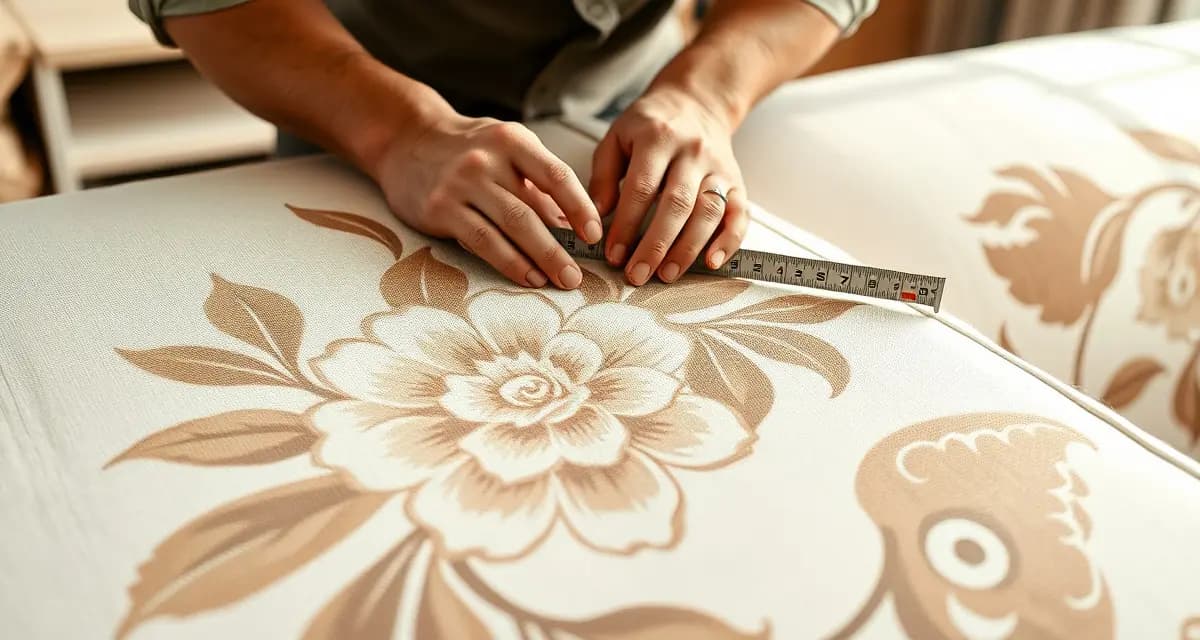
How to Center Patterns on Upholstery: Yardage Impact and Method
Centering a large floral on a sofa back adds 1.5-2.5 yards over rail-to-rail placement. Clients rarely know this, and many don't know there's a choice. But there is, and how you handle that conversation affects both client satisfaction and your yardage accuracy.
This guide explains pattern centering for upholstery: how to center patterns on different pieces, what it costs in extra yardage, and how to price it appropriately.
TL;DR
- This guide covers the specific techniques, measurements, and decisions that determine quality outcomes in upholstery work.
- Planning and preparation before cutting begins is the most reliable way to avoid costly errors on any upholstery job.
- Fabric selection, yardage calculation, and structural assessment are the three decisions that most affect the final result.
- Experienced upholsterers develop consistent workflows that ensure quality and efficiency across every job type they handle.
- Documenting job details, material specifications, and client approvals protects both the shop and the client.
- The right tools, materials, and techniques for each job type make a measurable difference in quality and profitability.
What Is Pattern Centering in Upholstery?
Pattern centering means positioning the fabric so that the main pattern element falls at the visual center of the upholstered panel. On a sofa back, the central motif of a floral or medallion pattern appears at the middle of the back, flanked symmetrically by the rest of the pattern.
The alternative is rail-to-rail placement, starting the fabric at one edge of the panel and running it straight across without positioning for centering. Rail-to-rail is more yardage-efficient but may place the pattern at an asymmetric or visually awkward position.
Centered placement is more expensive in fabric but looks intentional and professional. Rail-to-rail is acceptable when the pattern is small, non-directional, or geometric in a way that doesn't have an obvious focal point.
The Yardage Cost of Centering
Centering a pattern adds yardage in a specific way. The centering requirement forces you to start cutting a panel at a specific position in the repeat, wherever the center motif falls, rather than at the most yardage-efficient position.
The extra yardage from centering is half the repeat size (worst case) because you may need to advance up to half a repeat to find the centering position.
For a 27-inch repeat floral on a sofa back:
- Worst-case centering offset: 13.5 inches (half of 27 inches)
- Best-case (lucky alignment): 0 inches
- Average expected: ~6-9 inches = 0.17-0.25 yards just for the sofa back centering
Then the same centering adjustment applies to each cushion that must show centered pattern placement:
- 3 seat cushion fronts: 3 × average centering offset
- Back cushions (if pillow back): 2-3 × average offset
Total centering premium for a 27-inch repeat on a fully patterned sofa: 1.5-2.5 yards.
Cost-of-Centering Calculator: Three Sofa Sizes
| Sofa Configuration | Repeat Size | Centering Premium |
|---|---|---|
| 72" loveseat, 3 cushions | 9-inch repeat | 0.5-0.75 yards |
| 72" loveseat, 3 cushions | 27-inch repeat | 1-1.5 yards |
| 84" sofa, 5 cushions | 9-inch repeat | 0.75-1.25 yards |
| 84" sofa, 5 cushions | 18-inch repeat | 1-1.75 yards |
| 84" sofa, 5 cushions | 27-inch repeat | 1.5-2.5 yards |
| 96" sofa, 7 cushions | 27-inch repeat | 2-3 yards |
These centering premiums add to the baseline pattern repeat yardage. Both costs apply simultaneously.
When to Center and When Not To
Always center:
- Large-scale florals (18+ inch repeat)
- Medallion and damask patterns
- Any pattern with a clear focal point
- Client-selected fabric with a dominant motif
Centering usually advisable:
- Medium-scale patterns (9-18 inch repeat)
- Patterns with directional flow (botanical vines, landscapes)
- Any pattern where off-center placement would look unintentional
Centering optional:
- Small, all-over prints (under 6-inch repeat)
- Geometrics without a clear focal point
- Stripes (usually rail-to-rail is the right choice)
- Fabric where the repeat is subtle
How to Center a Pattern: Step by Step
Step 1: Identify the focal point. On a medallion fabric, this is the center of the medallion. On a floral, it's the primary flower. On a geometric, it may be the center of the repeat unit.
Step 2: Find the center of the panel. Mark the vertical centerline of the sofa back panel at the top and bottom.
Step 3: Align the focal point with the panel center. Position the fabric so the focal point falls on the panel's centerline. Measure from the focal point to the fabric edge to confirm the positioning.
Step 4: Cut with this alignment locked in. Don't move the fabric after confirming the position. Mark the edges of the panel on the fabric before cutting.
Step 5: Use this position as the reference for all subsequent panels. The position of the focal point in the repeat is now your "position 0." All other panels must align to this reference.
How to Charge for Pattern Centering
Centering is legitimate additional work that deserves a line item in your quote. How to charge:
Fabric surcharge: The extra yardage from centering (see table above) is charged at the fabric cost per yard. This is not optional, the client is choosing centered placement, which requires more fabric.
Labor surcharge: Centering takes planning and careful positioning. Add 30-60 minutes of labor per job for small-repeat centering, 60-120 minutes for large-scale centering on a sofa. At your hourly rate, this is a concrete additional cost.
Present it as a choice: "I can center the pattern on the sofa back and cushions for an additional cost of $X for extra fabric and $Y for the positioning work, or we can do rail-to-rail placement which uses the full pattern across the panel. Most clients with this fabric choose centered placement. Here's what both options look like."
Clients who understand the choice almost always choose centered placement. Clients who don't understand the choice may feel surprised by the additional cost later.
Use the pattern repeat calculator upholstery to show clients the exact extra yardage before ordering. The how to price reupholstery jobs guide covers the labor surcharge side of pattern work pricing.
FAQ
Should I center the pattern on a sofa back?
For any fabric with a large-scale pattern (18+ inch repeat) or a clear focal point (medallion, central floral), yes, center the pattern on the sofa back. The alternative (rail-to-rail placement) often places the focal point asymmetrically, which looks accidental rather than designed. For small repeats (under 9 inches) or geometric patterns without a focal point, rail-to-rail is usually fine.
How much extra fabric does centering a pattern require?
Centering adds 1.5-2.5 yards to a standard sofa for a large-scale (27-inch) repeat. The extra comes from the requirement to start each panel at a specific position in the repeat, wherever the centered motif falls, rather than at the most efficient cutting position. For small repeats (9 inches), the centering premium is 0.75-1.25 yards on a sofa. Always calculate and charge for centering yardage separately from baseline pattern repeat waste.
How do I charge for pattern centering in my upholstery quote?
Break it into two components: a fabric surcharge for the extra yardage required by centered placement (calculated at your fabric cost per yard), and a labor surcharge for the additional planning and positioning time (30-120 minutes depending on pattern scale and piece complexity). Present these as separate line items with brief explanations, or include them in a "pattern matching premium" line with the combined total. Never absorb these costs into your base price, they're real additional costs that are appropriate to pass on to the client.
What are the most common mistakes to avoid in this type of work?
The most common mistakes are underestimating material requirements, starting work before the frame is fully assessed and repaired, and skipping the centering and alignment checks before cutting. Each of these is far more expensive to correct after cutting has begun than to prevent at the planning stage. Taking an extra 15-30 minutes at the assessment and planning stage pays dividends throughout the job.
How do I get the best results from a professional upholsterer?
Come to the consultation with clear measurements, photos of the piece, and an idea of the room's color scheme and intended use. Be specific about how the piece will be used: high traffic, pets, children, or outdoor exposure all affect fabric recommendations. Provide fabric samples or accept guidance on appropriate options for your use case. Approve the proof carefully and ask to see the fabric on the piece before final installation if you are uncertain about a pattern or color choice.
Sources
- National Upholstery Association
- Association of Master Upholsterers and Soft Furnishers (AMUSF)
- Upholstered Furniture Action Council (UFAC)
- Furniture Today (trade publication)
Get Started with StitchDesk
Running a successful upholstery shop means getting the details right on every job. StitchDesk gives you purpose-built tools for quoting, fabric calculation, job tracking, and client communication, all in one place designed specifically for the trade. Start a free trial and see how StitchDesk supports quality work from intake to delivery.