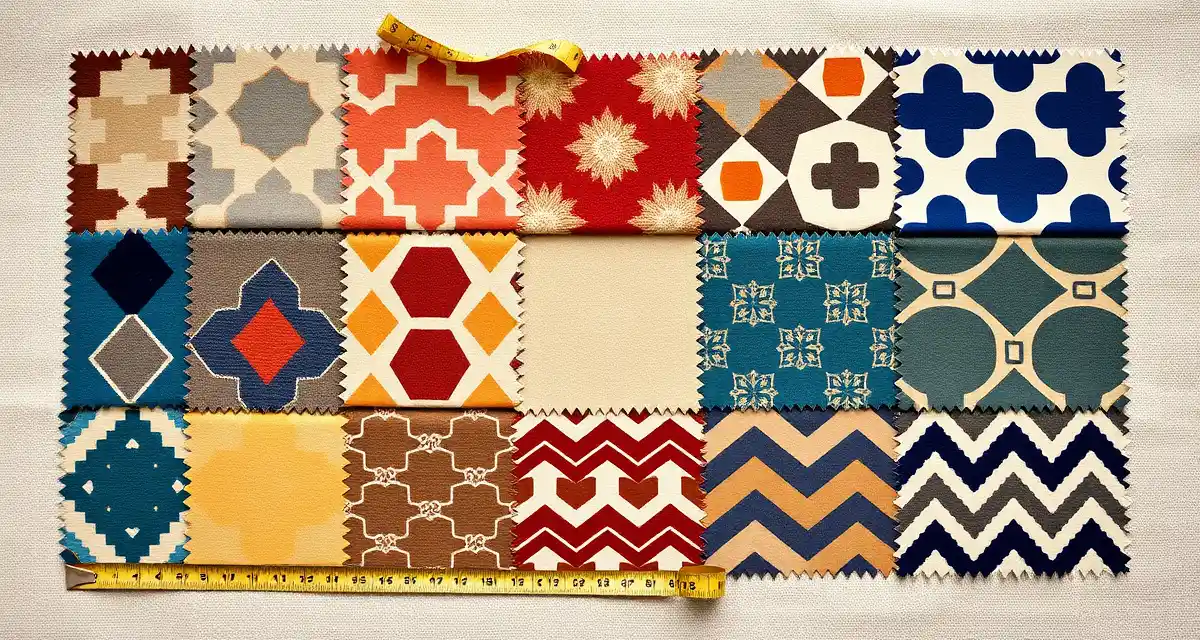
Geometric Pattern Upholstery Yardage: Diamonds Hexagons and Ogees
Chevron patterns require 20-25% more fabric than the same-scale diamond pattern due to directional waste. That's a specific number, and it comes from a specific reason: the V-shape of a chevron creates diagonal cuts that waste considerably more fabric than a grid-aligned diamond pattern.
No existing content differentiates between geometric pattern types for upholstery yardage. This guide does, with specific yardage impacts for diamonds, hexagons, ogees, chevrons, and which geometrics can be railroaded to save yardage.
TL;DR
- Geometric Pattern Upholstery yardage depends on fabric width, construction details, pattern repeat, and nap direction.
- Plain 54-inch fabric requires a baseline calculation plus 10-15% waste allowance for a standard geometric pattern upholstery job.
- Patterned fabric adds 20-35% to base yardage depending on repeat size and the number of cutting zones that must align.
- Directional fabrics add 15-25% over plain fabric because layout optimization is restricted by nap direction.
- Always verify fabric width before finalizing yardage; COM fabric often comes in non-standard widths.
- Calculating yardage at the quote stage, not mid-job, eliminates reorders and protects your profit margin.
Why Geometric Type Matters for Yardage
Geometric patterns look similar at a glance, they're all "repeat patterns" that tile across the fabric surface. But their yardage implications vary considerably based on:
- Alignment requirements: Some geometrics must align precisely at seams (chevron, plaid-based geometrics). Others are more forgiving (small all-over hexagons).
- Directional requirements: Chevrons and some other geometrics look different in different orientations and can't be cut freely.
- Railroading potential: Some geometrics can be rotated 90 degrees to save yardage; others can't without changing how the pattern reads.
- Cutting waste from diagonal edges: Chevrons and diagonal patterns create triangular waste at cut edges that regular grids don't.
Diamond Patterns
A diamond (or argyle) pattern has a repeat determined by the diamond width and height. Diamond patterns are typically aligned on a grid, which makes them relatively predictable for upholstery.
Key characteristic: Diamond patterns can often be railroaded without obviously changing the pattern appearance. A diamond rotated 90 degrees still looks like a diamond pattern.
Yardage extra on sofa:
- Small diamond (3-5 inch): 0.5-1.5 yards
- Medium diamond (6-12 inch): 1.5-3 yards
- Large diamond (13+ inch): 3-5 yards
The main yardage challenge with large diamonds is centering, the diamond points should ideally land at symmetrical positions relative to the sofa back center and cushion fronts.
Hexagon Patterns
Hexagonal patterns tile in a honeycomb arrangement. They typically have a smaller effective repeat than their visual scale suggests, because the hexagon cells interlock in a way that creates multiple offset rows.
Key characteristic: Small hexagon patterns are among the most forgiving geometrics. The repeat is small (typically 2-4 inches for small hex) and alignment at seams is not critical at normal viewing distances.
Yardage extra on sofa:
- Small hexagon (2-4 inch cell): 0.25-0.75 yards
- Medium hexagon (5-9 inch cell): 1-2.5 yards
- Large hexagon (10+ inch cell): 2.5-4 yards
Large hexagon patterns are more demanding because misalignment at seams is visible, the hexagon shape cuts awkwardly at a seam if the cell isn't properly positioned.
Ogee Patterns
The ogee is a curved-sided diamond shape, an S-curve form that creates a flowing, organic geometric. Traditional Moroccan-influenced ogee patterns are popular in current upholstery trends.
Key characteristic: Ogee patterns have both horizontal and vertical repeats that must match. The curved sides make misalignment more noticeable than on straight-edged geometrics.
Yardage extra on sofa:
- Standard ogee (6-12 inch repeat): 2-4 yards
- Large ogee (13-20 inch repeat): 3.5-6 yards
Centering matters on ogee patterns, the pointed top of each ogee cell should fall at a consistent position on the sofa back. Off-center placement on a large ogee looks unintentional.
Chevron Patterns
Chevron (or herringbone, in its upholstery application) requires the most careful handling of any common geometric. The V-shape runs at 45 degrees to the fabric edges, which creates cutting complications.
Why chevrons use 20-25% more fabric:
A chevron cut at an angle means every horizontal cut through the fabric produces a diagonal edge on the pieces. The triangular waste areas at each side of a diagonal cut can't be used for anything except welt strips.
On a standard straight cut, you lose 3/8 inch of seam allowance. On a diagonal chevron cut, you may lose a triangle 3 inches wide at the diagonal, which adds up across 10-15 cut pieces.
Additionally, chevron direction must be consistent on all panels, the V must always point the same direction. Upward-pointing chevrons and downward-pointing chevrons on the same piece look like an error.
Yardage extra on sofa:
- Small chevron (under 6-inch repeat): 2-3 yards
- Medium chevron (6-12 inch): 3-4.5 yards
- Large chevron (13+ inch): 4.5-7 yards
Can chevrons be railroaded? No, rotating a chevron 90 degrees makes the V point sideways, which changes the pattern appearance considerably. Chevrons cannot be railroaded to save yardage.
Which Geometrics Can Be Railroaded?
Pattern-type quick guide: which geometric patterns can be railroaded to save yardage and which cannot.
Can be railroaded:
- Diamond/argyle (appears similar in both orientations)
- Small all-over hexagon (orientation-neutral)
- Grid/check patterns
- Simple geometric tile patterns that are 4-way symmetrical
Cannot be railroaded:
- Chevron/herringbone (V becomes sideways)
- Ogee (pointed top becomes pointed side, very different)
- Any geometric with a clear "top" and "bottom"
- Directional geometrics (arrows, directional keys)
When a geometric can be railroaded, you can often save 1-2 yards on a sofa by eliminating vertical seam alignment issues.
Geometric Yardage Quick Reference
| Pattern | Small | Medium | Large |
|---|---|---|---|
| Diamond | 0.5-1.5 yds | 1.5-3 yds | 3-5 yds |
| Hexagon | 0.25-0.75 yds | 1-2.5 yds | 2.5-4 yds |
| Ogee | 2-4 yds |, | 3.5-6 yds |
| Chevron | 2-3 yds | 3-4.5 yds | 4.5-7 yds |
| Grid/check | 0.5-1.5 yds | 1.5-3 yds | 3-5 yds |
All figures are extra yardage on a standard 3-cushion sofa. Use the pattern repeat calculator upholstery for piece-specific calculations. The stripe matching upholstery yardage guide has additional information on stripe-based geometric patterns.
FAQ
How do I calculate yardage for a chevron pattern?
Start with your base sofa yardage in solid fabric. Apply the standard pattern repeat formula: (number of cut pieces × vertical repeat in inches) ÷ 36 to get the base pattern extra. Then multiply this by 1.20-1.25 to account for the diagonal cutting waste specific to chevron patterns. Add a centering premium if the chevron V must point consistently upward on all panels. Total: base + 20-25% pattern extra = roughly 3-5 yards extra on a standard sofa.
Can geometric fabric be railroaded to save yardage?
Some geometrics can be railroaded; many cannot. Diamond, grid, and small all-over hexagon patterns are generally safe to railroad because they look similar in both orientations. Chevron, ogee, and any directional geometric cannot be railroaded without considerably changing the pattern appearance. When railroading is possible, it can save 1-2 yards on a sofa by eliminating seam-alignment waste. Check with the client that the railroaded orientation is acceptable before planning your cutting layout.
How much extra fabric for an ogee pattern?
A standard ogee pattern with a 6-12 inch repeat adds 2-4 yards to a standard sofa. A large ogee with a 13-20 inch repeat adds 3.5-6 yards. The ogee's curved sides and dual-direction repeat (both horizontal and vertical must match) make it more demanding than a simple diamond pattern of the same scale. Centering the ogee on the sofa back adds an additional 0.5-1 yard centering premium. Total for a large ogee on a sofa: approximately 5-7 yards over the solid fabric base.
What is the biggest factor in yardage variation for this piece?
Pattern repeat is the biggest source of yardage variation. On plain fabric, the baseline calculation plus a 10-15% waste buffer is usually sufficient. Add a 13-inch pattern repeat and you may need 15-20% more. Add a 27-inch pattern repeat and the additional yardage can be 25-35% over the plain fabric calculation. Nap direction is the second-largest factor, typically adding 15-25% over plain fabric because layout optimization is restricted.
Sources
- National Upholstery Association
- Association of Master Upholsterers and Soft Furnishers (AMUSF)
- Upholstered Furniture Action Council (UFAC)
- Furniture Today (trade publication)
Get Started with StitchDesk
Getting yardage right on geometric pattern upholstery jobs is the difference between a profitable quote and an expensive reorder. StitchDesk's fabric calculator accounts for all the variables that cause errors: pattern repeat by zone, nap direction, fabric width, and cushion configuration. Start a free trial and see how accurate yardage calculation affects your bottom line.