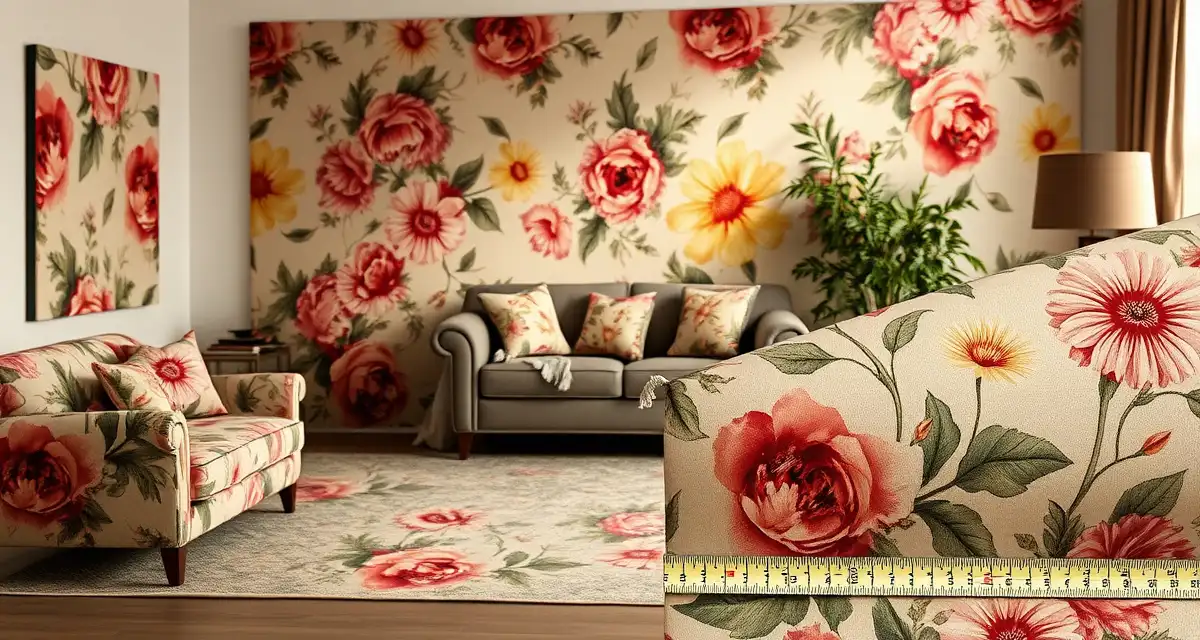
Floral Pattern Upholstery Yardage: Large Scale and Small Print Guide
Large-scale florals are the number one reason for last-minute fabric shortfall calls to upholstery suppliers. Not velvet. Not chenille. Not leather. Florals, specifically large-scale florals that shops calculated using small-print logic and ordered accordingly.
The distinction between a 3-6 inch small print and an 18-27 inch large-scale floral is enormous in yardage terms. A small print adds 0.5-1 yard over solid fabric on a sofa. A large-scale floral adds 3-6 yards. Using the same calculation approach for both is a consistent, expensive mistake.
TL;DR
- Floral Pattern Upholstery yardage depends on fabric width, construction details, pattern repeat, and nap direction.
- Plain 54-inch fabric requires a baseline calculation plus 10-15% waste allowance for a standard floral pattern upholstery job.
- Patterned fabric adds 20-35% to base yardage depending on repeat size and the number of cutting zones that must align.
- Directional fabrics add 15-25% over plain fabric because layout optimization is restricted by nap direction.
- Always verify fabric width before finalizing yardage; COM fabric often comes in non-standard widths.
- Calculating yardage at the quote stage, not mid-job, eliminates reorders and protects your profit margin.
Small Print Florals: Easy to Handle
A small floral print with a 3-6 inch repeat is the most manageable patterned fabric in upholstery. The repeat is small enough that:
- The pattern alignment is forgiving: A 0.5-inch offset in pattern alignment at a seam is hard to see at normal viewing distance.
- Centering is optional: On a small print, the pattern creates a consistent texture across the surface. There's no dominant focal point to center.
- Yardage premium is minimal: 0.5-1 yard extra on a sofa. Some skilled cutters can do small print florals with almost no extra yardage.
For small print florals (3-6 inch repeat): Use a 5-8% pattern premium on top of your solid fabric calculation. Or add 0.5-1 yard flat. Either approach is practical.
Scale comparison: A small print at 3-6 inches adds 0.5-1 yard on a sofa; a large scale (18-27 inches) adds 3-6 yards.
Medium Florals: Where Most Shops Are
Medium-scale florals in the 9-13 inch range represent the most common pattern range in residential upholstery fabric. These are the "cottage florals," "English garden" patterns, and classic chintz designs.
For a medium floral:
- The pattern is visible and distinct at normal viewing distance
- Centering is usually expected by clients on large panels
- Alignment at seams matters (seam-to-seam misalignment is visible)
- Yardage premium: 2-3.5 yards on a sofa
Calculation: Base yardage + (10 cuts × 11-inch repeat ÷ 36) + centering premium (0.75-1.25 yards) = base + 3.1 + 1 = base + 4.1 yards extra. Round conservatively.
Large-Scale Florals: The Shortfall Zone
Large-scale florals with 18-27 inch repeats are where last-minute supplier calls originate. The scale is impressive, beautiful bold flowers that fill a sofa panel. But every cut piece must start at the correct position in the repeat, and on a 27-inch repeat, the gap between where one piece ends and where the next matching position starts can be over 20 inches.
Why large-scale florals are uniquely problematic:
- Centering is mandatory: A large floral has an obvious focal point. Rail-to-rail placement will place the focal flower off-center, which looks unintentional on a large panel. Clients always expect centered placement on large florals.
- The repeat gap waste accumulates: On a 27-inch repeat with 10 cut pieces, the theoretical extra yardage is (10 × 27) ÷ 36 = 7.5 yards, before the centering premium.
- There are many cut pieces on a sofa: A 3-cushion sofa with a pillow back and 5 cushions total has 12-15 major cut pieces, not 10. The extra yardage scales with piece count.
For large-scale florals (18-27 inch repeat):
Start with base sofa yardage. Add (number of pieces × repeat size) ÷ 36 for the repeat waste. Add 1.5-2 yards centering premium for a full sofa. Round up generously, order a full extra repeat (1.5-2 yards) beyond your calculated total as insurance.
For a 3-cushion pillow-back sofa in a 27-inch floral:
- Base: 14 yards (pillow back)
- 12 pieces × 27 inches ÷ 36 = 9 yards repeat waste
- Centering: 1.5 yards
- Total: 24.5 yards minimum, order 25 yards
That number surprises clients. Present it before they commit to the fabric, not after.
How to Center a Large Floral: Sofa Backs and Cushions
Step 1: Identify the primary flower or focal element in the floral pattern. This is what must be centered.
Step 2: Find the vertical centerline of the sofa back panel.
Step 3: Position the primary flower on this centerline with the flower ideally in the upper third of the panel (not dead center, upper third looks more natural on a sofa back).
Step 4: Mark this position as your reference and cut all back-section panels with the primary flower at this reference position.
Step 5: Extend the centering reference to cushions. Each seat cushion top should show the primary flower (or a secondary flower of the same scale) in a consistent position. Each back cushion front should show the same floral element.
How do I center a large floral on sofa cushions?
The cushion tops on a sofa should show the floral in a way that reads as intentional. Options:
- Each cushion top shows the same flower centered on that cushion
- The cushion tops show a flowing section of the pattern, as if the pattern continues across all three cushions as a single piece
The second approach uses more fabric (pattern must align at cushion edges) but looks dramatically better. It's worth the 0.5-1 extra yard it requires.
What Floral Scale Works Best for Upholstery?
The pattern centering upholstery guide covers this in design terms. From a practical perspective:
- Small scale (3-6 inches): Works on any size piece, minimal yardage impact. Best for small furniture, dining chairs, ottomans where a large repeat would be out of scale.
- Medium scale (9-13 inches): The best all-around size for most upholstery. Visible and beautiful without the extreme yardage implications of large scale.
- Large scale (18-27 inches): Most dramatic visually but most expensive in fabric. Best suited for large sofas where the scale reads correctly. On a dining chair, a 24-inch floral repeat looks out of place.
Use the pattern repeat calculator upholstery to calculate exact yardage for any floral scale before ordering.
FAQ
How much extra fabric for a large floral pattern?
A large floral with an 18-inch repeat adds 3-5 yards to a standard sofa. A 27-inch floral adds 5-9 yards. These figures include centering premium. A sofa that needs 13 yards in solid fabric needs 18-22 yards in a large-scale floral. Always calculate large florals using the repeat formula: (number of cut pieces × repeat in inches) ÷ 36, plus 1.5-2 yards centering premium, plus 1-2 yards buffer. Never estimate large florals from the solid fabric yardage.
How do I center a large floral on sofa cushions?
Establish a reference position for the primary floral element on the sofa back first. Then position each seat cushion top so the same flower (or a secondary flower of equal prominence) appears at a consistent position relative to the cushion edge. For a unified look, consider treating the three cushions as a continuous panel, align the pattern so it flows across all three cushion fronts as if it were one piece. This requires precise cut positioning but creates an impressive finished effect.
What floral scale works best for upholstery?
Medium-scale florals (9-13 inch repeat) are the most practical choice for most upholstery applications, visible and beautiful without the extreme yardage implications of large-scale repeats. Small prints (3-6 inches) are easiest to work with and most forgiving of alignment imperfections. Large-scale florals (18-27 inches) are the most dramatic but add 5-9 yards to a sofa and require mandatory centering on large panels. Match the floral scale to the furniture scale, a 24-inch floral looks stunning on an 84-inch sofa and wrong on a 24-inch dining chair seat.
What is the biggest factor in yardage variation for this piece?
Pattern repeat is the biggest source of yardage variation. On plain fabric, the baseline calculation plus a 10-15% waste buffer is usually sufficient. Add a 13-inch pattern repeat and you may need 15-20% more. Add a 27-inch pattern repeat and the additional yardage can be 25-35% over the plain fabric calculation. Nap direction is the second-largest factor, typically adding 15-25% over plain fabric because layout optimization is restricted.
Sources
- National Upholstery Association
- Association of Master Upholsterers and Soft Furnishers (AMUSF)
- Upholstered Furniture Action Council (UFAC)
- Furniture Today (trade publication)
Get Started with StitchDesk
Getting yardage right on floral pattern upholstery jobs is the difference between a profitable quote and an expensive reorder. StitchDesk's fabric calculator accounts for all the variables that cause errors: pattern repeat by zone, nap direction, fabric width, and cushion configuration. Start a free trial and see how accurate yardage calculation affects your bottom line.