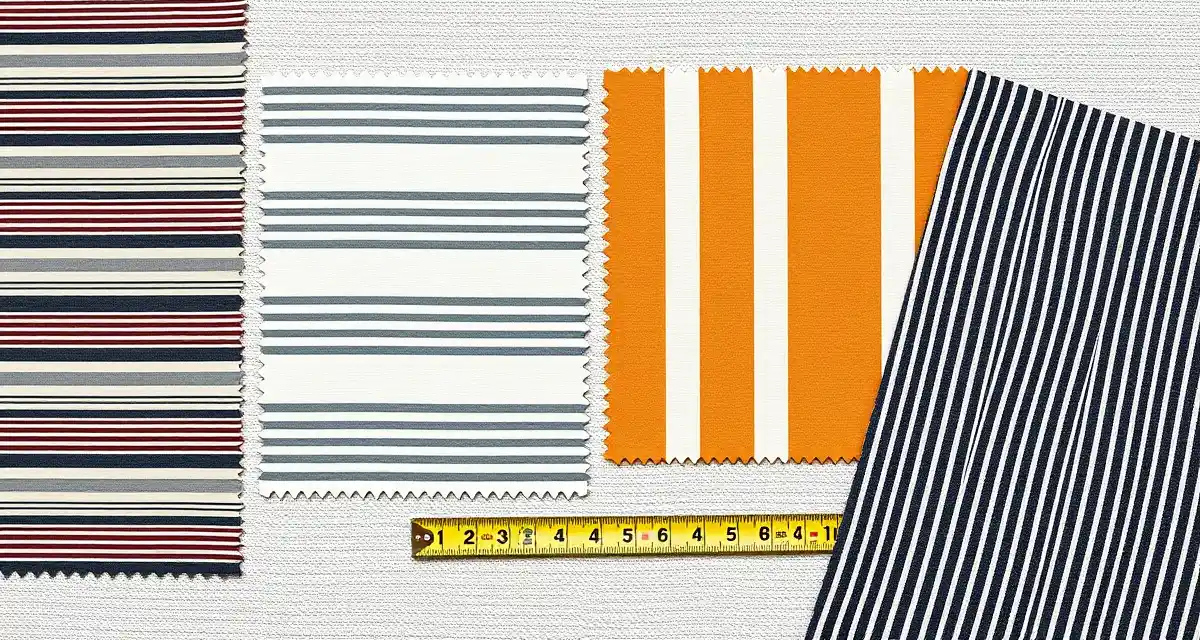
Stripe Matching in Upholstery: How to Calculate Extra Yardage
Horizontal stripes on a tufted sofa require 30-40% more fabric than the same sofa in solid, rarely estimated correctly. But not all stripe orientations are equal. Horizontal stripes, vertical stripes, and railroaded stripes each have different yardage implications, different matching requirements, and in some cases, the ability to save yardage rather than add it.
No existing guide covers all three stripe orientations together with their different yardage implications. This one does.
TL;DR
- Stripe Matching Upholstery yardage depends on fabric width, construction details, pattern repeat, and nap direction.
- Plain 54-inch fabric requires a baseline calculation plus 10-15% waste allowance for a standard stripe matching upholstery job.
- Patterned fabric adds 20-35% to base yardage depending on repeat size and the number of cutting zones that must align.
- Directional fabrics add 15-25% over plain fabric because layout optimization is restricted by nap direction.
- Always verify fabric width before finalizing yardage; COM fabric often comes in non-standard widths.
- Calculating yardage at the quote stage, not mid-job, eliminates reorders and protects your profit margin.
Horizontal Stripes: The Most Complex Case
A horizontal stripe fabric has stripes running perpendicular to the selvage, across the fabric width from edge to edge. When used in standard upholstery orientation (with stripes running horizontal on the finished piece), this is the most demanding stripe configuration.
Why horizontal stripes are complex:
Every horizontal panel seam must show continuous stripe alignment. The inside back and the back cushion fronts must have stripes at the same height. The seat cushion tops must have stripes at the same height across all three cushions. Even the boxing strips must show stripes at a consistent position.
This means each piece must be cut to start at the same position in the stripe repeat. And on a tufted sofa, the tufting buttons must be placed at specific points in the stripe repeat to look intentional, typically in the center of a solid stripe, not on a colored stripe.
Yardage impact:
A horizontal stripe with a 6-inch stripe unit repeat on a sofa adds approximately:
- Vertical matching waste between pieces: 2-3 yards (same as a 6-inch pattern repeat)
- Tufting button positioning premium (if tufted): 15-20% additional
- Total for a tufted sofa: 30-40% over solid fabric yardage
For an untufted sofa with horizontal stripes: 15-25% over solid.
Vertical Stripes: More Manageable But Not Free
Vertical stripes run parallel to the selvage, from the top to the bottom of the piece. This is the "natural" stripe direction for most upholstery applications.
Why vertical stripes are easier:
Each panel must show continuous vertical stripes at the seam edges. But because the stripes run the length of the bolt, there's no vertical offset issue, adjacent pieces on the bolt all show the same stripe sequence.
The challenge is at vertical seams: where the inside back meets the inside arm, the stripe on the inside back edge must align with the stripe on the inside arm edge. This requires positioning each piece so the stripe at its seam edge matches the stripe at the adjacent piece's seam edge.
Yardage impact:
Vertical stripe alignment at seams adds 5-12% to solid fabric yardage. The waste comes from horizontal positioning adjustments, shifting a panel slightly left or right to align its seam-edge stripe with the adjacent panel's seam-edge stripe.
On a sofa, vertical stripe alignment adds approximately 1-2 yards over solid fabric.
Railroading Stripes to Save Yardage
"Railroading" means rotating the fabric 90 degrees so the selvage runs front-to-back (or up-down) instead of side-to-side. For vertical-stripe fabrics, railroading means the stripes now run horizontally on the finished piece.
But for some stripe configurations, railroading can be a yardage saver. Stripe orientation selector shows cutting layout and extra yardage for horizontal vs vertical vs railroaded.
When railroading saves yardage:
If you have a vertical stripe fabric and you railroad it, the sofa back can potentially be cut as a single continuous piece running the full width of the sofa, with no vertical seam through the middle. This eliminates the seam alignment issue entirely.
For a sofa back that would normally require a 2-piece cut with a center seam (and stripe alignment at that seam), railroading eliminates the matching requirement and saves 0.5-1 yard.
When railroading doesn't work:
Not all fabrics can be railroaded. A fabric with a directional pattern (one that reads differently right-side-up vs upside-down) can't be railroaded without the pattern appearing upside down on horizontal surfaces. Stripes are often railroad-friendly since they're non-directional, but verify with the specific fabric.
Can I Railroad a Striped Fabric to Save Yardage?
The answer is often yes, but check two things:
- Is the stripe non-directional? (Would it look the same upside down?) Most simple stripe patterns pass this test. Gradated or shadowed stripes may not.
- Does the fabric's construction allow railroading? Some fabrics have a clear face/back that can't be rotated. Check with the fabric supplier.
If both tests pass, railroading a striped fabric can save 1-2 yards on a sofa compared to standard orientation matching.
Stripe Width and Yardage Impact
The width of the individual stripes in the pattern affects yardage:
- Narrow stripes (under 1 inch): Very forgiving, slight alignment imperfections are hard to see. Yardage premium is minimal (5-8% for horizontal stripes).
- Medium stripes (1-3 inches): Alignment at seams is visible. Yardage premium of 10-20%.
- Wide stripes (3+ inches): Very visible at seams. Alignment required on all seams. Yardage premium 20-35%.
- Broad stripe alternating (e.g., 6-inch solid alternating with 6-inch pattern): Must be matched exactly at seams. Yardage premium 25-40%.
Stripes and the Fabric Yardage Calculator
The fabric yardage calculator with stripe mode should accept stripe orientation and stripe width as separate inputs, since both affect yardage differently. The pattern repeat guide upholstery covers stripes as part of the larger pattern repeat guide.
Related Articles
FAQ
How much extra fabric do stripes add to upholstery?
The extra fabric depends on stripe orientation: horizontal stripes add 15-40% over solid fabric (higher end for tufted pieces), vertical stripes add 5-15%, and railroaded stripes can add 5-12% or potentially save yardage compared to standard-orientation matching. Stripe width also matters, wide stripes (3+ inches) require more careful alignment and add more waste than narrow stripes (under 1 inch).
How do I match horizontal stripes across sofa cushions?
Identify a reference stripe, typically the stripe that should appear at the top front edge of all seat cushions, and cut every cushion to start at that stripe. The stripe sequence across the front face of all three seat cushions should be identical. Work from the same reference stripe for back cushions: the stripe that appears at the top of the sofa back should appear at the same position on the back cushion fronts. Pre-plan all cut positions on the bolt before cutting anything.
Can I railroad a striped fabric to save yardage?
Yes, if the stripe is non-directional (looks the same upside down) and the fabric's construction allows it. Railroading eliminates the vertical seam alignment issue on large panels like sofa backs, you can run the full sofa back width from a single continuous piece, with stripes running across the piece rather than up and down it. This typically saves 1-2 yards on a sofa job. Verify railroading is appropriate for the specific fabric before planning your layout.
What is the biggest factor in yardage variation for this piece?
Pattern repeat is the biggest source of yardage variation. On plain fabric, the baseline calculation plus a 10-15% waste buffer is usually sufficient. Add a 13-inch pattern repeat and you may need 15-20% more. Add a 27-inch pattern repeat and the additional yardage can be 25-35% over the plain fabric calculation. Nap direction is the second-largest factor, typically adding 15-25% over plain fabric because layout optimization is restricted.
Sources
- National Upholstery Association
- Association of Master Upholsterers and Soft Furnishers (AMUSF)
- Upholstered Furniture Action Council (UFAC)
- Furniture Today (trade publication)
Get Started with StitchDesk
Getting yardage right on stripe matching upholstery jobs is the difference between a profitable quote and an expensive reorder. StitchDesk's fabric calculator accounts for all the variables that cause errors: pattern repeat by zone, nap direction, fabric width, and cushion configuration. Start a free trial and see how accurate yardage calculation affects your bottom line.