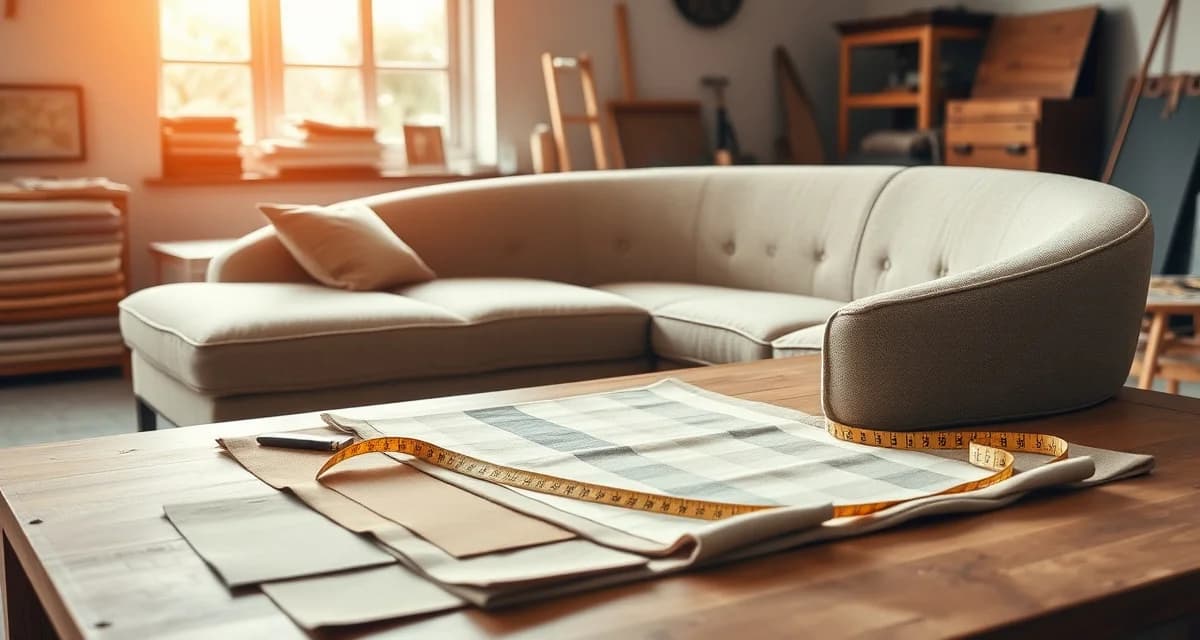
Curved Sectional Fabric Yardage: Curved Backs and Angled Pieces
Curved sectional backs add 15 to 25 percent to back panel yardage compared to straight configurations, and standard templates don't detect this at all. If you're running a curved sectional through a straight sectional calculator, you're setting up a fabric shortfall on every curved job you quote.
This guide covers where the extra yardage comes from on curved sectionals and how to calculate for common curved configurations.
TL;DR
- Upholstery For Curved Sectional yardage depends on fabric width, construction details, pattern repeat, and nap direction.
- Plain 54-inch fabric requires a baseline calculation plus 10-15% waste allowance for a standard upholstery for curved sectional job.
- Patterned fabric adds 20-35% to base yardage depending on repeat size and the number of cutting zones that must align.
- Directional fabrics add 15-25% over plain fabric because layout optimization is restricted by nap direction.
- Always verify fabric width before finalizing yardage; COM fabric often comes in non-standard widths.
- Calculating yardage at the quote stage, not mid-job, eliminates reorders and protects your profit margin.
Why Straight Templates Miss Curved Sectional Yardage
A straight sectional back panel is a rectangle. Width times height equals your panel area. Add seam allowance and you're done. The fabric cuts flat, the panels align efficiently, and waste is minimal.
A curved sectional back panel is not a rectangle. The back rail follows the curve of the sectional. When you flatten the fabric to cut a curved back panel, you need to cut it from a rectangular piece of fabric that's larger than the finished panel. The curved shape requires the rectangular bounding box, not the curved shape itself.
For a gentle back-rail curve (8-12 degrees), the bounding box is only slightly larger than the finished panel, maybe 5-10% waste. For a more pronounced curve (18-25 degrees, common on tight-radius curved sectionals), the bounding box can be 15-25% larger than the finished panel. That's all wasted fabric.
Multiply that waste by the full back length of a 6-piece curved sectional and you're looking at 3-5 extra yards that straight templates never account for.
Angled Arm Pieces: The Second Hidden Waste
On curved sectionals, the arm pieces don't sit perpendicular to the floor. The arms angle to follow the curve of the sectional's silhouette. An arm that's set at 15-20 degrees from vertical needs to be cut at that angle from the fabric. This diagonal cutting produces triangular waste pieces on each arm panel.
A straight sectional arm can be cut efficiently with minimal waste. An angled arm wastes a triangle of fabric at each end of every angled cut. On a sectional with 2 angled arms, this adds 0.5-1.5 yards of additional waste depending on the angle.
The inside arm panel, outside arm panel, and front arm panel all require angled cuts on a curved sectional. That's 6 angled panels just for the two arm sections, each producing waste.
Identifying Your Curve Degree
You don't need a protractor to estimate your curve degree for calculation purposes. Two practical methods:
The string method: Hold a string taut from one end of the back rail to the other. Measure the maximum distance from the string to the back rail at the deepest point of the curve. For a 72-inch back section, a 3-inch sag = roughly 5 degrees. An 8-inch sag = roughly 13 degrees.
Photo estimation: Take a photo of the sectional from directly above. Compare the back rail curvature to a reference arc. Most casual curved sectionals have 10-20 degree curves. Tight-radius sectionals can reach 25-35 degrees.
For quoting purposes:
- Gentle curve (under 10 degrees): Add 8-10% to back panel yardage
- Moderate curve (10-18 degrees): Add 15-18% to back panel yardage
- Pronounced curve (18-25 degrees): Add 20-25% to back panel yardage
Step-by-Step Curved Sectional Yardage Calculation
Step 1: Identify curved pieces.
Not all pieces of a curved sectional are curved. Typically the back panel and adjacent side panels curve; seat panels and outside arms may be straight or only slightly angled.
Step 2: Calculate straight pieces normally.
Use your standard sectional template for straight seat cushions, straight deck, and any straight arm sections.
Step 3: Calculate curved back panels with waste addition.
Measure the full back length (following the curve, not across the chord). Measure back height. Add your curve-appropriate waste percentage to the panel yardage.
Step 4: Add angled arm waste.
For each arm piece that cuts at an angle, add 0.25-0.5 yards of waste per arm section to account for diagonal cutting waste.
Step 5: Pattern repeat adjustment.
Pattern repeat on curved sections is harder to plan because the curve affects perceived pattern alignment. The pattern appears to rotate slightly as it follows the curve. For patterned fabric on a curved back, add an additional 10% above the standard pattern repeat calculation to account for perceived alignment.
Step 6: Sum all sections and add overall waste factor.
Add 10% overall waste to the total of all sections. Curved cutting is inherently less efficient than straight cutting.
Using the Calculator
The sectional fabric yardage calculator handles straight sectional configurations. For curved back calculations, use the curve mode toggle and input your estimated curve degree per back section. The calculator adds the appropriate waste percentage to back panel yardage and flags angled arm sections for additional waste.
For more on calculating fabric for unusual sectional shapes, the curved furniture fabric yardage guide covers barrel-back chairs and other curved furniture that creates similar cutting challenges.
Frequently Asked Questions
How much fabric for a curved sectional?
A curved sectional typically requires 15-25% more fabric than a same-size straight sectional, with the extra yardage concentrated in the back panels and angled arm sections. A 5-piece curved sectional that would take 28-32 yards as a straight configuration might require 33-38 yards as a curved version. The exact additional yardage depends on how pronounced the curve is and how many sections have curved back rails.
Why does a curved sectional need more fabric?
Curved back panels have to be cut from rectangular fabric pieces that are larger than the finished curved panel, because curved shapes can't be cut flat without the bounding box of the curve requiring extra material. Additionally, angled arm sections on curved sectionals cut diagonally, producing triangular waste on each panel. Standard templates assume all panels cut rectangular with minimal waste, which is accurate for straight sectionals but wrong for curved ones.
How do I measure a curved sectional for reupholstery?
Measure the back rail length by running a flexible tape measure along the curve itself, not across the chord from end to end. The curved measurement will be longer than the straight-line distance. Measure back height at multiple points to check whether the height is consistent along the curve. Measure seat depth at both the inside and outside radius positions, as these differ on tight-radius curves. Record arm angles if you can, this helps determine diagonal cutting waste for arm panels.
What is the biggest factor in yardage variation for this piece?
Pattern repeat is the biggest source of yardage variation. On plain fabric, the baseline calculation plus a 10-15% waste buffer is usually sufficient. Add a 13-inch pattern repeat and you may need 15-20% more. Add a 27-inch pattern repeat and the additional yardage can be 25-35% over the plain fabric calculation. Nap direction is the second-largest factor, typically adding 15-25% over plain fabric because layout optimization is restricted.
What should I do if I run short on fabric mid-job?
Stop cutting immediately when you realize you may run short. Calculate exactly how much additional fabric you need before contacting the supplier or client. If reordering from the same dye lot is possible, do so as quickly as possible because dye lots change. If a dye lot match is not available, contact the client before proceeding; visible dye lot differences on the same piece are unacceptable and must be disclosed. Document the situation and response in writing.
Sources
- National Upholstery Association
- Association of Master Upholsterers and Soft Furnishers (AMUSF)
- Upholstered Furniture Action Council (UFAC)
- Furniture Today (trade publication)
Get Started with StitchDesk
Getting yardage right on upholstery for curved sectional jobs is the difference between a profitable quote and an expensive reorder. StitchDesk's fabric calculator accounts for all the variables that cause errors: pattern repeat by zone, nap direction, fabric width, and cushion configuration. Start a free trial and see how accurate yardage calculation affects your bottom line.