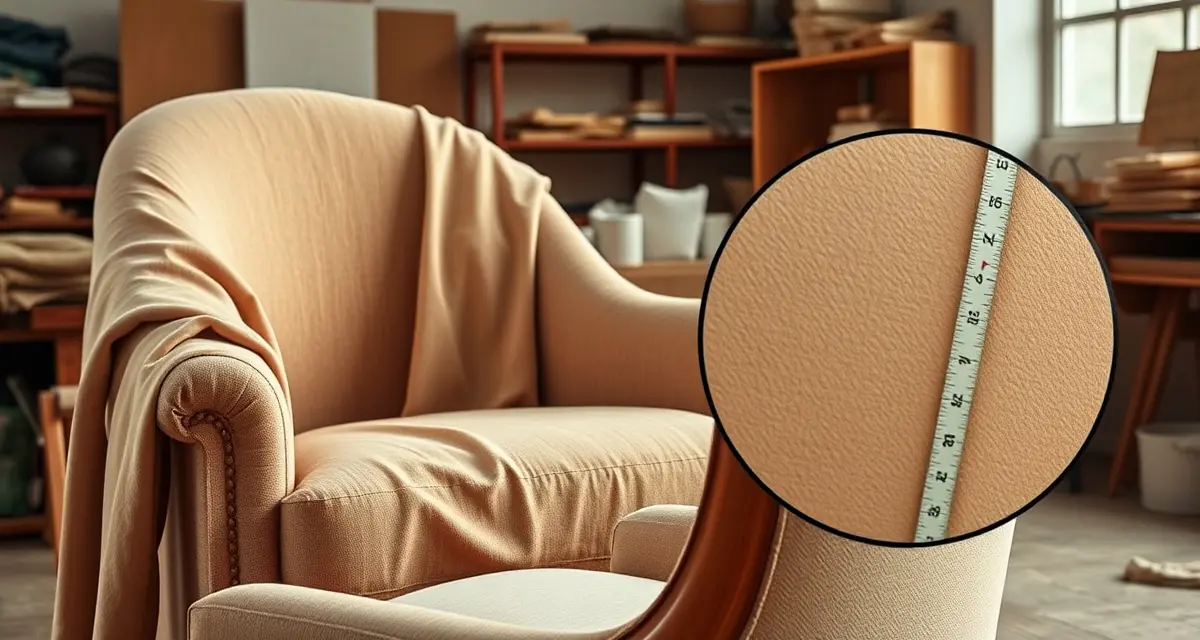
Curved Furniture Fabric Yardage: Round Backs Curved Arms and Organic Shapes
Curved furniture is where standard flat-panel yardage math breaks down. When a barrel chair's back curves in a continuous arc, the fabric panel you cut isn't a flat rectangle that uses its full area efficiently. It's a shape cut from a rectangle, and the corners of that rectangle become waste.
Rounded barrel-back chairs have the highest yardage shortfall rate of any furniture category in residential upholstery because flat-panel math doesn't apply, and most calculators use flat-panel math.
Here's how curvature adds waste, and what to do about it.
TL;DR
- Curved Furniture yardage depends on fabric width, construction details, pattern repeat, and nap direction.
- Plain 54-inch fabric requires a baseline calculation plus 10-15% waste allowance for a standard curved furniture job.
- Patterned fabric adds 20-35% to base yardage depending on repeat size and the number of cutting zones that must align.
- Directional fabrics add 15-25% over plain fabric because layout optimization is restricted by nap direction.
- Always verify fabric width before finalizing yardage; COM fabric often comes in non-standard widths.
- Calculating yardage at the quote stage, not mid-job, eliminates reorders and protects your profit margin.
Why Curved Surfaces Need More Fabric
When you cover a flat surface, the fabric panel uses nearly its full area. Seam allowance at the edges is the only real waste.
When you cover a curved surface, you're cutting a flat piece of fabric and asking it to conform to three-dimensional curvature. For mild curves, the fabric stretches or pleats to accommodate. For substantial curvature (barrel backs, tub chair continuous curves), you're often cutting a shaped panel rather than a rectangle.
That shaped panel comes from a rectangular piece of fabric. The curved edges of the panel create waste at every corner. A panel cut to follow a 180-degree barrel back curve uses maybe 70 to 75 percent of its bounding rectangle.
The waste percentage increases with tighter curves:
- Slight curve (less than 30 degrees of arc): 5 to 10% waste premium over flat
- Moderate curve (30 to 90 degrees): 10 to 20% waste premium
- Deep curve (90 to 180 degrees, barrel backs): 20 to 35% waste premium
- Full round (tub chair continuous back): 25 to 40% waste premium
Barrel Back Chairs
The barrel back chair has a back panel that curves from arm to arm in a continuous arc. The curvature can be gentle or quite dramatic: the most barrel-shaped versions have a back that curves almost 180 degrees.
For a typical barrel back chair with moderate curvature:
- Flat-panel equivalent yardage: 4 to 5 yards
- Actual yardage needed with curve waste: 5 to 6.5 yards
The StitchDesk barrel chair yardage calculator accounts for back curvature in the calculation. It asks for the depth of the curve (how far the back protrudes from the arm plane) and adjusts the waste calculation accordingly.
Tub Chairs
A tub chair is characterized by a continuous curved panel that runs from one arm, across the back, and down the other arm in an uninterrupted sweep. There's no break between back and arms: it's a single curving surface.
This continuous curve is the most complex single panel in residential upholstery. If you calculate the back and arms as separate flat panels (as most templates do), you miss the additional waste at the curves and the junction material needed to bridge the seams.
Standard approach (wrong): Calculate inside back + inside arm panels separately. Total: 1.5 yards inside back, 0.5 yards per arm = 2.5 yards for these surfaces.
Correct approach: Calculate the continuous curve panel as one connected surface. The arc from arm to arm across the back, cut from a single piece: approximately 3 to 3.5 yards.
The difference of 0.5 to 1 yard is what causes tub chair shortfalls. See the tub chair yardage guide for the detailed calculation.
Organic Modern Shapes
Contemporary furniture design has moved considerably toward organic and flowing shapes: S-curves, kidney shapes, pod chairs, curved sectional pieces. These organic forms present the most complex cutting layouts in residential upholstery.
For organic shapes, the best approach is to create a paper template of each panel before cutting any fabric. Trace the actual surface area you need to cover, lay the template on the fabric, and nest the templates as efficiently as possible. Calculate from the actual template area plus seam allowance, not from assumed flat-panel dimensions.
For irregular shapes, the bounding rectangle waste approach works: measure the bounding rectangle of each panel (the smallest rectangle that contains the panel's full shape), calculate yardage from the bounding rectangle area, and accept that a percentage of each rectangle will be waste.
For very large organic pieces (curved sectional backs, flowing sofa shapes), this approach can mean 25 to 40 percent of your ordered fabric is cutting waste. Factor that into your quote.
Fabrics That Handle Curves Better
Not all fabrics curve equally well:
Plain weaves with some stretch: The best choice for curved furniture. A small amount of stretch (5 to 10 percent) allows the fabric to ease around curves without puckering at seams.
Velvet: The pile allows slight easing around curves. Diamond tufting on curved backs works well with velvet because the pull gathers the excess at each button.
Leather: More challenging on curves. Full-grain and top-grain leather can crack at tight corners if forced into a curve it won't naturally conform to. Grade the curve radius against the leather's flexibility.
Boucle and looped pile: The loops can distort under the strain of curving around a tight radius. Use with caution on tight curves: test a sample around your tightest curve before committing.
Frequently Asked Questions
How do I calculate yardage for curved furniture?
Start with the bounding rectangle for each curved panel (the smallest rectangle that contains the panel's full shape). Calculate yardage from the bounding rectangle dimensions. Then apply a waste percentage based on the degree of curvature: 5 to 10 percent for slight curves, 20 to 35 percent for deep curves. Sum all panels including the waste adjustment.
Why does curved furniture need more fabric than flat-back pieces?
Because curved panels are cut from rectangular fabric pieces, and the curvature creates waste at the corners and edges of the bounding rectangle. A barrel-back chair with a deep curve might use 25 to 30 percent of its bounding rectangle as waste. On a flat-back chair, nearly all of the bounding rectangle is useful fabric. The waste percentage rises with the tightness of the curve.
What fabrics work best for curved furniture upholstery?
Plain weave fabrics with slight two-way stretch handle curves best because the fabric can ease around the radius without puckering at seams. Velvet works well on curved furniture, especially with tufting that gathers the excess at each button. Avoid very stiff fabrics (heavy canvas, some structured wovens) on tight curves: they resist easing and produce visible puckers at seam lines.
What is the biggest factor in yardage variation for this piece?
Pattern repeat is the biggest source of yardage variation. On plain fabric, the baseline calculation plus a 10-15% waste buffer is usually sufficient. Add a 13-inch pattern repeat and you may need 15-20% more. Add a 27-inch pattern repeat and the additional yardage can be 25-35% over the plain fabric calculation. Nap direction is the second-largest factor, typically adding 15-25% over plain fabric because layout optimization is restricted.
What should I do if I run short on fabric mid-job?
Stop cutting immediately when you realize you may run short. Calculate exactly how much additional fabric you need before contacting the supplier or client. If reordering from the same dye lot is possible, do so as quickly as possible because dye lots change. If a dye lot match is not available, contact the client before proceeding; visible dye lot differences on the same piece are unacceptable and must be disclosed. Document the situation and response in writing.
Sources
- National Upholstery Association
- Association of Master Upholsterers and Soft Furnishers (AMUSF)
- Upholstered Furniture Action Council (UFAC)
- Furniture Today (trade publication)
Get Started with StitchDesk
Getting yardage right on yardage curved furniture jobs is the difference between a profitable quote and an expensive reorder. StitchDesk's fabric calculator accounts for all the variables that cause errors: pattern repeat by zone, nap direction, fabric width, and cushion configuration. Start a free trial and see how accurate yardage calculation affects your bottom line.