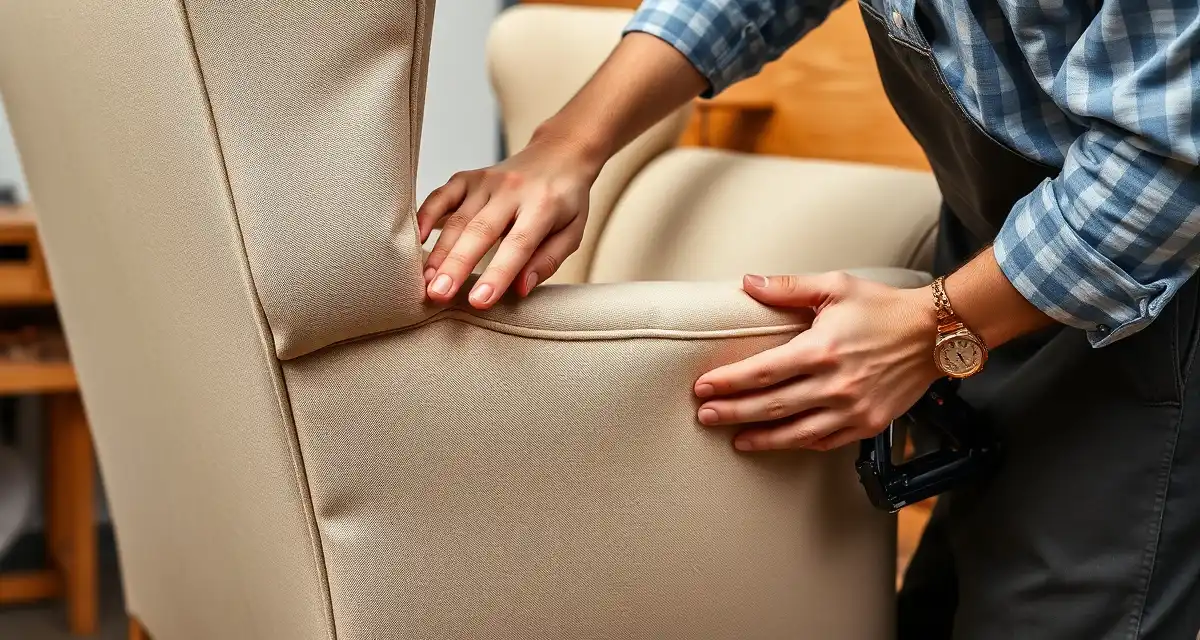
Wing Chair Reupholstery Guide: All 16 Panels in Order
The inside arm must be installed before the inside wing. Reversing this order causes permanent visible wrinkles at the arm-to-wing junction. This is the single most consequential sequencing rule in wing chair reupholstery, and it's violated regularly by upholsterers who treat wing chairs like scaled-down sofas and use a standard sofa panel sequence.
This guide covers all 16 panels of a wing chair in the professional installation sequence, with the technique decisions that determine whether the finished chair looks amateur or professional.
TL;DR
- Successful reupholstery starts with a thorough frame and spring assessment before any fabric is ordered.
- Professional technique follows a consistent panel sequence: strip, repair frame, replace foam, then install fabric panels in the correct order.
- Pattern fabric requires centering and repeat alignment decisions made before cutting; errors discovered after cutting are expensive to correct.
- Professional labor time ranges from 12-20 hours depending on furniture style and fabric complexity.
- Foam selection matters as much as fabric selection; the right density and ILD creates the correct seating profile and longevity.
- Consistent tension on all panels and quality welt cording are the marks of professional finishing.
The 16 Wing Chair Panels
Count them first so you don't miss any in your yardage and cut plan:
- Seat deck
- Inside arm left
- Inside arm right
- Inside wing left
- Inside wing right
- Inside back
- Back rail cap (top back, if the design has a visible cap panel)
- Outside wing left
- Outside wing right
- Outside arm left
- Outside arm right
- Outside back
- Front arm panel left
- Front arm panel right
- Seat cushion top
- Seat cushion bottom (and boxing strips, counted together)
This count doesn't include welt cord sections, which are separate cuts. Some wing chairs have a 17th panel, a small facing panel at the front base below the seat deck.
Panel Installation Sequence
1. Seat deck
Install the deck fabric over the seat platform. Tuck at the back and sides, staple at the front. Leave the side edges loose where they'll interact with the inside arm panels.
2. Inside arm left, then inside arm right
Each inside arm panel runs from the arm platform edge, up and over the arm top, to the back of the chair. Tuck the back edge under the inside back (which goes in later). Pull the arm panel over the arm crest and staple at the back. Leave the front arm post area loose for now.
3. Inside wing left, then inside wing right
With inside arms in place, install inside wing panels. The bottom edge of each inside wing panel tucks under the top of the inside arm. This tuck creates the clean arm-to-wing transition. If inside arm goes in after inside wing, this tuck is impossible without reworking the arm panel.
4. Inside back
After both inside arms and inside wings are in, install the inside back. The inside back tucks at both sides behind the inside arm and inside wing panels.
5. Loose seat cushion assembly (if applicable)
Assemble the seat cushion off the chair. The cushion doesn't go in place until the outside panels close the chair.
6. Outside wing left, then outside wing right
Close each outside wing using a blind tack strip along the front edge and top edge. The bottom edge of the outside wing aligns with the top of the outside arm panel that goes in next.
7. Outside arm left, then outside arm right
Blind tack along the front arm post and top arm rail. The outside arm overlaps the bottom edge of the outside wing.
8. Outside back
Closes the back panel last among the outside surfaces.
9. Front arm panels (both)
The decorative facing on the front of each arm. These go on late in the sequence because they cover the ends of the inside arm and outside arm panels.
10. Dust cover
Bottom cambric fabric, applied after all other panels are complete.
The Inside Arm Panel Technique
The inside arm is the panel that most often shows quality differences. It's large, spans a complex path, and its installation affects every subsequent panel.
Running the inside arm: Start with the fabric positioned on the arm platform. Center it on the platform width. Pull the fabric up and over the arm crest. At the back, tuck the fabric edge down behind the back rail, it'll be hidden by the inside back when that goes on.
The front arm post: Where the inside arm meets the front arm post, cut a diagonal slit in the fabric from the edge to within 1/4 inch of the post. This allows the fabric to fold cleanly around the post on both the inside arm and outside arm sides.
Tension: The inside arm panel needs uniform tension from front to back. Pull from the center of the front arm post toward the center of the back post before finalizing any staples. This establishes your tension baseline before you work outward.
Welt Application on Wing Chairs
Wing chairs typically have welt at several junctions:
- The arm-to-body junction on the outside arm
- The outside back perimeter
- Sometimes at the wing-to-arm junction on the inside face
Sew welt to panels before installation. The welt should be applied to the inside arm panel's outward-facing edge so that when the outside arm is installed, the welt is captured cleanly at the seam.
For an uninterrupted welt line at the outside arm-to-outside back junction, create a continuous welt strip that runs the full path from the front of the arm, around the outside arm, and into the outside back. Joining welt in the middle of a visible seam line creates a bump, do the join at a corner or hidden point.
For technique on specific wing chair variations, the how to reupholster a chair guide covers wing, club, and barrel chair sequences. For fabric yardage on wing chairs, use the wing chair fabric yardage calculator.
Frequently Asked Questions
In what order do I upholster a wing chair?
The correct order is: seat deck, inside arm (both sides), inside wing (both sides), inside back, loose cushion assembly, outside wing, outside arm, outside back, front arm panels, dust cover. The most critical rule is inside arm before inside wing, the inside wing tucks under the top of the inside arm at the junction. Reversing this creates an unworkable joint. Installing the inside back after the inside arms and wings ensures it can tuck behind both panels cleanly.
How do I attach the wing panels on a wing chair?
The inside wing panel's bottom edge tucks under the top of the inside arm panel at the arm-to-wing junction. The inside wing's back edge tucks behind the inside back panel (installed later). The outside wing is attached with a blind tack strip along the front edge, with the top stapled at the back of the back rail. The outside wing's bottom aligns with the top edge of the outside arm panel that goes in directly after.
How do I install welt on a wing chair?
Apply welt to panels before installation, not after. For the outside arm welt, sew welt to the outward-facing edge of the inside arm panel. When the outside arm is installed, the welt is captured cleanly in the junction between inside and outside arm panels. For a continuous welt line around the outside back perimeter, join welt strips at corners, not in the middle of visible seam lines.
What tools are required for professional reupholstery?
Professional reupholstery requires a heavy-duty staple gun (pneumatic or electric), a staple remover and tack puller, quality scissors and a rotary cutter, a sewing machine capable of sewing upholstery-weight fabric, foam cutting tools, and regulator pins for manipulating stuffing. For tufted work, a curved needle and tufting twine are also required. The quality of your tools directly affects the quality of the finished work, particularly at seams and edges.
How do I handle pattern matching across multiple panels?
Establish the dominant panel first (usually the inside back) and center the pattern motif there. Then cut each subsequent panel so the pattern aligns with the adjacent panel at the seam. Mark the pattern alignment point on each piece before cutting. For complex pieces, some upholsterers make a cutting plan on paper showing where each panel falls in the pattern before cutting any fabric. This investment in planning prevents the most common and costly pattern-matching errors.
Related Articles
Sources
- National Upholstery Association
- Association of Master Upholsterers and Soft Furnishers (AMUSF)
- Upholstered Furniture Action Council (UFAC)
- Furniture Today (trade publication)
Get Started with StitchDesk
Accurate reupholstery quotes require knowing your labor time, material costs, and overhead for each job type. StitchDesk helps upholstery shops build detailed, professional quotes that account for all cost factors, so every job is priced to cover costs and generate profit. Try StitchDesk free and bring accuracy to every estimate you send.