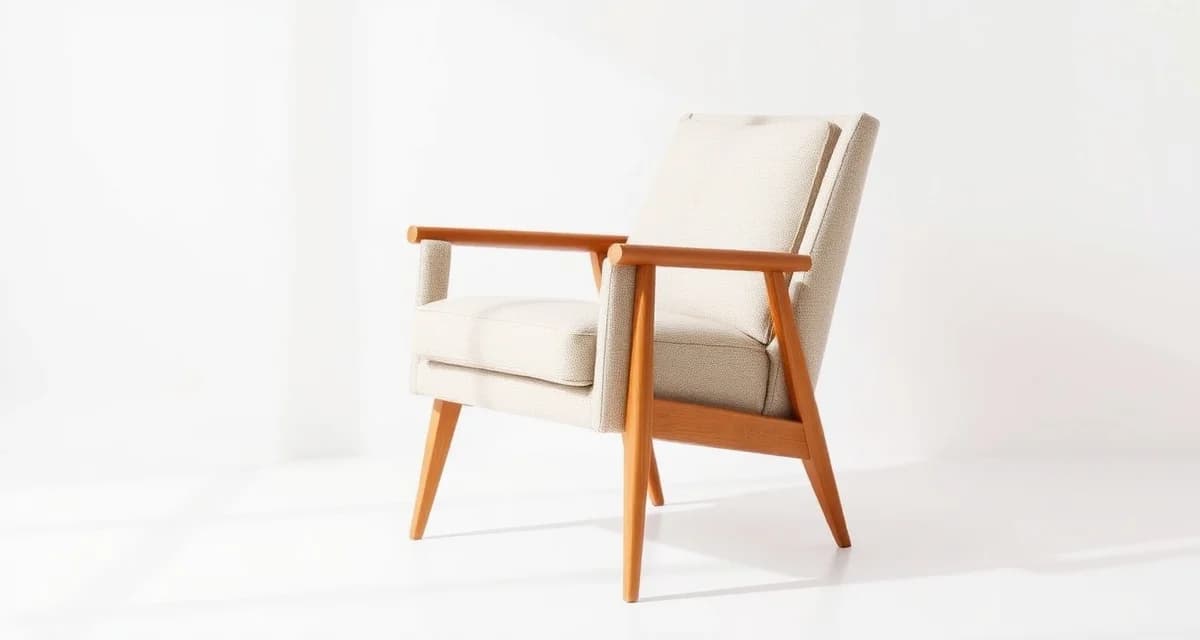
Mid-Century Furniture Fabric Yardage: Tapered Legs and Thin Arms
Mid-century modern pieces are some of the most fun to reupholster, with clean lines, beautiful bones, and clients who genuinely love the style. But they're also pieces that shops consistently miscalculate yardage on. The problem is almost always the same: applying a standard chair or sofa yardage template to a piece that has considerable exposed wood.
When a chair has four tapered walnut legs and thin wooden arms showing, you're not covering those surfaces. Pull that square footage out of your calculation, and the number changes more than most people expect.
TL;DR
- Accurate yardage calculation for mid century jobs prevents costly fabric shortfalls and over-ordering that erode margin.
- Pattern repeats are the most common source of yardage errors; always calculate each cutting zone separately, not as a flat percentage.
- Nap-direction fabrics (velvet, chenille, mohair) require 15-25% more yardage than the same job in plain fabric.
- Fabric width significantly affects yardage: the difference between 54-inch and 60-inch fabric can be 1-2 yards on the same piece.
- Always add a 10-15% buffer on plain fabric and 15-20% on patterned fabric to account for cutting waste.
- Entering measurements accurately at the quoting stage eliminates the need to reorder mid-job.
Why Mid-Century Yardage Differs from Modern
A contemporary fully-upholstered arm chair wraps fabric all the way down to the floor on all sides. A mid-century slipper chair or lounge chair? The legs are bare wood, the arm frames are typically exposed, and sometimes even portions of the back frame show.
That difference adds up fast. A mid-century lounge chair with exposed wooden legs and thin-arm frame can use 15 to 25 percent less fabric than a modern chair of the same overall dimensions. That's a meaningful difference, sometimes a full yard less on a single chair.
The issue is that most yardage calculators use one preset for "arm chair" and don't account for what's actually covered on your specific piece.
What to Measure on a Mid-Century Chair
To get an accurate yardage calculation, you need to measure only the upholstered surfaces:
Seat: Top and front edge. Measure width and depth at the widest points.
Inside back: The padded interior surface. Stop at the frame, don't include wood.
Outside back: The panel visible from behind. On many mid-century pieces, this is much narrower than the inside back because the wooden frame eats into it.
Arm panels: If the arms are upholstered at all. Many mid-century chairs have arms that are entirely wooden: those get zero fabric.
Any cushions: Seat cushion and back cushion panels if they're separate from the fixed upholstery.
For pieces like the classic mid-century lounge chair with ottoman, the exposed-element reduction can take what looks like a 5-yard job down to 3.5 yards. That matters for your pricing and your order.
Using the StitchDesk Fabric Yardage Calculator
StitchDesk's chair calculator includes an exposed-frame toggle specifically for mid-century and showwood pieces. When you flag a chair as having exposed wooden legs and thin arms, it removes those surfaces from the total calculation automatically.
You can also input partial arm coverage, for pieces where the top of the arm is padded but the sides and underside are bare wood. This kind of precision is what separates an accurate quote from one that leaves money on the table.
Common Mid-Century Pieces and Yardage Ranges
Lounge chair (exposed legs, upholstered seat and back): 2.5 to 3.5 yards in solid fabric. Fully-upholstered equivalent would be 4 to 5.
Accent chair with thin wooden arms: 3 to 4 yards. Standard arm chair would be 4.5 to 5.5.
Mid-century sofa with exposed legs: 12 to 14 yards depending on cushion count. Modern equivalent: 15 to 17.
Dining chair with upholstered seat and back panel only: 0.5 to 0.75 yards per chair. Very different from a Parsons chair where every surface is covered.
That seat-and-back-only dining chair calculation is important. If you have a 6-chair set and use a standard dining chair template, you might quote 6 yards when you actually need 3 to 4. That's a real overcharge on fabric and a confusing conversation with a client who looked up yardage estimates online.
Fabric Choices for Mid-Century Pieces
The good news about less yardage: your fabric choices can stretch a bit more when you have less total coverage area. That said, mid-century clients often want period-appropriate materials.
Wool tweed and boucle are extremely popular for this style. Velvet works beautifully on lounge chairs. If you're using a fabric with a pattern, check the nap direction guide before ordering: the visual effect of a misaligned nap on a small chair seat is proportionally much more obvious than on a large sofa.
For solid fabrics on mid-century pieces, you typically don't need to add a pattern repeat buffer, which is another small yardage saving.
Don't Forget Welt and Trim
Welt cording on mid-century pieces is often a key design element: it defines the clean lines. But the wood-to-fabric transitions need accurate welt yardage too. Add 15 to 20 percent of your total linear inches of seams to account for welt fabric, or calculate it separately.
If the piece uses contrasting welt in a different fabric, that's a separate yardage calculation entirely. Don't lump it into your primary fabric order.
Frequently Asked Questions
How much fabric for a mid-century modern chair?
Most mid-century lounge chairs and accent chairs need 2.5 to 4 yards of fabric in solid fabric, depending on what's upholstered. Exposed wooden legs and thin wooden arms reduce yardage by 15 to 25 percent compared to a fully-upholstered modern chair the same size.
Do exposed legs reduce fabric yardage?
Yes, noticeably. On a standard arm chair, the legs are covered by fabric that wraps down the front, sides, and back. When the legs are bare wood, that wrapping fabric disappears from the calculation. On a chair with four exposed tapered legs plus wooden arm frames, you can easily save 1 to 1.5 yards over a comparable modern chair.
What fabric is best for mid-century furniture reupholstery?
Wool, boucle, and velvet are the most historically appropriate and client-popular choices for mid-century pieces. Performance fabrics in these same textures work well for clients with kids or pets. Avoid very heavyweight fabrics on thin-arm pieces, the bulk can look wrong at the transition between fabric and exposed wood.
Should I add a buffer to calculated yardage?
Yes. A 10-15% buffer is standard on plain fabric to account for cutting waste and minor errors. On patterned fabric, use 15-20% above the pattern-adjusted calculation. For COM fabric that cannot be reordered if you run short, some upholsterers increase the buffer to 20-25%. The cost of a modest buffer is far lower than the cost of sourcing additional fabric after cutting has begun.
Sources
- National Upholstery Association
- Association of Master Upholsterers and Soft Furnishers (AMUSF)
- Upholstered Furniture Action Council (UFAC)
- Furniture Today (trade publication)
Get Started with StitchDesk
Getting yardage right on mid century jobs is the difference between a profitable quote and an expensive reorder. StitchDesk's fabric calculator accounts for all the variables that cause errors: pattern repeat by zone, nap direction, fabric width, and cushion configuration. Start a free trial and see how accurate yardage calculation affects your bottom line.