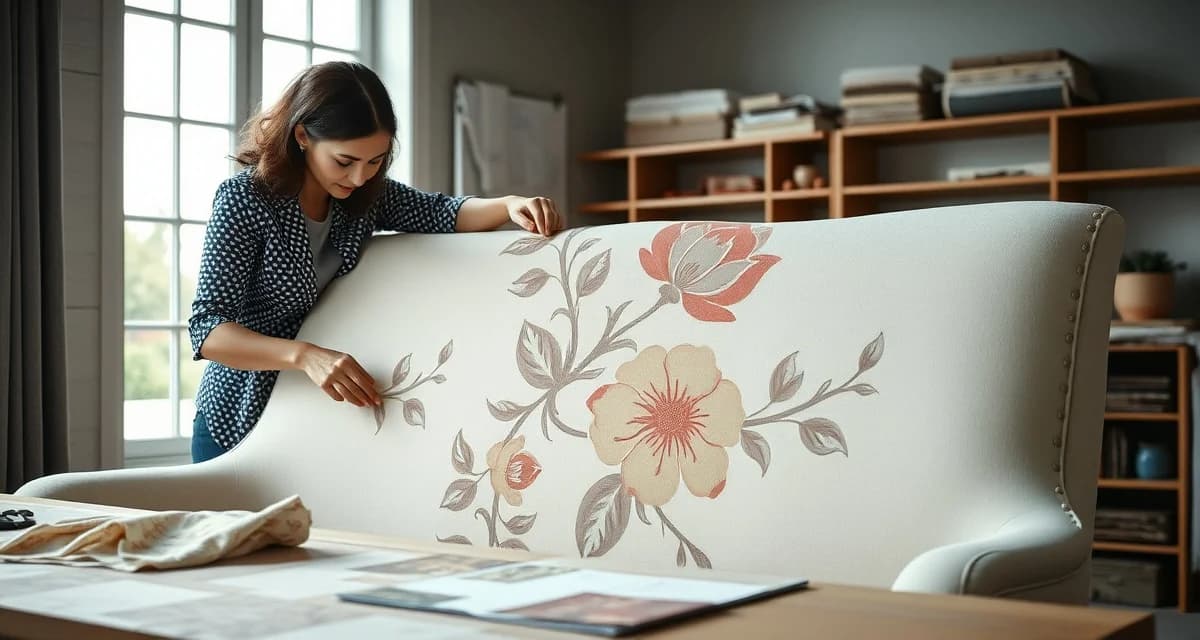
Florals in Upholstery: Large Scale Small Print and Centering Guide
Large-scale florals (18+ inch repeat) require centering on the sofa back. Not doing so looks accidental and unprofessional, the client's eye immediately finds the partial bloom at the edge, the motif cut at a seam, the feeling that the pattern was placed without intention.
Floral fabric is the most common patterned fabric in residential upholstery. It spans from small scatter prints where matching is unnecessary to large-scale chintz and botanical prints where centering and alignment are genuine technical challenges. Understanding which approach applies to each scale is what separates a professionally executed floral job from one that just has a floral fabric on it.
TL;DR
- Pattern repeat is the most common source of fabric waste and yardage underestimation in upholstery shops.
- Each cutting zone on a piece must start at the same point in the repeat, meaning waste accumulates across every panel.
- A 27-inch vertical repeat on a 3-cushion sofa can add 4-6 yards of fabric over the same sofa in plain fabric.
- Horizontal and vertical repeats must both be planned; a plaid or geometric with both adds more waste than a single-axis repeat.
- Pattern centering decisions (where the motif falls on the seat face) should be made at the quoting stage, not after cutting begins.
- Always quote pattern repeat work with a zone-by-zone calculation, not a flat percentage buffer.
Small Print Florals: When Matching Isn't Required
Small print florals have a repeat under 6 inches in any direction. The individual motifs are small enough that the eye reads the overall texture and color rather than individual flowers. A cut that's 2 inches off from a theoretically perfect position is indistinguishable from the correct position.
For small print florals, the handling approach is:
- No centering required on panels
- No matching required at seams
- Calculate yardage as solid fabric, no repeat premium
- Cut efficiently for minimum waste
The only consideration for small prints is grain direction: even a small floral should be cut on-grain so the overall pattern doesn't appear to lean.
Medium Print Florals: Centering Without Strict Matching
Medium print florals, with repeats in the 6-12 inch range, present a situation where centering matters but strict seam matching is often impractical or not visually necessary.
At this scale, the individual motifs are visible and the placement reads as intentional or accidental. A prominent bloom split by a seam, or a motif falling consistently off-center across all cushions, reads as a layout error.
The approach for medium prints:
- Center the primary motif horizontally on the outside back panel
- Cut cushion faces to place the dominant motif near the center of each face
- At visible seams (arm-to-back, cushion-to-cushion side borders), attempt matching but allow up to ½ inch tolerance
- Add 10-15% yardage for centering adjustments
Large-Scale Florals: Centering Is Non-Negotiable
Large-scale florals, repeat over 18 inches in any direction, which includes most chintz, botanical prints, and large tropical patterns, must be centered deliberately on every major panel.
At this scale, the individual motifs are large enough to create a clear visual focal point. Where that focal point lands on each panel is visible immediately to the observer. An 18-inch bloom that falls two-thirds of the way across the sofa back doesn't read as "the pattern", it reads as "someone didn't pay attention."
The centering principle: The most visually prominent motif (or the center of the repeat if there's no single dominant motif) should land at or very near the center of the most visible panel face.
Centering approach for large florals:
- Identify the primary motif or the visual center of the pattern repeat.
- Measure the panel width and mark the center.
- Position the primary motif at the panel center before cutting.
- Cut the outside back panel first with this centering.
- Calculate the vertical offset for each adjacent panel, maintaining the centering across seams where possible.
Aligning Floral Motifs Across Cushion Faces
For sofas with multiple cushions and a large-scale floral, the alignment across cushion faces is a design decision:
Option 1: Each cushion centered independently. Each cushion face is centered with its own placement of the dominant motif. This creates a symmetrical, balanced appearance on each individual cushion but may not create continuity across the assembled sofa.
Option 2: Continuous alignment across all cushions. The cushion faces are cut as if they were a continuous panel, so the floral pattern reads across all three (or more) cushions as one unbroken field of pattern. This is the more sophisticated approach and creates a sofa that reads as a whole rather than as individual cushions.
Option 2 requires careful cutting and significantly more yardage but produces a noticeably more professional result on large-scale florals.
Yardage Impact of Floral Patterns
The extra yardage required depends on the repeat size and the centering approach chosen:
| Floral Scale | Repeat Size | Extra Yardage (Standard Sofa) |
|---|---|---|
| Small print | Under 6 inches | None (treat as solid) |
| Medium print | 6-12 inches | 10-15% |
| Large scale | 12-18 inches | 20-30% |
| Very large scale | Over 18 inches | 25-40% |
For the largest-scale florals, where centering and inter-cushion continuity both apply, the yardage premium can approach 40% over a comparable solid fabric. This should be communicated to the client at quote time.
The floral pattern upholstery yardage calculator accepts your repeat dimensions and piece configuration for a precise estimate. See the pattern centering upholstery guide for the full centering workflow across all pattern types.
Pre-Sale Client Communication on Large Florals
When a client brings in a large-scale floral, two conversations need to happen before cutting:
1. The centering conversation. Show the client where you plan to center the primary motif on the sofa back. Let them see it on the fabric before committing. Some clients will have a different preference, catching that preference at this stage prevents a rework conversation later.
2. The yardage conversation. Explain the yardage premium in concrete terms. "This fabric has a large pattern repeat, which means we need approximately 20% more yardage than a solid fabric. Your quote includes [X yards] at $[Y/yard], rather than the [Z yards] a solid fabric would require."
Clients who understand why the yardage is higher before the job is done are rarely surprised by the cost.
Related Articles
FAQ
How do I center a large floral on a sofa?
Identify the primary motif or the visual center of the pattern repeat. Measure the width of the outside back panel and mark its center. Position the primary motif at that center on the fabric before cutting. The resulting panel has the dominant floral element centered visually. Cut this panel first, it becomes the reference for all subsequent panels. For multi-cushion sofas, decide before cutting whether each cushion face will be centered independently or whether the floral will run continuously across all cushion faces as one field of pattern. Both approaches are valid; the continuous approach is more demanding in yardage and execution but produces a more sophisticated result.
How much extra fabric does a large floral add?
A large-scale floral with a repeat over 18 inches typically adds 25-40% to the yardage requirement compared to a solid fabric for the same piece. The extra yardage is consumed by centering adjustments (moving the cut point to place the motif correctly) and by inter-cushion alignment (cutting each panel at the specific repeat position that maintains continuity). Medium print florals (6-12 inch repeat) require 10-15% extra. Small print florals (under 6 inch repeat) require no extra yardage. Always quote floral jobs with the actual required yardage, not the theoretical minimum coverage.
Do I need to match small floral prints across cushions?
No. For small print florals with a repeat under 6 inches, the individual motifs are too small to read as an alignment pattern from normal viewing distance. The eye reads the overall texture and color distribution rather than individual flower placements. A seam that's 2 inches off from a theoretically perfect match is invisible in a small print. Cut small print florals for efficiency rather than matching. No centering adjustment is required, and no pattern repeat premium applies to yardage. Treat small print floral the same way you'd treat a solid fabric for both cutting layout and yardage calculation.
What is the difference between horizontal and vertical pattern repeats?
A vertical repeat is the distance between the same motif measured vertically along the fabric. A horizontal repeat is the distance measured across the fabric width. Both affect yardage and cutting layout. A fabric with only a vertical repeat affects how panels stack on the fabric. A fabric with both vertical and horizontal repeats (like a plaid or grid) requires alignment in both directions, which further restricts layout options and increases waste.
Sources
- National Upholstery Association
- Association of Master Upholsterers and Soft Furnishers (AMUSF)
- Upholstered Furniture Action Council (UFAC)
- Furniture Today (trade publication)
Get Started with StitchDesk
Pattern repeat work is where fabric errors are most common and most costly. StitchDesk's yardage calculator handles pattern repeats zone by zone, not as a flat buffer, so your quotes for patterned fabric are accurate before the first cut. Start a free trial and eliminate the most expensive source of fabric waste in your shop.