Upholstery Corner Techniques: Knife Edge Waterfall and Rounded
Corners are where upholstery work either looks professional or gives itself away. They're the most visible detail on a finished piece, the hardest to fix after the fact, and the area where the correct technique is most dependent on furniture style. Waterfall pleats on knife-edge corners of contemporary furniture look unprofessional. The right approach there is the pull-and-tuck method. Understanding which technique goes with which corner style prevents most of the visible finishing mistakes in upholstery work.
That mismatch is one of the most common errors: using a traditional pleat on a modern piece, or using a pull-and-tuck on an antique with rounded feet. The corner technique should match the design language of the furniture. Getting that right is as important as the mechanical execution.
TL;DR
- This guide covers the specific techniques, measurements, and decisions that determine quality outcomes in upholstery work.
- Planning and preparation before cutting begins is the most reliable way to avoid costly errors on any upholstery job.
- Fabric selection, yardage calculation, and structural assessment are the three decisions that most affect the final result.
- Experienced upholsterers develop consistent workflows that ensure quality and efficiency across every job type they handle.
- Documenting job details, material specifications, and client approvals protects both the shop and the client.
- The right tools, materials, and techniques for each job type make a measurable difference in quality and profitability.
Corner Types in Upholstery
There are three main corner situations in upholstery, each requiring a different approach:
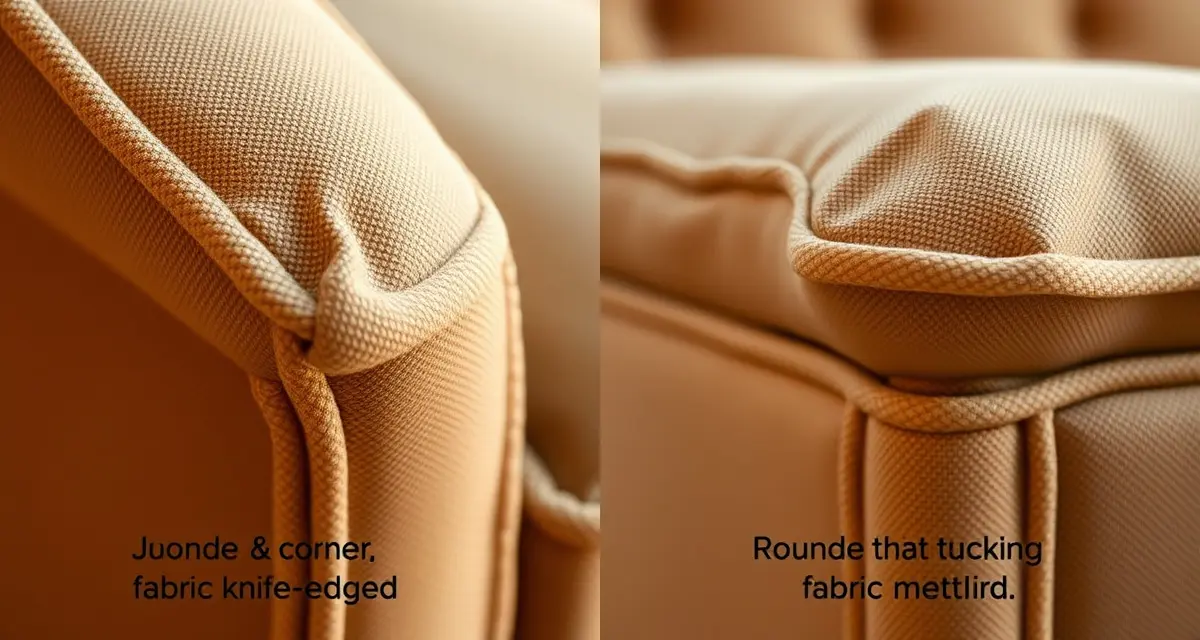
Knife-edge corners appear on square ottomans, contemporary sofas with straight lines, and any piece where the cushion or upholstered panel meets at a sharp 90-degree angle. The goal is a clean, crisp fold with no visible fabric excess.
Waterfall pleats are the traditional corner technique for rounded corners on traditional furniture styles. The fabric excess at the corner is folded into a single pleat that runs vertically, centered on the corner. This pleat is a deliberate design element on period pieces but looks out of place on modern ones.
Rounded corner wraps apply to furniture with curved corners. Barrel chairs, tub chairs, rolled arms, and any piece where the corner radius is significant. Here, the fabric is gathered or pleated continuously around the curve rather than folded at a single point.
Knife-Edge Corner: The Pull-and-Tuck Method
The pull-and-tuck technique is the correct approach for contemporary furniture with square, knife-edge corners. The goal is zero visible pleat, zero fabric bunching, and a sharp fold that reads as a clean line.
Step 1: Cut a diagonal notch. At the corner, cut a notch in the fabric from the corner point inward at a 45-degree angle. Cut to within 3/4 inch of the corner of the frame. This removes the fabric bulk that would otherwise stack up at the corner.
Step 2: Pull one side. Pull the fabric on one side of the corner taut and staple it down to the frame, stopping about 1 inch from the corner.
Step 3: Tuck the adjacent side. Fold the fabric on the other side so its raw edge tucks under the first side's fold. Press the fold with your thumb to create a sharp crease.
Step 4: Pull and staple. Holding the tuck in place with one hand, pull the entire corner taut and staple through both layers at the corner.
The result should be a clean mitered fold at the corner with no fabric stacking. If there's still bulk, your diagonal notch wasn't cut deep enough. Remove the staples, deepen the notch, and retry.
Waterfall Pleat: Traditional Corner Technique
Waterfall pleats are appropriate on traditional furniture: wingback chairs, Chesterfield sofas, Queen Anne pieces, and any design with period character. This technique intentionally creates a single centered fold at the corner.
Step 1: Find the center of the corner. Mark the midpoint of the corner with chalk. This is where the pleat will be centered.
Step 2: Pull the fabric straight. Pull the fabric directly outward from the center point and staple it at the top and bottom of the corner. This creates the foundation tension.
Step 3: Fold each side into the center. Bring the fabric on each side of the corner in toward the center mark, folding equal amounts on each side to create a pleat that meets at the center line.
Step 4: Staple the pleat. Hold the pleat folds down firmly and staple through all layers. The pleat should be centered and the two fold lines should be equal in width.
Trim any excess fabric from behind the pleat before pressing the corner down. Excess fabric behind a waterfall pleat creates a bump that's visible through the front face.
Rounded Corner Wrap
Rounded corners appear on barrel chairs, tub chairs, and sofas with curved front corners. The challenge here is distributing fabric evenly around the curve without creating irregular gathers or visible fabric lines.
The technique is similar to upholstering a curved edge: work from the center of the curve outward, pulling and stapling in small increments. Don't try to staple the whole curve in one pass.
Step 1: Mark the center of the curve. Find the apex of the curve and mark it. This is your starting point.
Step 2: Pull and staple at center. Pull the fabric at the center of the curve, apply moderate tension, and staple.
Step 3: Work outward in small increments. Move 1 to 2 inches to each side alternately, pulling and stapling. Keep the fabric taut but not distorted.
Step 4: Distribute pleats evenly if needed. If your fabric won't stretch around the curve without excess, create small evenly-spaced pleats on the back side of the corner. Evenly distributed pleats on the underside are invisible; one large pleat is visible through the face.
For more complex curved work like contemporary furniture reupholstery, the principles are the same but apply to larger curved surfaces.
Corner Technique for Square Ottomans
Square ottomans are the most common place the wrong corner technique appears. The client sees a flat, modern ottoman and the upholsterer defaults to a waterfall pleat. But the pleat looks bulky and period-inappropriate on a clean-lined modern piece.
For a square ottoman with knife-edge corners:
- Use the pull-and-tuck method at every corner.
- Make sure your notch cuts are identical at each corner. Inconsistent notches produce corners of different sizes.
- After stapling, run a regulator needle along the corner fold to sharpen the crease before the piece leaves the shop.
For more on the full reupholstery process, the sofa reupholstery guide covers corner work in the context of a complete job sequence.
Frequently Asked Questions
How do I do a knife edge corner in upholstery?
Cut a 45-degree notch in the fabric at the corner, stopping about 3/4 inch from the frame corner. Pull one side of the fabric taut and staple it to within 1 inch of the corner. Fold the adjacent side so its raw edge tucks under the first fold, creating a mitered crease. Pull the entire corner taut while holding the tuck in place, and staple through both layers. The result should be a sharp, clean fold with no visible bulk. If fabric is still stacking at the corner, deepen the notch and retry. That's almost always the cause of remaining bulk.
What is a waterfall corner in upholstery?
A waterfall pleat is a traditional corner technique where the fabric excess at a corner is folded into a single centered pleat. Pull the fabric straight out from the center of the corner and staple it. Then fold the fabric on each side inward toward the center line, creating two equal folds that meet at the midpoint. Staple through all layers. The resulting pleat runs vertically down the center of the corner. It's the correct technique for period furniture like wingback chairs and Chesterfield sofas, but it looks out of place on contemporary designs with clean square lines.
How do I get sharp corners on a square ottoman?
Use the pull-and-tuck method, not a waterfall pleat. Cut equal 45-degree notches at each corner. Pull one side taut and staple. Tuck the adjacent side under the first fold to create a mitered crease. Pull the corner tight and staple. After all four corners are done, run a regulator needle or bone folder along each corner fold to sharpen the crease. Inconsistent notch depth is the main cause of uneven corners. Measure and mark your notch depth before cutting if you want all four corners to look identical.
How do I get the best results from a professional upholsterer?
Come to the consultation with clear measurements, photos of the piece, and an idea of the room's color scheme and intended use. Be specific about how the piece will be used: high traffic, pets, children, or outdoor exposure all affect fabric recommendations. Provide fabric samples or accept guidance on appropriate options for your use case. Approve the proof carefully and ask to see the fabric on the piece before final installation if you are uncertain about a pattern or color choice.
Sources
- National Upholstery Association
- Association of Master Upholsterers and Soft Furnishers (AMUSF)
- Upholstered Furniture Action Council (UFAC)
- Furniture Today (trade publication)
Get Started with StitchDesk
Running a successful upholstery shop means getting the details right on every job. StitchDesk gives you purpose-built tools for quoting, fabric calculation, job tracking, and client communication, all in one place designed specifically for the trade. Start a free trial and see how StitchDesk supports quality work from intake to delivery.