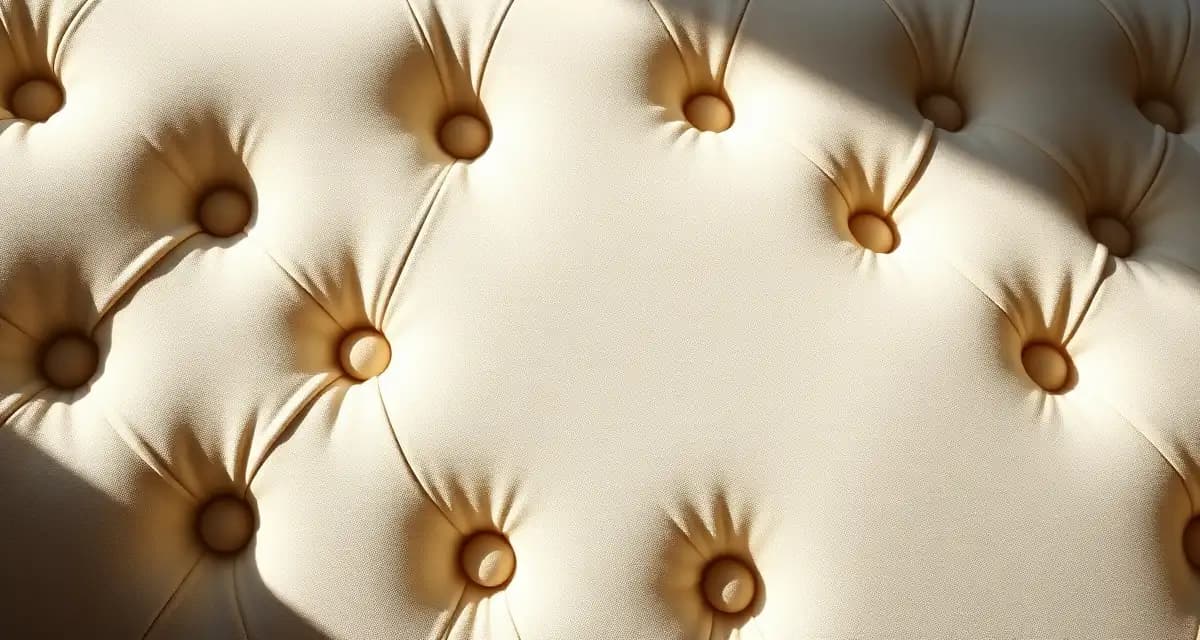
Fabric Yardage for Tufted Upholstery: Button Placement and Pull Waste
Diamond tufting on a sofa back adds 2–3 yards of fabric compared to flat upholstery. Most upholsterers know tufting uses more fabric. The problem is most don't know how much more, and that guess-based buffer consistently falls short.
Button pull waste is the fabric consumed when a button draws the surface down and creates the characteristic diamond or square depression. That pulled fabric has to come from somewhere. It comes from the yardage. If you didn't account for it before cutting, you run short.
This guide breaks down how to calculate button pull waste by button density, why diamond and square grid patterns compound differently, and how to build an accurate yardage estimate for any tufted piece.
TL;DR
- Upholstery For Tufting yardage depends on fabric width, construction details, pattern repeat, and nap direction.
- Plain 54-inch fabric requires a baseline calculation plus 10-15% waste allowance for a standard upholstery for tufting job.
- Patterned fabric adds 20-35% to base yardage depending on repeat size and the number of cutting zones that must align.
- Directional fabrics add 15-25% over plain fabric because layout optimization is restricted by nap direction.
- Always verify fabric width before finalizing yardage; COM fabric often comes in non-standard widths.
- Calculating yardage at the quote stage, not mid-job, eliminates reorders and protects your profit margin.
Why Tufted Yardage Is Consistently Underestimated
Flat upholstery is a straightforward panel calculation. You measure the surface, add seam allowances, order accordingly. Tufted upholstery has an additional variable that most simple calculators skip: the fabric consumed by the tufts themselves.
When a button pulls fabric down into the foam, the fabric around that button has to travel. The gathered folds radiating from each button are not flat fabric, they're extra length and width that has to be pre-cut into the panel. A panel that covers 30 × 24 inches on a flat surface needs to be cut larger to cover the same area tufted, because part of the panel disappears into the tufts.
The amount consumed per button depends on:
- The depth of the tuft (how far down the button pulls)
- The tension setting (tighter pull = more fabric consumed)
- The fabric type (some fabrics pucker more at the gather points)
- The button spacing (how many inches between buttons)
On average, button pull adds 10–20% to base panel yardage. Diamond tufting tends toward the 15–20% range because the diamond orientation puts more panel width into the gathered folds. Square grid tufting runs closer to 10–15%.
Button Density: How Rows and Columns Compound
The more buttons you add, the more fabric each button consumes, and the compound effect is nonlinear. This is the part most upholsterers underestimate.
A Simple Example
Consider a sofa back panel, 48 inches wide × 28 inches tall:
Flat (no tufting): Panel cut at 49 × 29 inches = approximately 1.0 yard on 54-inch fabric.
3 × 3 button grid (9 buttons): Each button pulls approximately 1.5 inches of extra fabric in each direction. With 9 buttons, the panel needs to be cut at 53 × 32 inches to account for pull. That's 1.1 yards, about 10% more.
4 × 4 button grid (16 buttons): Pull adds up more considerably with closer spacing. Panel needs approximately 57 × 35 inches. You're now into two widths on 54-inch fabric. Yardage: roughly 1.4 yards for this panel alone, a 40% increase over flat.
5 × 5 button grid (25 buttons): At this density, buttons are close enough that adjacent pulls interact. The compound pull across the surface is notable. Panel cut requirement approaches 63 × 39 inches. Yardage: over 1.6 yards, 60% more than flat.
That progression from 3 × 3 to 5 × 5 isn't linear. Adding more buttons in a grid doesn't just add proportionally more pull, each button affects the fabric around adjacent buttons, amplifying the effect.
Diamond vs Square Grid
Diamond tufting places buttons in a rotated grid pattern. The diamonds point to the corners of the panel. This orientation puts the button tension along the bias of the fabric arrangement, which actually requires slightly more fabric per button than a square grid, because the gathered folds are larger at the diamond points.
Expect diamond tufting to add about 5 percentage points more yardage than the equivalent square grid. A 4 × 4 square grid might add 35–40%. A 4 × 4 diamond equivalent adds 40–45%.
Calculating Tufting Waste: The Working Formula
Here's the formula professionals use:
Tufted panel width = Flat panel width + (number of button columns × pull factor)
Tufted panel height = Flat panel height + (number of button rows × pull factor)
The pull factor per button depends on depth:
- Shallow tufting (1–1.5 inch depth): 1.25 inches per button
- Medium tufting (1.5–2 inch depth): 1.5 inches per button
- Deep tufting (2–3 inch depth): 2 inches per button
For a Chesterfield sofa back with deep tufting in a 5 × 4 grid:
- Flat panel: 90 × 32 inches
- Columns: 5 × 2 inches = 10 extra inches of width
- Rows: 4 × 2 inches = 8 extra inches of height
- Tufted panel needed: 100 × 40 inches
At 100 × 40 inches, you need two widths of 54-inch fabric. That's approximately 2.25 yards for this single panel, vs 1.6 yards flat. The tufting added 0.65 yards just on the back panel.
Over a full sofa with tufted seat, back, and arm scrolls, the compound effect reaches 2–3 extra yards total.
Tufted Headboard Yardage
Headboards are the most common tufted piece after sofas. The fabric yardage calculator for headboards handles tufting calculations, but here's the manual method:
For a queen diamond-tufted headboard (60 × 36 inches flat):
- Typical button grid: 5 × 3 diamonds
- Medium tufting depth: 1.5 inches per button
- Width: 60 + (5 × 1.5) = 67.5 inches
- Height: 36 + (3 × 1.5) = 40.5 inches
Panel needed: 68 × 41 inches. At 54-inch fabric, this is 1.3 yards. A flat headboard the same size is 0.85 yards. The tufting adds about 0.45 yards.
For a king diamond-tufted headboard with a 6 × 4 grid and deep tufting:
- Width: 76 + (6 × 2) = 88 inches
- Height: 40 + (4 × 2) = 48 inches
You need a 88 × 48-inch panel, wider than most 54-inch fabric, requiring either railroading (if the fabric allows), piecing, or switching to wider fabric.
Yardage by Tufted Piece Type
Here's a practical quick-reference for common tufted pieces:
| Piece | Flat Yardage | Added for Tufting | Tufted Total |
|---|---|---|---|
| Dining chair back (4×3 grid) | 0.4 yd | 0.1 yd | 0.5 yd |
| Accent chair back (3×3 grid) | 0.6 yd | 0.15 yd | 0.75 yd |
| Twin headboard (4×3 grid) | 0.7 yd | 0.2 yd | 0.9 yd |
| Queen headboard (5×3 grid) | 0.85 yd | 0.45 yd | 1.3 yd |
| King headboard (6×4 grid) | 1.1 yd | 0.7 yd | 1.8 yd |
| Sofa back, light tufting (4×3) | 1.6 yd | 0.5 yd | 2.1 yd |
| Sofa back, deep tufting (5×4) | 1.6 yd | 1.0 yd | 2.6 yd |
| Chesterfield sofa (full) | 12 yd | 3.0 yd | 15 yd |
These are estimates at medium fabric width and standard piece sizes. Always calculate from your actual panel measurements.
For pattern centering on tufted fabric, you have an additional variable: the button placement interacts with the pattern repeat. Visit the pattern centering guide before cutting patterned tufted pieces.
Fabric Choice for Tufting
Some fabrics tuft more easily than others. Here's what matters:
Velvets and chenilles: Gather beautifully at the tuft point. The pile fills in the fold, making for clean diamond faces. They do require more pull depth to get the tuft to hold, which increases yardage consumption.
Linen and cotton weaves: Tuft cleanly but need to be pre-marked carefully. The structure holds the tuft point well without stretching.
Performance fabrics: Many don't tuft well, the coatings resist the button pull and the tuft points don't create clean folds. Check before committing a performance fabric to a tufted design.
Leather: Can be tufted with proper preparation and deep button attachment through the hide. Yardage calculation follows the same rules but factor in that leather panels can't be eased, the pull has to be exact.
FAQ
How much extra fabric does tufting require?
Button tufting adds 10–20% to base panel yardage on average. Light tufting (3 × 3 grid, shallow depth) adds closer to 10%. Deep tufting (5 × 5 grid, 2-inch depth) adds 20% or more. On a standard three-cushion sofa with full-back tufting, this translates to 2–3 extra yards over the same sofa in flat upholstery.
How do I calculate yardage for a diamond-tufted sofa?
Start with your flat panel dimensions. Add the pull factor per button (1.25–2 inches depending on depth) multiplied by the number of buttons per row and per column. Recalculate the required panel size using those expanded dimensions, then convert back to yardage based on your fabric width. For a Chesterfield-style sofa with deep tufting across back, arms, and seat scrolls, budget 14–16 yards total.
Does tufting pattern affect fabric yardage?
Yes. Diamond tufting uses slightly more fabric than square grid tufting at the same button count because the diagonal orientation increases the gathered fold size at each tuft point. Expect diamond tufting to add 5 percentage points more than the equivalent square grid. Pattern-repeat fabrics add another layer: the pattern must be centered on each diamond face, which can require additional yardage to align the repeat correctly across the grid.
What is the biggest factor in yardage variation for this piece?
Pattern repeat is the biggest source of yardage variation. On plain fabric, the baseline calculation plus a 10-15% waste buffer is usually sufficient. Add a 13-inch pattern repeat and you may need 15-20% more. Add a 27-inch pattern repeat and the additional yardage can be 25-35% over the plain fabric calculation. Nap direction is the second-largest factor, typically adding 15-25% over plain fabric because layout optimization is restricted.
What should I do if I run short on fabric mid-job?
Stop cutting immediately when you realize you may run short. Calculate exactly how much additional fabric you need before contacting the supplier or client. If reordering from the same dye lot is possible, do so as quickly as possible because dye lots change. If a dye lot match is not available, contact the client before proceeding; visible dye lot differences on the same piece are unacceptable and must be disclosed. Document the situation and response in writing.
Sources
- National Upholstery Association
- Association of Master Upholsterers and Soft Furnishers (AMUSF)
- Upholstered Furniture Action Council (UFAC)
- Furniture Today (trade publication)
Get Started with StitchDesk
Getting yardage right on upholstery for tufting jobs is the difference between a profitable quote and an expensive reorder. StitchDesk's fabric calculator accounts for all the variables that cause errors: pattern repeat by zone, nap direction, fabric width, and cushion configuration. Start a free trial and see how accurate yardage calculation affects your bottom line.