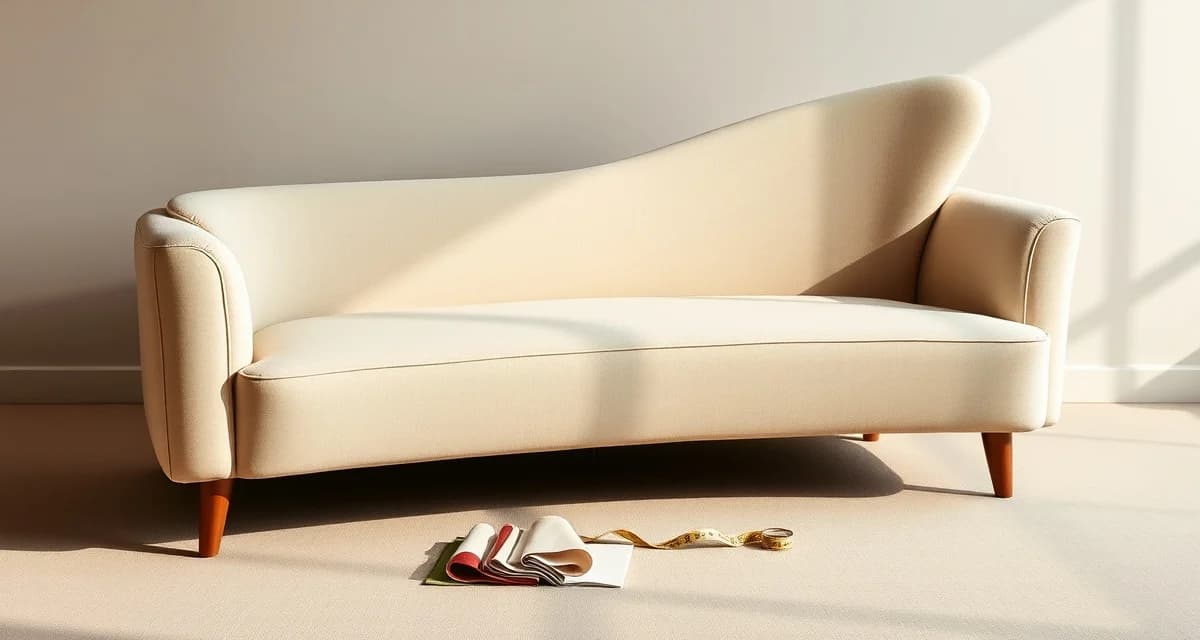
Fainting Couch Fabric Yardage Calculator: Curved Silhouette Guide
The fainting couch, or recamier, if you want the proper term, is one of those pieces that looks like it should be straightforward until you actually start calculating the yardage. The asymmetrical silhouette, the curved back that rises on one end only, and the lack of conventional seat cushions all combine to make this a genuinely unusual calculation.
And then there's the asymmetry. A left-raise and a right-raise fainting couch need different cutting layouts. They're not mirror images you can achieve by flipping your cut, the fabric has a right side and a wrong side, so what works for a left-raise version creates problems on a right-raise.
TL;DR
- Fainting Couch yardage depends on fabric width, construction details, pattern repeat, and nap direction.
- Plain 54-inch fabric requires a baseline calculation plus 10-15% waste allowance for a standard fainting couch job.
- Patterned fabric adds 20-35% to base yardage depending on repeat size and the number of cutting zones that must align.
- Directional fabrics add 15-25% over plain fabric because layout optimization is restricted by nap direction.
- Always verify fabric width before finalizing yardage; COM fabric often comes in non-standard widths.
- Calculating yardage at the quote stage, not mid-job, eliminates reorders and protects your profit margin.
What Is a Fainting Couch (Recamier)?
The recamier takes its name from a famous portrait of Juliette Récamier painted in 1800. It's a daybed-style chaise with a raised headrest on one end and either a lower footrest on the other or an open end with no back support.
Key characteristics:
- One raised end: The head end has a curved, scrolled back or armrest that rises to 18 to 36 inches above the seat
- Asymmetrical silhouette: Not left-right symmetric, one end is higher than the other
- Long, flat seating area: The seat is essentially a chaise surface, not a cushioned sofa seat
- Curved back/arm elements: The raised end curves inward or scrolls in ways that require shaped cutting
The "fainting couch" label applies to both Victorian recamiers with their ornate carved frames and modern upholstered versions with clean curves. Both present similar calculation challenges.
Why Standard Chaise Calculations Are Wrong
A chaise lounge is long and has one raised end. Seems close to a fainting couch. The difference is that a standard chaise typically has a straight or gently curved back at the raised end that runs parallel to the long axis. The fainting couch's raised end curves perpendicular to the seating surface, it's not a back that runs alongside you; it's an armrest that rises above your head.
That curved perpendicular element changes several panels. The "inside back" of a fainting couch is really the inside of the curved scrolled headrest, which is a completely different shape from a standard back panel. The outside of that curve is another unique panel. And the transition from the headrest to the flat seat surface creates a seam at an angle that doesn't exist in chaise construction.
Left-Raise vs Right-Raise: Why It Matters for Cutting
When you look at a fainting couch from the front, the raised headrest is on either the left or the right side. This is the left-raise or right-raise designation.
For yardage purposes, the total amount of fabric needed is the same for both. But the cutting layout is different.
On a directional fabric (velvet, pile, or patterned), the raised end's curved panels need to be oriented with the fabric grain and pile direction consistent with the rest of the piece. A left-raise piece has the curved headrest panels cut with grain running one direction relative to the seating panels. Flip the piece to a right-raise and the equivalent panels are mirrored, but since fabric has a right and wrong side, you can't simply flip your pattern piece, you have to cut it anew.
For solid, non-directional fabrics this is a minor concern. For velvet or patterned fabric, it's a notable planning consideration that affects how you lay out your cuts.
Fainting Couch Panel Breakdown
Raised end (headrest/scroll):
- Inside curved face (the surface against which the head/shoulder rests)
- Outside curved face (visible exterior of the raised end)
- Top cap of the scroll (if present)
- Arm/headrest transition panel
Flat seating surface:
- Seat face (long panel covering the seating deck)
- Side panel, raised end side (shorter, connecting headrest to seat)
- Side panel, open end side (longer, or absent if the end is open)
Base/skirt:
- Front base panel (long, visible front apron)
- Back panel (either full upholstery or partial cover depending on wall placement)
- Base sides (if the piece has an enclosed base)
Legs: Typically exposed wood on period pieces. Modern upholstered versions may have wrapped legs.
Fainting Couch Yardage Reference
Solid 54-inch fabric:
Victorian/period fainting couch (exposed wood frame elements): 5 to 8 yards
Modern fully upholstered fainting couch: 8 to 12 yards
Modern fainting couch with back panel tufting: 10 to 14 yards
The range is wide because the overall length varies considerably (from 60 to 84 inches long) and the degree of frame exposure changes what needs to be covered.
Calculating the Curved Headrest Panels
The curved headrest is the most technically demanding part of the calculation. Here's the approach:
Step 1: Template the curved surfaces. Pull existing covering or create paper templates directly from the foam/frame. The inside curve and outside curve are mirror images in shape but need to be cut separately (not flipped).
Step 2: Find the maximum dimensions of each template. Measure the widest and tallest dimensions of each curved panel template.
Step 3: Calculate the rectangular yardage for each panel. The rectangle that contains your curved template represents the fabric you need, even though some of it becomes waste.
Step 4: Estimate shape waste. For a moderately curved scroll, waste is typically 20 to 30% of the containing rectangle. For a dramatic high scroll, waste can be 35 to 40%.
Step 5: Apply the curve waste percentage. Multiply your rectangular yardage by 1.25 to 1.35 to get the actual yardage for the curved panels.
Asymmetrical Cutting Layout Planning
Because the fainting couch is asymmetrical, you can't rely on mirror-image cutting efficiency that sometimes helps with symmetrical pieces. Each shaped panel needs its own containing rectangle.
Plan your cut layout before ordering by sketching out all the panel shapes on graph paper scaled to your fabric width. Start with the largest panels (seat face, back panel) and fit smaller panels in the remaining spaces. The shaped headrest panels often fit alongside the long seat panels in the leftover width space.
Planned cutting layout is especially important on patterned fainting couches, the asymmetry means pattern centering decisions for the headrest inside face, seat face, and back panel are all independent and need to be resolved before cutting.
Fabric Recommendations for Fainting Couches
Velvet is the most traditionally appropriate choice for period fainting couches. The lush pile suits the ornate silhouette. Pile direction should run down on the seat and toward the viewer on the raised end facing panel.
Brocade and damask for Victorian-era pieces. The pattern centering decisions are complex on the asymmetrical shape but look spectacular when done well.
Leather or faux leather for modern versions. The clean curves of a contemporary fainting couch pair well with the smooth surface of leather.
Performance fabrics in statement colors (dusty rose, sapphire, emerald) are popular for modern decorative fainting couches used as bedroom accent pieces.
Using the Chaise Fabric Yardage Calculator
The chaise calculator provides a useful baseline for the seat length and side panels of a fainting couch. For the curved headrest panels, add your templated measurements manually. The Chaise Yardage Guide covers chaise and chaise-adjacent pieces with more detail on asymmetrical measurement.
How many yards for a fainting couch?
A fully upholstered modern fainting couch needs 8 to 12 yards of 54-inch solid fabric. A Victorian-style piece with some exposed wood frame elements needs 5 to 8 yards. Tufted versions add 1.5 to 3 yards over the base calculation.
How do I calculate fabric for an asymmetrical piece?
Template every curved surface separately. Don't assume you can flip a pattern piece, fabric has a right side and wrong side. Calculate each panel's yardage by finding the containing rectangle for its template shape and adding the appropriate waste percentage for the curved cutout. Plan your cutting layout on paper before ordering.
What fabric is best for a fainting couch?
For period and decorative pieces, velvet and brocade are most appropriate. For modern bedroom accent pieces, bold solid colors in performance fabric or boucle are popular choices. Leather works well for contemporary lounge-style fainting couches. Avoid loosely woven fabrics that may stretch or distort over the curved headrest structure.
What is the biggest factor in yardage variation for this piece?
Pattern repeat is the biggest source of yardage variation. On plain fabric, the baseline calculation plus a 10-15% waste buffer is usually sufficient. Add a 13-inch pattern repeat and you may need 15-20% more. Add a 27-inch pattern repeat and the additional yardage can be 25-35% over the plain fabric calculation. Nap direction is the second-largest factor, typically adding 15-25% over plain fabric because layout optimization is restricted.
FAQ
Sources
- National Upholstery Association
- Association of Master Upholsterers and Soft Furnishers (AMUSF)
- Upholstered Furniture Action Council (UFAC)
- Furniture Today (trade publication)
Get Started with StitchDesk
Getting yardage right on yardage fainting couch jobs is the difference between a profitable quote and an expensive reorder. StitchDesk's fabric calculator accounts for all the variables that cause errors: pattern repeat by zone, nap direction, fabric width, and cushion configuration. Start a free trial and see how accurate yardage calculation affects your bottom line.