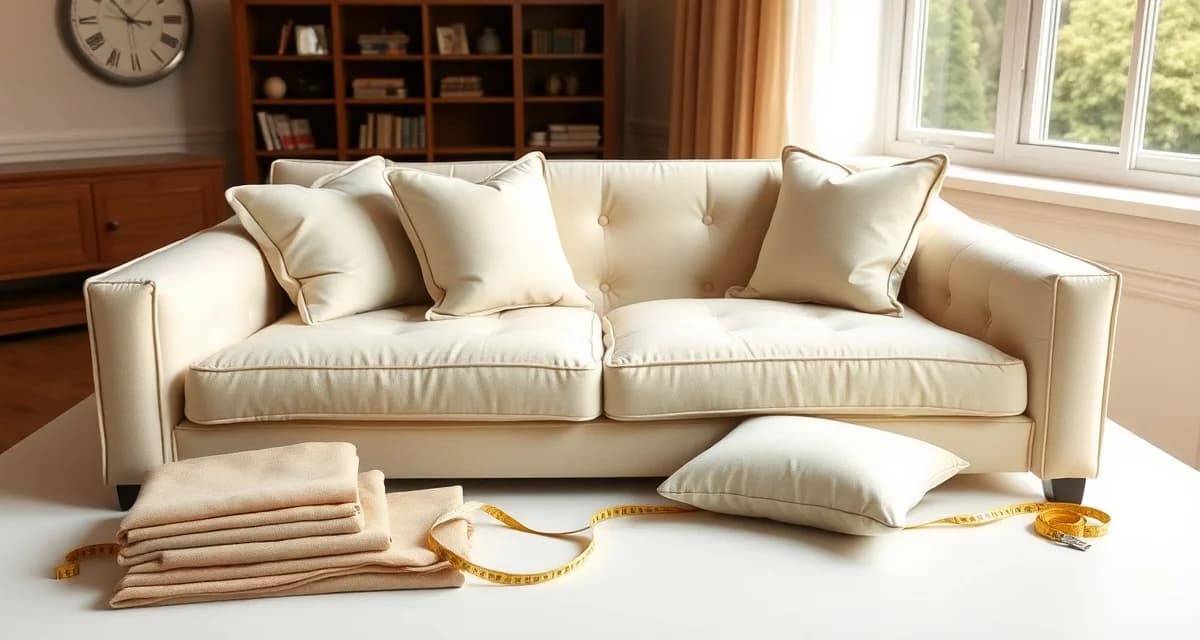
Settee Cushion Fabric Yardage: Seat and Back Cushion Planning
Settee back cushions are often bolster-style, which is a completely different yardage calculation than square back cushions. Most calculators and templates default to treating settee backs like a scaled-down loveseat, which produces wrong numbers for any traditional settee with cylindrical bolster backs. Getting this right before you order saves a return trip to the supplier.
TL;DR
- For Settee Cushions yardage depends on fabric width, construction details, pattern repeat, and nap direction.
- Plain 54-inch fabric requires a baseline calculation plus 10-15% waste allowance for a standard for settee cushions job.
- Patterned fabric adds 20-35% to base yardage depending on repeat size and the number of cutting zones that must align.
- Directional fabrics add 15-25% over plain fabric because layout optimization is restricted by nap direction.
- Always verify fabric width before finalizing yardage; COM fabric often comes in non-standard widths.
- Calculating yardage at the quote stage, not mid-job, eliminates reorders and protects your profit margin.
What Makes Settee Cushion Yardage Different
A settee sits between a loveseat and a bench in scale. Standard seating depth is 18-22 inches, width is 44-60 inches, and it typically seats two. The cushion configurations vary more than they do for standard sofas.
Tight-seat, tight-back settee: No separate cushions at all. Calculate as upholstered panels, not cushions. The yardage approach here is similar to a small sofa.
Loose seat cushions, tight back: Seat cushions are loose and fabric-covered; the back is upholstered directly. Calculate seat cushions separately (top, bottom, boxing strip, zipper flap) and back panel as a flat zone.
Loose seat and loose back cushions: Most common on transitional and contemporary settees. Seat cushions are similar to sofa seat cushions. Back cushions may be square, T-shaped, or bolster, depending on style.
Traditional settee with bolster backs: Bolster back cushions are cylindrical. They sit at each arm end of the settee. These require considerably different yardage calculation than square back cushions of the same apparent size.
Calculating Seat Cushion Yardage
Measure each seat cushion's width, depth, and height (thickness). A standard settee seat cushion is approximately 20-24 inches deep, 22-28 inches wide, and 4-6 inches thick.
For each seat cushion, calculate:
- Top panel: cushion width + 1 inch (seam allowance) x cushion depth + 1 inch
- Bottom panel: same as top
- Boxing strip: perimeter of cushion x boxing height (thickness), divided by fabric width for yardage
- Zipper flap: back edge of cushion perimeter x boxing height x 2 (for flap and extension)
Example for a 24x22x5 inch seat cushion:
- Top/bottom panels: 25 x 23 inches each
- Boxing strip: perimeter (2x24 + 2x22 = 92 inches) x 5 inches = 460 square inches
- At 54-inch fabric, boxing strip = 8.5 linear inches of fabric per panel run
Total per seat cushion at 54-inch fabric: approximately 0.75-0.9 yards including seam allowance.
For a settee with 2 seat cushions: 1.5-1.8 yards for seats.
Calculating Square Back Cushion Yardage
Square or rectangular back cushions on a settee are typically smaller than seat cushions (15-18 inches high, 20-24 inches wide, 3-5 inches thick). Calculate the same way as seat cushions:
- Top/bottom panels
- Boxing strip
- Zipper or back-panel closure
For a 22x16x4 back cushion:
- Top/bottom panels: 23 x 17 inches each
- Boxing strip: perimeter 76 inches x 4 inch height
Total per back cushion: approximately 0.6-0.75 yards.
For a settee with 2 square back cushions: 1.2-1.5 yards.
Calculating Bolster Back Cushion Yardage
Bolster cushions are the calculation that trips up standard templates. A bolster is cylindrical, with:
- A main body panel (the tube of the cylinder)
- Two circular or dome-shaped end caps
Main body panel: Circumference of the bolster x length.
- Circumference = pi x diameter (approximately 3.14 x 6 inches for a typical 6-inch bolster = 18.85 inches)
- For an 18-inch-long bolster at 18.85 inch circumference: 18.85 x 18 inches = 339 square inches
End caps: Each end cap is a circle of the bolster diameter.
- For a 6-inch diameter bolster: each end cap is a 7-inch circle (6-inch diameter + 1-inch total seam allowance)
- Two end caps per bolster
For a settee with two 18-inch bolsters:
- Each bolster main body: 1 yard of 54-inch fabric (body wraps around with seam)
- End caps: 4 circles at 7 inches each
Total for 2 bolsters: approximately 2-2.5 yards including seam allowance.
Compare this to 2 square back cushions at 1.2-1.5 yards, the bolsters use nearly twice the fabric. This is the yardage error that matters for traditional settee jobs.
Using the Calculators
The loveseat fabric yardage calculator can be used for settee seat cushions if you input the actual settee cushion dimensions rather than loveseat defaults. For bolster back cushions, use the cushion calculator with cylinder mode or calculate manually as described above.
The settee reupholstery guide covers technique decisions for different settee styles once your yardage is sorted.
Frequently Asked Questions
How much fabric for settee cushions?
A settee with 2 loose seat cushions and 2 square back cushions typically requires 2.75-3.5 yards of fabric total for cushions only (not frame upholstery). A settee with bolster-style back cushions instead of square backs requires approximately 3.5-4.5 yards, because bolster construction uses more fabric per unit than square cushions of equivalent apparent size. Always calculate each cushion type separately rather than using a generic loveseat or bench cushion estimate.
Do settee back cushions use the same fabric as seat cushions?
They can use the same fabric for a coordinated look, and most settees are done this way. However, the back cushions experience less wear and compression than seat cushions, so some upholstery clients choose a more delicate or decorative fabric for backs while using a more durable fabric on seats. Yardage for each zone should still be calculated separately even if the same fabric is ordered.
What fabric is best for a settee?
The right fabric depends on the settee's style and use. Traditional Victorian settees look best in damask, brocade, or velvet, which are period-appropriate. Contemporary settees suit performance fabrics, linen blends, or solid-color synthetics. For heavily used settees, a performance fabric with 25,000+ Wyzenbeek rub count handles wear better. For occasional settees or decorative pieces, softer fabrics like velvet or linen are appropriate. Seat cushions warrant a more durable fabric than back cushions in any style.
What is the biggest factor in yardage variation for this piece?
Pattern repeat is the biggest source of yardage variation. On plain fabric, the baseline calculation plus a 10-15% waste buffer is usually sufficient. Add a 13-inch pattern repeat and you may need 15-20% more. Add a 27-inch pattern repeat and the additional yardage can be 25-35% over the plain fabric calculation. Nap direction is the second-largest factor, typically adding 15-25% over plain fabric because layout optimization is restricted.
Sources
- National Upholstery Association
- Association of Master Upholsterers and Soft Furnishers (AMUSF)
- Upholstered Furniture Action Council (UFAC)
- Furniture Today (trade publication)
Get Started with StitchDesk
Getting yardage right on yardage for settee cushions jobs is the difference between a profitable quote and an expensive reorder. StitchDesk's fabric calculator accounts for all the variables that cause errors: pattern repeat by zone, nap direction, fabric width, and cushion configuration. Start a free trial and see how accurate yardage calculation affects your bottom line.