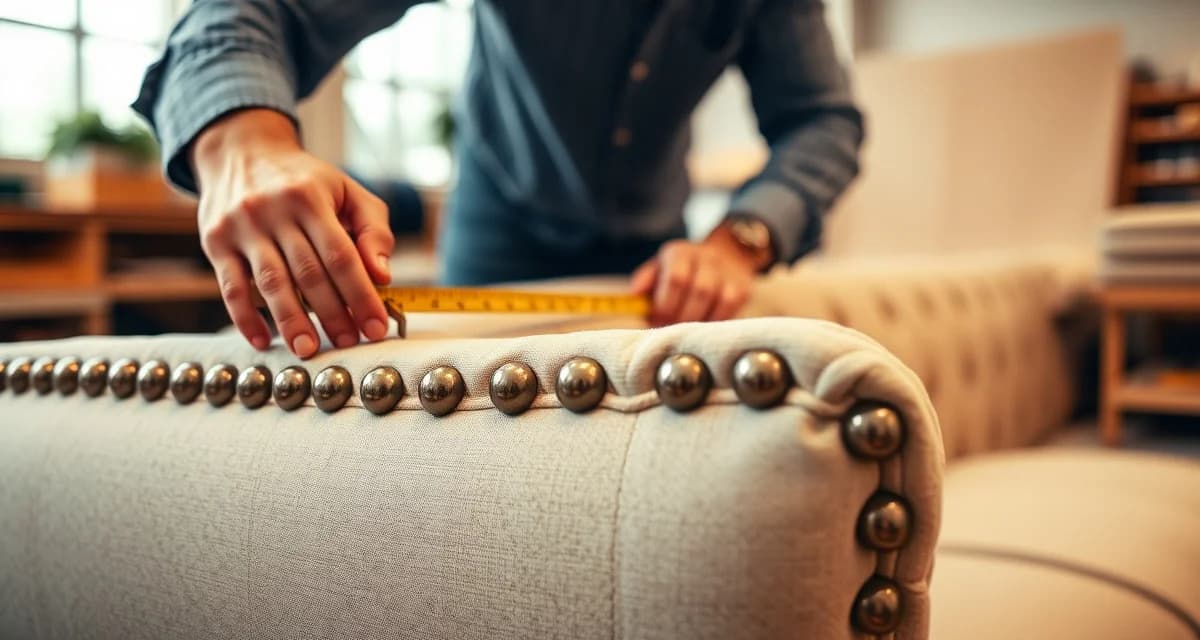
Sofa with Nailhead Trim Fabric Yardage: Edge vs Border Nailhead
Border nailhead sofas require 0.5 to 0.75 yards more fabric than the same sofa with edge nailhead, because the deeper tuck depth needed at the nail line adds material that standard yardage templates never account for. If you're quoting a nailhead sofa off a standard calculator, you're likely under-ordering fabric on every border nailhead job.
This guide breaks down the difference between nailhead styles, how each affects yardage, and how to calculate accurately before you order.
TL;DR
- Sofa With Nailhead yardage depends on fabric width, construction details, pattern repeat, and nap direction.
- Plain 54-inch fabric requires a baseline calculation plus 10-15% waste allowance for a standard sofa with nailhead job.
- Patterned fabric adds 20-35% to base yardage depending on repeat size and the number of cutting zones that must align.
- Directional fabrics add 15-25% over plain fabric because layout optimization is restricted by nap direction.
- Always verify fabric width before finalizing yardage; COM fabric often comes in non-standard widths.
- Calculating yardage at the quote stage, not mid-job, eliminates reorders and protects your profit margin.
Nailhead Trim Styles and What They Mean for Fabric
Edge nailhead (also called border tack): Nails are applied along the fabric edge where fabric meets the frame or a seam. The nail head sits at the boundary between the fabric cover and the wood frame. The fabric tuck behind this style of nail is minimal, typically 1/4 to 3/8 inch.
Decorative border nailhead: A row or double row of nails applied as a design element across the face of the upholstered panel, not at an edge. These nails are set 1-2 inches in from the panel perimeter. The fabric must fold back behind the nail line and tuck into the frame, which requires 1-2 inches of additional fabric beyond what the panel dimension alone would suggest.
Decorative panel nailhead: Nails arranged in geometric patterns on panel faces. Each panel needs fabric sized to accommodate the full nail pattern plus the tuck behind the outermost nails.
Why Border Nailhead Adds Yardage
With edge nailhead, the fabric edge is tacked tight to the frame with the nail finishing the edge. There's no additional fabric depth required behind the nail because the nail sits at the fabric termination point.
With border nailhead, the nail is set on the face of the panel, not at the edge. The fabric behind the nail has to continue past the nail line, fold back, and be secured inside the frame or beneath an adjoining panel. That fold requires 1 to 1.5 inches of additional fabric on each panel edge where border nails appear.
On a standard sofa:
- Outside back panel: 2 sides with border nails = 2-3 inches additional fabric width needed
- Inside back: often nailed at arm junctions = additional fabric at both sides
- Outside arms: nailed at front border = additional fabric at front edge of each arm
Run those additions across all affected panels and you're looking at 0.5-0.75 yards of additional fabric that disappears into the frame tuck.
Calculating Nailhead Sofa Yardage: Step by Step
Step 1: Identify which panels have border nails.
Walk through the piece mentally or from a photo. Mark every panel where nails will be set away from the frame edge. This is typically the outside back, outside arms, and sometimes the front apron and cushion boxing.
Step 2: Add tuck depth to each affected dimension.
For each border-nailed panel, add 1.5 inches to the measurement on any side where nails are set away from the edge. For a double-row border nailhead, add 2 inches.
Step 3: Calculate yardage from adjusted dimensions.
Use the modified panel dimensions in your yardage calculator. The increase will look small per panel but sums to 0.5-0.75 yards across the full sofa.
Step 4: Add welt cord yardage if applicable.
Many nailhead sofas combine nailhead trim with welt cord at seams. Calculate welt cord yardage separately. A full sofa typically requires 15-25 yards of piping.
Fabric Selection for Nailhead Work
Not every fabric works well with nailhead trim. A few considerations:
Avoid thick napped fabrics. Velvet, chenille, and heavy boucle compress unevenly under nailhead installation, creating visible depressions around each nail. If the client wants velvet with nailheads, discuss this limitation before you start.
Tight weaves hold nailheads better. Linen, cotton canvas, and tight synthetic weaves grip the nail shank better and don't fray or distort at the nail penetration point. Loose weaves can distort visibly with applied nailheads.
Pattern placement for nailhead panels. If the fabric has a pattern and the client wants a decorative panel of nailheads, the pattern and nail pattern need to be coordinated. This can add further to yardage if the cut position is dictated by pattern alignment rather than pure efficiency.
Common Nailhead Yardage Mistakes
The most common error is using a standard sofa template and simply not adding anything for nailhead. The thinking is "it's just tacks, the fabric dimensions are the same." For edge nailhead, that's mostly true. For border nailhead, it's wrong.
The second most common error is forgetting the welt cord fabric when the sofa combines nailhead with welted seams. These are two separate additions to yardage that both need to be accounted for.
A third error: not checking nailhead spacing before cutting. If the client provides nailheads that are larger than expected (1-inch heads vs standard 3/8-inch), the tuck depth behind the nail line needs to increase.
Using a Calculator for Nailhead Sofas
The fabric yardage calculator for nailhead trim includes a nailhead style selector that adjusts tuck depth calculations automatically. Select edge, border, or decorative panel nailhead for each affected panel, and the calculator adds the correct additional yardage.
For a standard sofa yardage starting point before adding nailhead adjustments, see the sofa yardage calculator.
Frequently Asked Questions
How does nailhead trim affect sofa yardage?
Edge nailhead has minimal effect on yardage since the nail sits at the fabric termination point. Border nailhead, where nails are set on the panel face away from the edge, requires additional fabric to fold behind the nail line and tuck into the frame. This adds approximately 0.5-0.75 yards to a standard sofa. Decorative panel nailhead arrangements may add more depending on the extent of the nail pattern.
Is nailhead trim hard to do on a sofa?
Nailhead trim requires patience and precise spacing for a professional result. Edge nailhead along a straight run is accessible for intermediate upholsterers. Decorative border patterns set on panel faces require careful layout before installation, and mistakes are difficult to correct without fabric damage. Nailhead tools (spacing wheels and jigs) make spacing consistent and speed up the work considerably. Using a jig for straight runs is standard practice in professional shops.
What fabric is best for nailhead trim on a sofa?
Tightly woven fabrics work best with nailhead trim. Linen blends, cotton canvas, tightly woven synthetics, and medium-weight upholstery weaves all hold nailheads cleanly. Avoid loose weaves that distort at nail penetration points and napped fabrics like velvet that compress visibly around nail heads. Leather and faux leather work well with nailhead trim and are a classic combination.
What is the biggest factor in yardage variation for this piece?
Pattern repeat is the biggest source of yardage variation. On plain fabric, the baseline calculation plus a 10-15% waste buffer is usually sufficient. Add a 13-inch pattern repeat and you may need 15-20% more. Add a 27-inch pattern repeat and the additional yardage can be 25-35% over the plain fabric calculation. Nap direction is the second-largest factor, typically adding 15-25% over plain fabric because layout optimization is restricted.
What should I do if I run short on fabric mid-job?
Stop cutting immediately when you realize you may run short. Calculate exactly how much additional fabric you need before contacting the supplier or client. If reordering from the same dye lot is possible, do so as quickly as possible because dye lots change. If a dye lot match is not available, contact the client before proceeding; visible dye lot differences on the same piece are unacceptable and must be disclosed. Document the situation and response in writing.
Sources
- National Upholstery Association
- Association of Master Upholsterers and Soft Furnishers (AMUSF)
- Upholstered Furniture Action Council (UFAC)
- Furniture Today (trade publication)
Get Started with StitchDesk
Getting yardage right on yardage sofa with nailhead jobs is the difference between a profitable quote and an expensive reorder. StitchDesk's fabric calculator accounts for all the variables that cause errors: pattern repeat by zone, nap direction, fabric width, and cushion configuration. Start a free trial and see how accurate yardage calculation affects your bottom line.