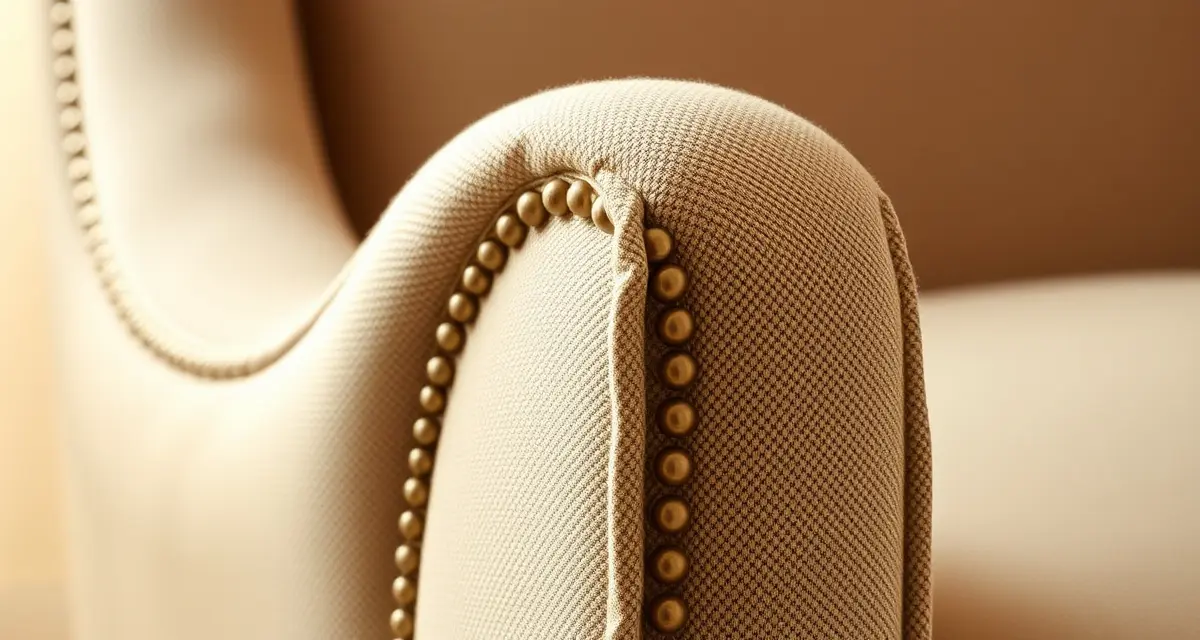
Fabric Yardage with Nailhead Trim: How Nail Placement Affects Cuts
A clean nailhead border on a chair looks like a finishing detail. Behind it, there's a tuck depth that most upholsterers forget to calculate before ordering fabric. Border nailhead designs require 10–15% more fabric tuck depth, that's 0.25–0.5 yards on most chair jobs.
If you ordered fabric based on the panel dimensions without accounting for nailhead placement, you'll find out at the cutting table. This guide covers how nail placement changes your fabric layout, how to calculate yardage correctly for edge nailhead and decorative border patterns, and which fabric types work best under nail.
TL;DR
- Nailhead Trim yardage depends on fabric width, construction details, pattern repeat, and nap direction.
- Plain 54-inch fabric requires a baseline calculation plus 10-15% waste allowance for a standard nailhead trim job.
- Patterned fabric adds 20-35% to base yardage depending on repeat size and the number of cutting zones that must align.
- Directional fabrics add 15-25% over plain fabric because layout optimization is restricted by nap direction.
- Always verify fabric width before finalizing yardage; COM fabric often comes in non-standard widths.
- Calculating yardage at the quote stage, not mid-job, eliminates reorders and protects your profit margin.
The Nailhead Yardage Problem Nobody Explains
Nailhead trim doesn't just sit on top of fabric. On properly finished upholstery, the fabric tucks behind the nailhead row and wraps around the frame. That hidden tuck is part of your yardage calculation.
The depth of fabric required behind a nailhead row depends on placement:
Edge nailhead (single row at the seam line): The nail sits directly at the edge of the panel, pinning the fabric to the frame. Tuck depth is minimal, usually 0.25–0.5 inches behind the nail head itself. This style has the smallest yardage impact.
Decorative border nailhead (single row inset from the edge): The nail row sits 1–3 inches inset from the panel edge, creating a visible border. The fabric must wrap from the edge, around to the nail row, and then the nail holds it. The distance from the edge to the nail row has to be factored into the panel cut, it's fabric that's consumed by the border but invisible on the finished piece.
Double or triple nail row borders: Multiple rows multiply the tuck depth. A triple row border set 2 inches from the edge with 0.5 inches between rows requires 3.5 inches of extra fabric depth behind the visible surface, entirely hidden once nailed.
Decorative nail patterns (geometric shapes, lines across the face): These don't primarily affect tuck depth, but they affect how you cut and position the panel. The nail pattern has to be planned before cutting, and the panel must be sized to accommodate the full pattern with margins.
Calculating Fabric for Edge Nailhead Trim
Edge nailhead is the simpler calculation. The nail sits at the perimeter of the panel. Your fabric must:
- Cover the face of the piece
- Wrap around the frame edge
- Have enough behind the nail to be held securely
Standard allowance for edge nailhead: add 0.5–0.75 inches to each edge that gets nailhead trim.
For a chair back that's 24 × 28 inches and gets nailhead on all four sides:
- Flat panel: 24 × 28 inches
- Add 0.75 inches per nailhead edge × 4 edges = 3 inches added to both dimensions
- Nailhead panel: 27 × 31 inches
That 3-inch addition on each dimension adds meaningfully to the yardage calculation, especially when multiplied across multiple pieces.
Calculating Fabric for Border Nailhead Trim
Border nailhead requires more careful calculation. The border creates a visual frame that's set back from the edge of the piece. Here's how the math works:
Identify the border inset distance. A 2-inch border means the nail row sits 2 inches from the visible edge of the panel.
Add the tuck depth. The fabric has to wrap from the visible front surface, over the frame edge, and be held by the nail. This requires:
- Face panel (normal)
- Frame wrap: typically 1–1.5 inches over the edge
- Hidden tuck to nail point: 2 inches (the border inset)
- Allowance behind nail: 0.5 inches
Total extra depth per border edge: 3.5–4 inches.
For a wing chair back with a 2-inch nailhead border on three edges:
- Standard flat panel: 26 × 30 inches
- Add 4 inches to each bordered edge
- Nailhead panel: 34 × 38 inches (adding 4 inches to width for two side borders, 4 inches to height for top border)
That's nearly 31% more panel area, which translates directly to more yardage.
The chair fabric yardage calculator includes a nailhead border toggle that adds this depth calculation automatically when you select your trim style.
Geometric and Pattern Nailhead Designs
Some pieces use nailhead in decorative patterns across the face of the fabric, diagonal lines, chevrons, X shapes, or custom logos. These designs don't primarily affect tuck depth but do affect how you handle the fabric panel.
The key issue: the nailhead pattern must be planned on paper before you cut. If you're doing a chevron pattern on a chair back, the starting point of the chevron has to align with the panel center. The panel must be cut large enough to accommodate the full pattern with margins on all sides.
Typical addition for decorative face patterns: Add 2–3 inches to both panel dimensions as planning margin. You may not use all of it, but you need it available as you work through the nail placement.
Marking the pattern: Use chalk to mark the nail pattern on the fabric before nailing. Never nail by eye on a geometric design, small cumulative errors become obvious at the center of the pattern.
Which Fabrics Work Best with Nailhead Trim
Not all fabrics hold up equally well under nailhead. Here's what to know before you start:
Good Nailhead Fabrics
Linen and linen blends: The tight weave holds well around nail shafts. Linen is a traditional nailhead fabric for a reason, it resists tearing at the nail point.
Cotton canvas and duck cloth: Heavy and stable. Nails don't pull through.
Velvet: Works well with the right nail size. Use a smaller nail to avoid crushing the pile around the nail head. Test on a scrap first.
Leather: Nailhead on leather is a classic combination. Leather doesn't fray at the nail point and holds indefinitely. Use the right gauge nail for hide thickness.
Problematic Nailhead Fabrics
Loose-weave fabrics (open chenille, bouclé): The loose weave pulls away from the nail over time. The nail head eventually cuts through the loops rather than holding them.
Thin polyester fabrics: Light polyester tears at the nail shaft, especially on pieces that see regular use. The nail hole becomes a tear origin.
Performance-coated fabrics: The coating can crack around nail shafts over time, particularly at flexion points. Test before committing.
Sheer or semi-sheer fabrics: These simply aren't suitable for nailhead, the nail is visible through the fabric and the fabric weight doesn't support the nail properly.
The welt cording yardage calculator is useful for jobs that combine welt and nailhead, which is a common combination on traditional-style pieces.
Yardage Summary: Edge vs Border Nailhead
| Trim Style | Extra Depth per Edge | Impact on Chair (0.5 yd base) | Impact on Sofa (12 yd base) |
|---|---|---|---|
| Edge nailhead, single row | 0.5–0.75 in | +0.05–0.1 yd | +0.2–0.4 yd |
| Border nailhead, 1-inch inset | 2.5–3 in | +0.15–0.2 yd | +0.35–0.5 yd |
| Border nailhead, 2-inch inset | 3.5–4 in | +0.25–0.4 yd | +0.5–0.75 yd |
| Triple-row border, 2-inch inset | 4–5 in | +0.35–0.5 yd | +0.6–1.0 yd |
These are per-piece estimates assuming nailhead on three or four edges. Single-edge nailhead (front edge only on a seat, for example) has proportionally smaller impact.
Practical Workflow: Accounting for Nailhead Before Ordering
- Define your nailhead style before you quote. Edge or border? Single row or multiple? Pattern?
- Measure the finished panel size as if the piece were flat with no nailhead.
- Add the appropriate depth to each edge that gets nailhead. Use the figures above.
- Recalculate yardage from the expanded panel dimensions.
- Document the nailhead allowance in your quote so the client understands it's a real cost factor, not padding.
FAQ
Does nailhead trim require extra fabric?
Yes. The amount depends on the trim style. Edge nailhead adds 0.5–0.75 inches of depth per bordered edge, a minor addition. Border nailhead inset 2 inches from the edge requires 3.5–4 inches of extra depth per edge to accommodate the fabric tuck and wrap. For a chair with a 2-inch border on three edges, this can add 0.25–0.4 yards to your total fabric order.
How do I calculate fabric for a nailhead border design?
Start with your standard flat panel dimensions. For each edge that gets a nailhead border, add the sum of: the border inset distance + the frame wrap depth (1–1.5 inches) + the allowance behind the nail (0.5 inches). For a 2-inch inset border, this is typically 3.5–4 inches of extra depth per edge. Add this to the appropriate panel dimension before converting to yardage.
What fabric types work best with nailhead trim?
Linen, cotton canvas, duck cloth, leather, and velvet all work well with nailhead. Linen is the traditional choice, it holds firm around nail shafts and resists tearing. Avoid loose-weave fabrics like open chenille and bouclé, which can pull away from the nail over time. Light polyester is also problematic; the nail shaft can tear through with regular use. For decorative face patterns in nailhead, choose a fabric with enough body to hold the visual pattern crisp, thin fabrics sag between nails.
What is the biggest factor in yardage variation for this piece?
Pattern repeat is the biggest source of yardage variation. On plain fabric, the baseline calculation plus a 10-15% waste buffer is usually sufficient. Add a 13-inch pattern repeat and you may need 15-20% more. Add a 27-inch pattern repeat and the additional yardage can be 25-35% over the plain fabric calculation. Nap direction is the second-largest factor, typically adding 15-25% over plain fabric because layout optimization is restricted.
What should I do if I run short on fabric mid-job?
Stop cutting immediately when you realize you may run short. Calculate exactly how much additional fabric you need before contacting the supplier or client. If reordering from the same dye lot is possible, do so as quickly as possible because dye lots change. If a dye lot match is not available, contact the client before proceeding; visible dye lot differences on the same piece are unacceptable and must be disclosed. Document the situation and response in writing.
Sources
- National Upholstery Association
- Association of Master Upholsterers and Soft Furnishers (AMUSF)
- Upholstered Furniture Action Council (UFAC)
- Furniture Today (trade publication)
Get Started with StitchDesk
Getting yardage right on yardage nailhead trim jobs is the difference between a profitable quote and an expensive reorder. StitchDesk's fabric calculator accounts for all the variables that cause errors: pattern repeat by zone, nap direction, fabric width, and cushion configuration. Start a free trial and see how accurate yardage calculation affects your bottom line.