Fabric Grain Direction for Upholstery: Why It Matters More Than You Think
You cut the fabric. It fits. The job looks great on day one. Then six months later, a client sends you a photo, the cushion seat is pulling to one side, the back panel is starting to sag, and the whole piece looks like it's had a hard life. Off-grain cutting does this. And it's invisible until it isn't.
Upholstery fabric grain direction is one of those fundamentals that gets skipped in training and ignored in practice, until a job comes back. Off-grain upholstery shows visible sag within 12–18 months versus 5 or more years for grain-aligned work. That gap isn't about fabric quality. It's about how you cut.
This guide covers the warp, weft, and bias explained clearly, how to check grain before touching your rotary cutter, and how grain direction affects your total yardage order.
TL;DR
- Understanding grain direction properties helps you select the right material for each client's specific use case and budget.
- Durability ratings (double-rub count) are the standard measure of upholstery fabric longevity: 15,000+ for light use, 30,000+ for heavy residential, 100,000+ for commercial.
- Fabric cleaning codes (W, S, WS, X) determine what cleaning methods are safe and should be communicated to every client at handoff.
- Pattern repeat, nap direction, and fabric width are the three variables that most affect yardage requirements on any piece.
- COM fabric should always be verified for rub count and cleaning code before acceptance.
- Fabric performance in real use depends on the application: a fabric rated for light residential use will fail quickly in high-traffic settings.
The Problem With Off-Grain Upholstery
Fabric is a grid. Warp threads run lengthwise (parallel to the selvage), weft threads run crosswise, and the bias runs diagonally. Each direction has different stretch characteristics. Warp is the most stable. Weft has moderate give. Bias stretches, a lot.
When you cut a seat panel off-grain, you're pulling against that bias in use. Every time someone sits, the panel shifts slightly. It's invisible initially. The tuck-in holds it. But over months, the fabric migrates toward the bias, the pattern skews, and the cushion starts looking wrong. The client doesn't know why. They just know the chair looks worn.
This isn't about low-end fabric. A $40/yard fabric cut off-grain will fail faster than a $15/yard fabric cut correctly.
The Failure Timeline Compared
Grain-aligned upholstery on a well-used piece (daily family sofa) typically shows first wear signs at the 4–5 year mark, fraying at stress points, fading, pilling. That's normal life expectancy.
Off-grain panels on the same piece start showing structural distortion at 12–18 months. The panel itself hasn't worn through, but it's pulling in directions it wasn't designed to go. Seams torque. Welts twist. Back panels sag at the center.
By year three, an off-grain piece can look like a six-year-old piece. That's the real cost.
Warp, Weft, and Bias: What Each Direction Does
Warp: The Strong Direction
Warp threads run parallel to the selvage, the finished edge of the fabric roll. They're the threads that are held under tension during weaving, which makes them the most stable direction. On most upholstery fabrics, warp runs up and down the roll.
For seats and backs that take vertical load, cushion tops, sofa seats, dining chair seats, you want the warp running vertically on the piece. It resists compression. It doesn't stretch under weight.
Weft: The Crosswise Direction
Weft threads run perpendicular to the selvage, across the fabric width. They have more give than warp because they weren't held under the same tension. On most fabrics, weft runs side to side.
Weft is fine for side panels, arms, and pieces that don't take constant compression. But putting weft in a seat direction means the fabric stretches more than it should under body weight.
Bias: When You Need It and When You Don't
True bias runs at 45 degrees to the selvage. It has maximum stretch and is used intentionally for welt cording, the stretch helps the welt bend around curves without puckering. Bias-cut welt is a deliberate choice.
Bias is not something you want in your panels. Even a 5–10 degree off-grain cut introduces enough bias stretch to cause long-term problems. A panel doesn't need to be cut 45 degrees off-grain to fail. It just needs to be cut wrong enough to pull.
How to Check Fabric Grain Before Cutting
Step 1: Find the Selvage
Roll out your fabric on the cutting table. The selvage edges, the factory-finished edges on both long sides, define your warp direction. Warp runs parallel to these edges.
If the pattern is printed rather than woven, look for the pattern's intended vertical direction. Usually the pattern was designed to hang correctly with warp vertical.
Step 2: Straighten the Cut End
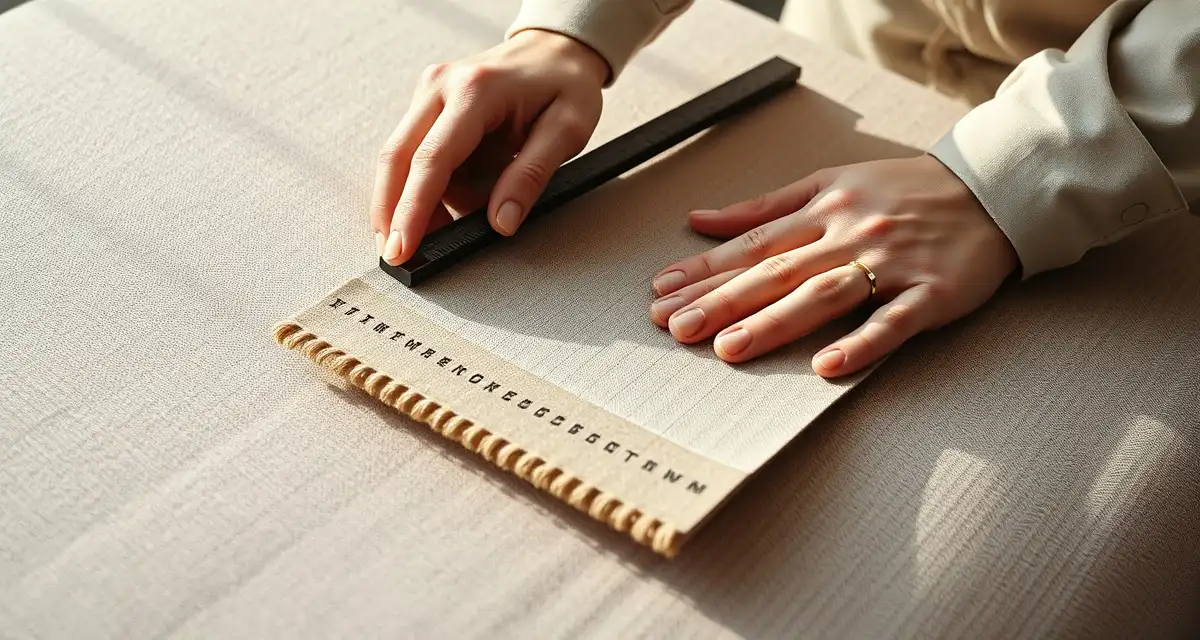
Fabric doesn't always come off the roll with a perfectly square end. Before measuring, establish a true crosswise cut. Pull a weft thread across the width, literally pull a single thread and cut along the pulled line, or use a T-square against the selvage to establish true 90 degrees.
This is the step most people skip. Measuring from a skewed end compounds the error across every subsequent cut.
Step 3: Check Pattern Grain Alignment
On patterned fabrics, the pattern should align with the grain. It usually does, but not always. When a fabric's pattern runs slightly off-grain (common in cheaper prints), you have to decide: align with the pattern, or align with the grain.
For most upholstery, align with the grain. A slightly cocked pattern is visible but looks like a pattern quirk. A grain-misaligned panel that sags looks like a bad job. Use your fabric yardage calculator to account for any extra yardage needed when the pattern requires adjustment.
Step 4: Mark Your Grain Line on Every Panel
Before moving panels off the cutting table, mark the grain direction with chalk. An arrow from top to bottom indicating warp direction takes five seconds and prevents the most common mistake, rotating a panel 90 degrees when arranging cuts to save fabric.
Grain Direction by Furniture Section
Not every panel needs the same grain orientation. Here's the working standard:
Seat cushion top and bottom: Warp runs front to back (direction of primary use). This resists compression when someone sits.
Seat cushion boxing strip: Warp runs lengthwise around the boxing, horizontally around the cushion perimeter. This keeps the boxing strip from stretching taller under pressure.
Back panel (inside): Warp runs vertically. The back panel needs to resist sag as it's leaned against repeatedly.
Back panel (outside): Warp vertical here too. These panels are primarily aesthetic but still see stress from people pushing against the back.
Arm panels: Warp running vertically is standard, though some upholsterers run it horizontally on tight arms. If in doubt, vertical.
Welt cording: True bias cut. This is the one place you want that stretch.
Does Grain Direction Affect How Much Fabric You Need?
Yes, sometimes meaningfully. When you lay panels grain-correct, you're locked into certain orientations that may not give you the most efficient nesting. Rotating a panel 90 degrees might save half a yard but puts it on the weft instead of the warp.
On solid fabrics, the grain call is straightforward, mark warp, cut panels in the correct orientation, calculate accordingly.
On patterned fabrics, grain direction often aligns with the pattern. But if it doesn't, you may need to add 0.25–0.5 yards per large panel to account for the extra waste from keeping grain correct while also matching the pattern repeat.
The velvet nap direction guide covers the additional complication of directional fabrics, where grain direction and nap direction both apply simultaneously.
Common Grain Direction Mistakes
Rotating panels to save yardage. This is the most common error. A tight layout on the cutting table leads to rotating a back panel 90 degrees to fit beside a seat panel. It fits. It ships. It fails in a year.
Measuring from a skewed end. If your starting cut isn't square to the selvage, every subsequent measurement inherits the error. A 3-degree skew becomes visible after 10 yards.
Assuming the pattern is on-grain. Printed fabrics can have patterns that run 2–5 degrees off the true grain. Check both before assuming they're aligned.
Ignoring grain on small pieces. Arm cap panels, borders, and small accent pieces seem too small to matter. But if an arm cap is cut off-grain, it'll pucker at the edge and never sit flat.
FAQ
What is fabric grain direction in upholstery?
Fabric grain direction refers to the orientation of the threads in a woven fabric, specifically the warp (lengthwise, running parallel to the selvage) and weft (crosswise). In upholstery, grain direction determines how the fabric responds to stress over time. Panels cut on the grain hold their shape. Panels cut off-grain gradually distort, sag, and show premature wear.
How do I check fabric grain before cutting for upholstery?
Start by identifying the selvage edges of the fabric, the factory-finished edges on each long side of the roll. Warp runs parallel to these edges. Then square your starting cut by pulling a weft thread across the width and cutting along the pulled line. Mark your grain direction on each panel with chalk before moving them from the table. For patterned fabrics, verify that the pattern aligns with the grain before cutting.
Does grain direction affect how much fabric I need?
It can. Grain-correct panel layouts are sometimes less efficient than layouts that rotate panels freely. On solid fabrics, the additional waste is usually small, under 0.25 yards per piece. On patterned fabrics where both grain alignment and pattern matching apply, you may need to budget an extra 0.25–0.5 yards per large panel. Factor grain direction into your estimate from the start rather than discovering the shortfall at the cutting table.
How do I explain fabric choices to a client?
Start with use case: how the piece will be used, who will use it, and whether pets or children are factors. Then narrow by durability requirement (rub count) and cleaning preference (cleaning code). Once practical requirements are set, move to aesthetics: color, texture, pattern. Clients who understand why certain fabrics are recommended are more confident in their choices and less likely to question cost differences between options.
Sources
- National Upholstery Association
- Association of Master Upholsterers and Soft Furnishers (AMUSF)
- Upholstered Furniture Action Council (UFAC)
- Furniture Today (trade publication)
Get Started with StitchDesk
Helping clients choose the right fabric is a core part of the job, and having accurate yardage calculations and fabric records at hand makes those conversations faster and more confident. StitchDesk keeps fabric data, yardage calculations, and client records in one place so you spend less time on paperwork and more time on the work itself. Try StitchDesk free.