Upholstery for Beginners: What You Need to Start Learning
Beginners who start with dining chair seats before sofas have an 80% success rate. Beginners who start with sofas have approximately a 20% success rate. The difference isn't talent, it's complexity. A dining chair seat teaches you the core skills of upholstery without the 15 variables that make a sofa difficult.
If you're interested in learning upholstery, whether to develop a skill, save money on your own furniture, or explore it as a profession, here's the right starting point and the right progression.
TL;DR
- This guide covers the specific techniques, measurements, and decisions that determine quality outcomes in upholstery work.
- Planning and preparation before cutting begins is the most reliable way to avoid costly errors on any upholstery job.
- Fabric selection, yardage calculation, and structural assessment are the three decisions that most affect the final result.
- Experienced upholsterers develop consistent workflows that ensure quality and efficiency across every job type they handle.
- Documenting job details, material specifications, and client approvals protects both the shop and the client.
- The right tools, materials, and techniques for each job type make a measurable difference in quality and profitability.
Why Starting Small Matters
Upholstery has a steep visual feedback curve. When you make a mistake on a sofa, you find out after hours of work. When you make a mistake on a dining chair seat, you find out in 45 minutes with a small piece of fabric at stake.
The skills that matter in upholstery are developed through repetition: measuring accurately, cutting straight, applying tension evenly, and making clean corners. These skills transfer from simple projects to complex ones. A beginner who has done 10 dining chair seats before attempting a footstool is in a completely different position than a beginner whose first project is a wingback chair.
The beginner skill ladder: dining chair seat (start here) → footstool → headboard → chair → sofa. In that order.
Starting Tools
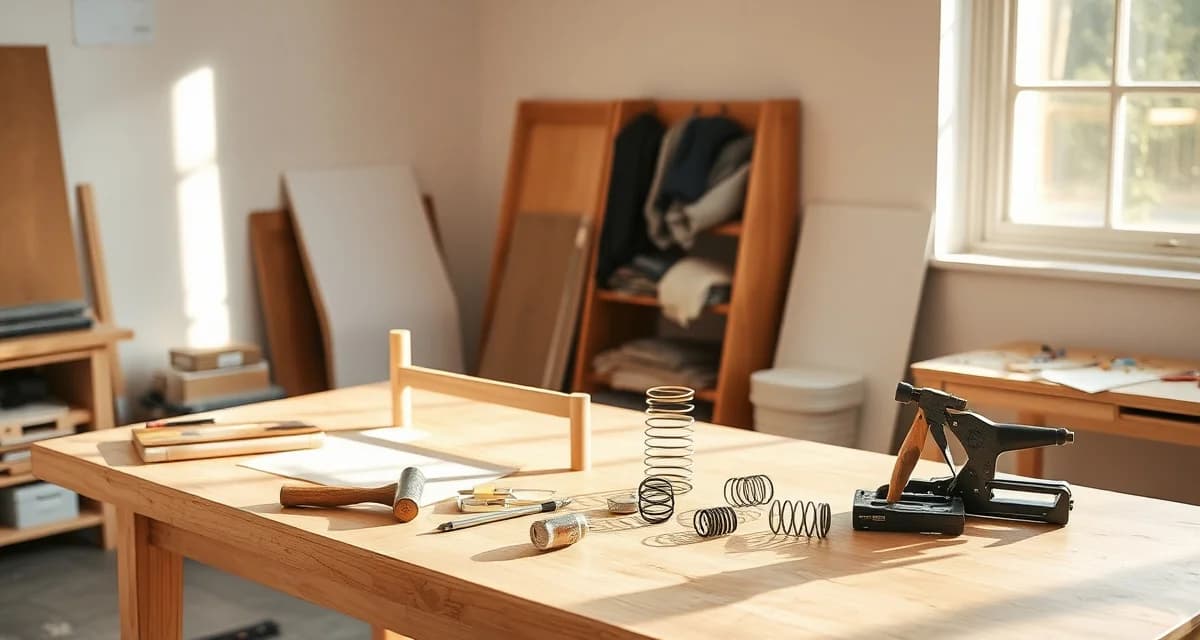
You don't need much to start. Here's the minimum kit for a dining chair seat project:
Staple gun: An electric or pneumatic staple gun with 3/8-inch staples is the standard. Manual staple guns are available but tire your hand quickly on even a small project. An electric staple gun costs $30-60 and handles all beginning projects.
Staple remover (tack puller): To remove old fabric and staples from the existing seat. A flathead screwdriver works but a purpose-built tack puller is faster and damages the frame less.
Scissors or shears: Sharp fabric shears. A dull pair crushes fabric edges instead of cutting cleanly. Keep these for fabric only.
Tape measure: For measuring the seat and calculating how much fabric you need.
Pliers: For pulling out stubborn staples that the tack puller can't reach.
Fabric marker or chalk: For marking cut lines on fabric.
Optional but helpful: A rubber mallet for setting staples more evenly, and a hot glue gun for securing edge trim or gimp.
Basic Materials
Fabric: Buy more than you think you need for your first project. For a dining chair seat, buy a piece that's 6-8 inches wider and longer than the seat pad on all sides. That gives you enough to pull and secure without running short.
Foam (if replacing): For dining chair seats, 2-inch foam at medium density is standard. Cut the foam to the seat shape before covering.
Batting (optional): A thin layer of polyester batting over the foam softens the profile and prevents the foam edge from showing through the fabric.
Your First Project: Dining Chair Seat
Here's the basic process for a dining chair seat with a removable pad:
- Remove the seat pad from the chair. Most screw in from underneath with 4 screws. A screwdriver handles this.
- Remove old fabric. Use the tack puller to remove staples from the underside of the pad. Peel off the old fabric. Note how it was attached, you're reversing this process.
- Assess the foam. If it's compressed and uncomfortable, replace it. If it still has good density and shape, you can reuse it.
- Cut new fabric. Place the fabric face-down on a flat surface. Center the seat pad face-down on the fabric. Mark a cut line 4-6 inches outside the seat edge on all sides. Cut along the marked line.
- Position and staple. Pull the fabric taut over the front edge and staple in the center. Move to the back edge and pull taut, staple in the center. Repeat on both sides. Work outward from center staples on each side, pulling fabric taut and stapling every 1-2 inches.
- Handle corners. Fold the corner fabric neatly (a hospital corner fold or a folded pleat) and staple flat. Trim any excess bulk from the fold.
- Inspect. Check that the fabric is taut and even across the top surface with no wrinkles. If a wrinkle persists, remove the staples near it and re-pull.
- Reattach. Screw the seat pad back into the chair.
That's your first project. It takes 20-45 minutes once you've done it once.
The Next Level: Footstool
A footstool adds a vertical surface and requires you to handle the fabric at the transition from the top to the sides without puckering. It also introduces the concept of starting in the center of each side and working outward, a technique that applies to every upholstery project.
A footstool with a simple rectangular top and straight sides is appropriate after 2-3 successful dining chair seats.
The Learning Resource Gap
Upholstery tutorials online are numerous but inconsistent. Many show technique on soft pieces (cushion covers, poufs) that doesn't directly prepare you for furniture upholstery. Look specifically for tutorials showing:
- How to handle corners on hard frames
- How fabric tension is achieved and maintained
- How to work with curved surfaces
The how to reupholster dining chairs guide goes deeper on the dining chair technique. For tools, the upholstery shop tools guide covers both beginner and professional equipment with explanations of what each tool does.
When to Call a Professional
At any point in the beginner progression, if a project is more complex than your current skill level or if the furniture has significant value, a professional shop produces better results more cost-effectively.
The learning curve is real, and so is the cost of mistakes on expensive fabric or valuable furniture. Starting with inexpensive fabric on furniture with low monetary value is the right way to build skill without risk.
Related Articles
FAQ
How do I learn upholstery?
Start with dining chair seats and work your way up through the beginner skill ladder: dining chair seat, footstool, headboard, chair, sofa. Each stage builds skills that transfer to the next. Dining chair seats teach you fabric tension and corners. Footstools add vertical surfaces. Headboards add foam cutting and straight-line technique. Chairs add arm sections and more complex corners. Sofas add cushion panels and full-piece seam management. Skipping stages means learning multiple new skills simultaneously, which significantly increases the error rate and frustration level.
What projects should a beginner start with?
Start with a dining chair seat with a removable pad. It's the ideal learning project because it teaches the core skills (measuring, cutting, pulling fabric taut, stapling, corner folding) in a controlled, reversible context. If a corner goes wrong, you remove 4 staples and try again. The whole project takes less than an hour, uses a small amount of fabric, and produces an immediately usable result. After two or three successful chair seats, move to a simple rectangular footstool. Build your way up the skill ladder before tackling anything with arms or cushions.
What tools do I need to start upholstery?
For a beginner starting with dining chair seats: an electric staple gun with 3/8-inch staples, a tack puller for removing old staples, sharp fabric shears, a tape measure, and chalk for marking cuts. That's the complete kit for simple beginner projects. As you move to more complex work, add: a fabric hammer or rubber mallet for even staple setting, hot glue gun for trim, a hand sewing needle and thread for slip stitches, and eventually a sewing machine for cushion covers and piping. Don't buy professional tools before you know you'll continue, start with the minimum and add as specific projects require it.
What are the most common mistakes to avoid in this type of work?
The most common mistakes are underestimating material requirements, starting work before the frame is fully assessed and repaired, and skipping the centering and alignment checks before cutting. Each of these is far more expensive to correct after cutting has begun than to prevent at the planning stage. Taking an extra 15-30 minutes at the assessment and planning stage pays dividends throughout the job.
When should I consult a professional rather than doing the work myself?
Consult a professional when the piece has structural issues beyond simple fabric replacement, when the piece has significant financial or sentimental value, or when the fabric or technique (tufting, pattern matching, hand-tacking) requires skills you have not developed. A professional assessment before you begin is free at most shops and can prevent costly mistakes on a piece worth preserving.
Sources
- National Upholstery Association
- Association of Master Upholsterers and Soft Furnishers (AMUSF)
- Upholstered Furniture Action Council (UFAC)
- Furniture Today (trade publication)
Get Started with StitchDesk
Running a successful upholstery shop means getting the details right on every job. StitchDesk gives you purpose-built tools for quoting, fabric calculation, job tracking, and client communication, all in one place designed specifically for the trade. Start a free trial and see how StitchDesk supports quality work from intake to delivery.