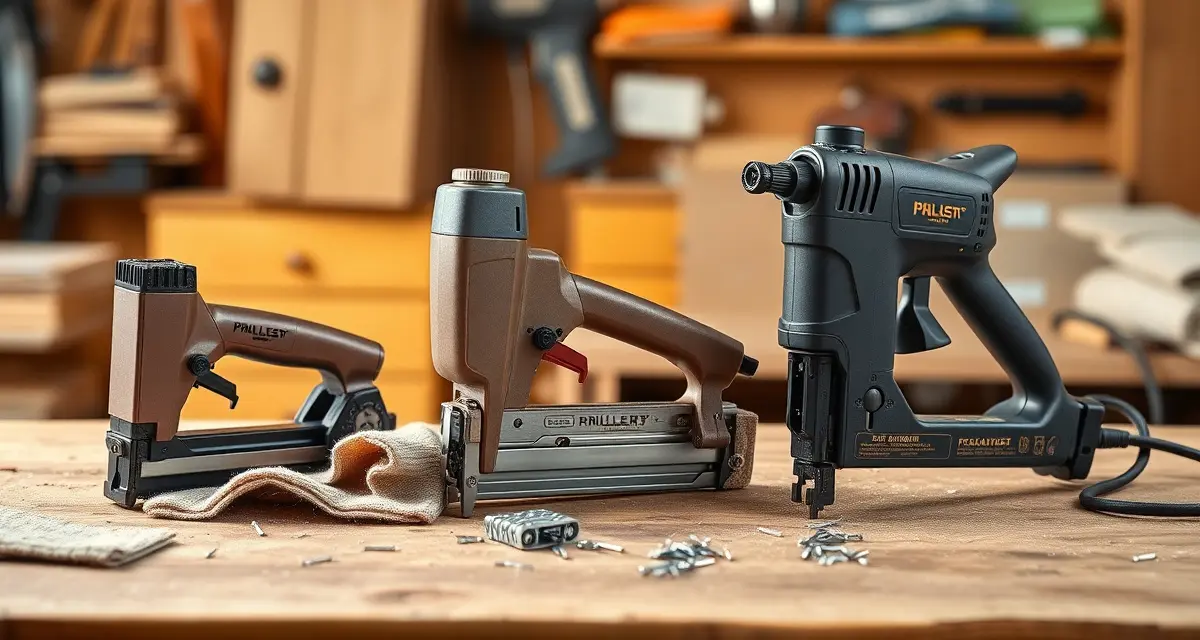
Upholstery Staple Gun Guide: Manual Pneumatic and Electric Compared
Choosing the wrong staple gun for upholstery work creates problems that show up in the finished piece. Using #7 staples on thin silk fabric blows out the weave. The damage is visible through the face fabric and permanent. Using too light a staple on heavy vinyl means it pulls free before the piece ships. Matching staple gun type and staple size to your fabric is a basic shop skill that directly affects work quality.
Most upholstery shops use pneumatic staple guns for daily production work and keep a manual gun on hand for tight spots a compressor hose can't reach. Electric guns have improved significantly and are now a viable option for lower-volume shops that don't want to deal with a compressor. Each type has real tradeoffs worth understanding before you spend money on equipment.
TL;DR
- A well-managed upholstery shop tracks every job from intake to delivery with documented status at each stage.
- Fabric management, including ordering, receiving, storing, and allocating by job, is operationally the most complex part of running an upholstery shop.
- Client communication (status updates, completion photos, delivery scheduling) reduces inbound calls and increases repeat business.
- Shops that document their workflow can train new employees faster and maintain consistent quality during growth periods.
- Measuring key metrics (jobs per week, average ticket, fabric waste rate) is the foundation of informed business decisions.
- Professional shop management tools pay for themselves through reduced errors and faster quoting, typically within the first quarter.
Manual Staple Guns
Manual staple guns are what most people start with, and they're the least suited for professional upholstery production work. They require significant hand strength to drive staples consistently, and hand fatigue over a full workday leads to inconsistent staple depth. Some staples are countersunk into the fabric, others are proud and create bumps.
Manual guns do have legitimate uses in an upholstery shop:
- In tight corners where a pneumatic gun won't fit
- For light tacking during initial positioning (where you need to remove staples easily)
- Offsite work where a compressor isn't available
- Quick repairs on finished pieces in the shop
If you're doing high volume (more than 5 to 8 pieces per week) a manual gun as your primary tool will slow your output and put repetitive stress on your hands. It's a support tool, not a production tool.
Pneumatic Staple Guns
Pneumatic staple guns run off a compressor and deliver consistent staple depth with minimal hand effort. They're the standard in professional upholstery shops for good reasons: consistent drive depth, high speed, and they don't fatigue the hand over a full workday.
The two main pneumatic gun styles in upholstery are:
Standard pneumatic upholstery guns (like the Bostitch or Arrow pneumatic) drive staples with a single trigger pull and are the workhorse for most fabric-to-frame attachment work. They accept a range of staple sizes from the same gun by changing the staple type loaded.
Narrow crown pneumatic guns drive staples with a 3/8-inch crown (vs the standard 1/2-inch crown) and are used for thin or delicate fabric where a wide crown would show through. They're less common but useful for velvet and lightweight woven work.
The main disadvantages of pneumatic guns are the compressor requirement and hose management. On large pieces that require moving around, the hose can snag on furniture and is cumbersome. Some shops use inline coiled hoses to reduce this problem.
Electric Staple Guns
Electric upholstery staple guns (cordless or corded) have closed the gap with pneumatic in recent years. A quality cordless electric gun like the Freeman or DeWalt upholstery model drives staples at consistent depth comparable to a mid-range pneumatic, with no hose to manage.
Electric guns work well for:
- Shops doing moderate volume (under 15 pieces per week)
- Offsite work where a compressor isn't practical
- Shops where the noise of a compressor is a problem
- Lighter fabric and thin material work
The limitation is stamina on heavy vinyl and thick canvas. On very tough materials, a pneumatic gun delivers more consistent drive force than most electric models, especially toward the end of a battery charge. If vinyl and boat canvas are a significant part of your work, pneumatic remains the better choice.
Staple Size Guide by Fabric Type
This is the most practically important information in this guide. Using the wrong staple size damages fabric in ways that can't be undone.
| Fabric Type | Crown Width | Leg Length | Notes |
|---|---|---|---|
| Thin silk, gauze, sheer | 3/8" crown | 3/8" leg | Use narrow-crown gun, minimal force |
| Lightweight woven (cotton, linen) | 1/2" crown | 3/8-1/2" leg | Standard upholstery staple |
| Medium woven (chenille, velvet, bouclé) | 1/2" crown | 1/2" leg | Most common residential work |
| Heavy woven (canvas, outdoor fabric) | 1/2" crown | 1/2-9/16" leg | May need two passes for clean bite |
| Vinyl and faux leather | 1/2" crown | 1/2" leg | Pull firmly before stapling: no stretch later |
| Real leather | 1/2" crown | 9/16" leg | Penetrates hide cleanly, firm hold |
| Marine vinyl/boat canvas | 1/2" crown | 9/16-5/8" leg | Maximum penetration for weather exposure |
The leg length determines how deep the staple bites into the frame. For most wood frames, a 1/2-inch leg is standard. For hardwood frames (oak, ash), a 9/16-inch or 5/8-inch leg ensures the staple doesn't pull free over time.
Common Staple Gun Mistakes
Overdriving staples through thin fabric. Too much air pressure or too strong a manual strike drives the staple crown into the fabric instead of flat against it. The crown cuts through weave threads and creates a visible perforation. Reduce air pressure on pneumatic guns; reduce grip force on manual guns.
Underdriving staples in heavy material. A staple that doesn't sit flush with the frame surface creates a bump that telegraphs through the fabric face. Increase air pressure or use a heavier leg staple on thick canvas and heavy vinyl.
Using the same staple size for all materials. The most common equipment error in lower-volume shops. Keep at minimum three sizes on hand: a light staple for delicate fabric, a medium for standard woven upholstery, and a heavy for vinyl and leather.
For a full overview of shop tools beyond staple guns, the upholstery shop tools guide covers everything from webbing stretchers to regulators. For technique on using staples correctly in the full reupholstery process, the sofa reupholstery guide shows the stapling sequence in context.
Frequently Asked Questions
What staple gun should I use for upholstery?
For production work in a professional shop, a pneumatic staple gun is the right choice. It delivers consistent drive depth without hand fatigue over a full day. A good entry point is a standard 1/2-inch crown pneumatic upholstery gun running off a small shop compressor (at least 2 gallon, 1 CFM). For lower-volume work or offsite jobs, a quality cordless electric gun from Freeman or DeWalt is a viable alternative. Keep a manual gun as backup for tight spots. Avoid making a manual gun your primary tool if you're doing more than a handful of pieces per week.
What size staples for upholstery?
The most common staple for standard residential upholstery work is a 1/2-inch crown by 1/2-inch leg (also written as #7 or T50. For thin or delicate fabrics, drop to a 3/8-inch leg. For leather, vinyl, and heavy outdoor fabric, use a 9/16 or 5/8-inch leg. The crown width determines visibility (wider crown = more holding power but more visible); leg length determines how deep the staple bites into the frame. Never use a heavy staple on lightweight fabric) a #7 staple in thin silk or sheer fabric blows through the weave and damages the fabric permanently.
Is a pneumatic staple gun better than electric for upholstery?
For high-volume production work and heavy materials like vinyl and marine canvas, pneumatic is better. It delivers more consistent force on tough materials, and it doesn't slow down at the end of a charge cycle the way battery-powered tools do. For moderate-volume work and standard woven fabrics, a quality electric gun performs comparably to a mid-range pneumatic without the hose management. The decision mostly comes down to volume, material types, and whether you already have a compressor. If you're doing 15+ pieces per week with heavy vinyl, get a pneumatic. If you're doing lighter fabric work at lower volume, electric works well.
How do I track multiple jobs at different stages simultaneously?
A job tracking system, whether paper-based or software-based, should give you a clear view of every active job's current stage at a glance. The minimum useful stages are: intake received, fabric ordered, fabric received, work in progress, quality check, ready for pickup/delivery, completed. Software that shows all active jobs on a single dashboard with current stage and due date eliminates the mental overhead of tracking multiple jobs manually.
Sources
- National Upholstery Association
- Association of Master Upholsterers and Soft Furnishers (AMUSF)
- Upholstered Furniture Action Council (UFAC)
- Furniture Today (trade publication)
Get Started with StitchDesk
A well-run upholstery shop is built on consistent processes, accurate information, and clear client communication. StitchDesk gives you the tools to manage all three from intake to delivery, without the overhead of paper systems or generic software that does not understand the trade. Start a free trial and see how StitchDesk fits your workflow.