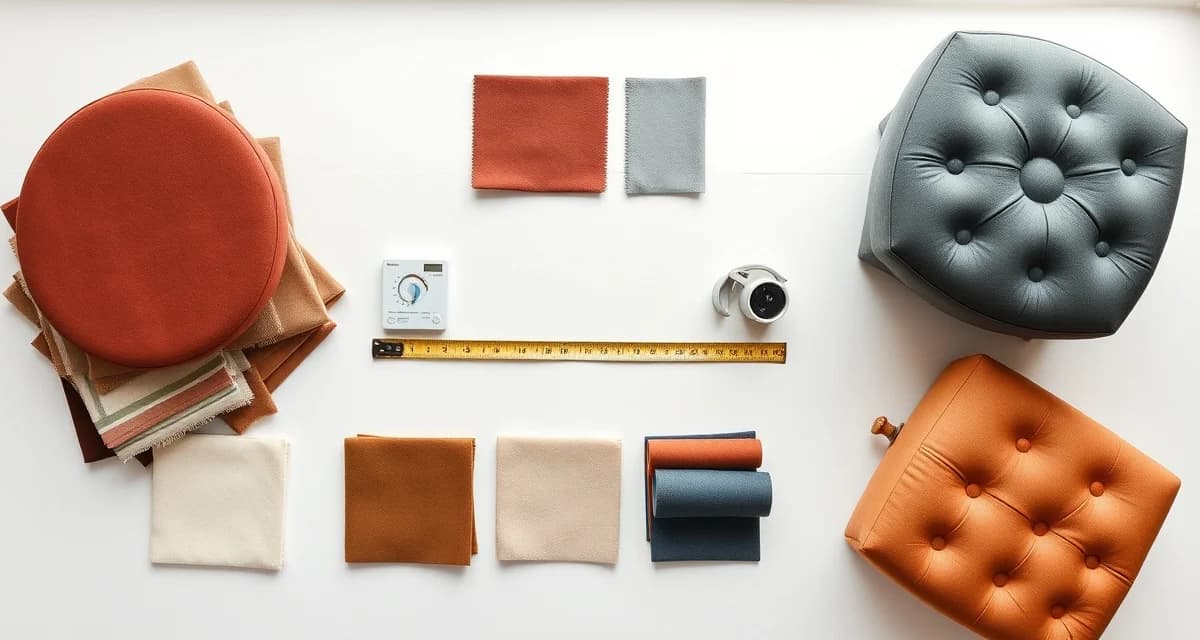
Ottoman Reupholstery Fabric Yardage: Round Square and Tufted Styles
Round ottomans waste 20-30% more fabric than square ottomans. The reason is simple: you're cutting a circle from a rectangular piece of fabric, and the corners of the rectangle become offcuts. The larger the round ottoman, the more you waste.
This guide covers ottoman reupholstery fabric yardage for every common style, square, round, rectangular, tufted, and nailhead-trimmed, with cutting diagrams for minimal waste.
TL;DR
- Ottoman yardage depends on fabric width, construction details, pattern repeat, and nap direction.
- Plain 54-inch fabric requires a baseline calculation plus 10-15% waste allowance for a standard ottoman job.
- Patterned fabric adds 20-35% to base yardage depending on repeat size and the number of cutting zones that must align.
- Directional fabrics add 15-25% over plain fabric because layout optimization is restricted by nap direction.
- Always verify fabric width before finalizing yardage; COM fabric often comes in non-standard widths.
- Calculating yardage at the quote stage, not mid-job, eliminates reorders and protects your profit margin.
Yardage by Ottoman Style and Shape
| Ottoman Style | Approximate Yardage (54" fabric) |
|---|---|
| Square ottoman, standard (24"×24") | 1-1.5 yards |
| Rectangle ottoman, standard (30"×20") | 1.25-1.75 yards |
| Large square ottoman (36"×36") | 1.75-2.5 yards |
| Round ottoman (24" diameter) | 1.5-2 yards |
| Round ottoman (36" diameter) | 2.5-3.5 yards |
| Tufted square ottoman (24"×24") | 1.5-2 yards |
| Tufted round ottoman (24" diameter) | 2-2.5 yards |
| Storage ottoman (large, rectangular) | 2.5-3.5 yards |
Use the fabric yardage calculator ottoman for piece-specific calculations with your exact dimensions.
Round Ottomans: The Cutting Challenge
The top of a round ottoman is a circle. But fabric comes as a rectangle. When you cut a circle from a rectangle of fabric, the four corners of the fabric that remain outside the circle are offcuts you typically can't use for anything on the same job.
For a 24-inch diameter ottoman top, you need at least a 26×26-inch square of fabric (adding seam allowance). From a 54-inch wide bolt, you can cut two 27-inch sections and get two circles. The waste is the strips between the circles and the triangular corners outside each circle.
Shape-specific cutting diagrams show round vs square vs rectangular cutting waste side by side. On a round ottoman, the effective waste is 20-30% of the fabric used. On a square ottoman, it's closer to 8-12%.
Side Panel on a Round Ottoman
The side panel of a round ottoman is a rectangle that wraps around the full perimeter. Perimeter = π × diameter. For a 24-inch diameter ottoman: 3.14 × 24 = 75 inches of side panel needed. That wraps around and seams at the back.
At 8 inches tall, that's a 75×8-inch strip plus seam allowance, you'll need about 2.5 inches of fabric width for this strip (75 inches wrapped into a strip you cut from the width of the bolt).
Square and Rectangle Ottomans: Efficient Cutting
Square and rectangular ottomans are the most fabric-efficient ottoman shapes. The top, bottom, and four side boxing strips are all rectangles that nest efficiently on a fabric bolt.
For a 24×24-inch square ottoman with 8-inch-tall sides:
- Top: 25×25 inches
- Bottom: 25×25 inches (optional, can use muslin)
- Four side strips: 25×9 inches each
Total fabric from a 54-inch bolt: top and bottom from one 25-inch section, four side strips from another. Total fabric consumed: approximately 25+9+9 = 43 inches = 1.2 yards. With seam allowance buffer: 1.25-1.5 yards.
Tufted Ottomans: Add 30-40%
Tufting adds notable fabric to an ottoman because each button tuft pulls the top fabric downward, creating folds that consume surface area.
For a tufted square ottoman, the effective area of the top panel increases by 25-35% after tufting, which means you need to cut the panel 25-35% larger than the finished top dimensions before tufting.
Does tufting affect ottoman yardage? Yes. A flat-top 24×24-inch ottoman needs about 0.75 yards for the top panel. A tufted version of the same ottoman needs 1-1.25 yards for the top panel alone, before the sides.
The more buttons, the more fabric. For deep tufting (buttons more than 1.5 inches below surface), use the higher end of the tufting add-on range.
Nailhead-Trim Ottomans
Nailhead trim doesn't change fabric yardage, the nailheads go over the fabric, not into it. But nailhead trim does change how you calculate the side panel, because the fabric must be wrapped and folded cleanly at each corner for the nailheads to lie flat.
Clean corners on nailhead trim require mitered or notched corners on the side boxing strips. Plan for 0.25 yards of extra fabric for corner adjustments on a nailhead-trimmed ottoman.
What Fabric Works Best for High-Use Ottomans?
Ottomans take direct impact, foot pressure, and often sit-on use. The ottoman reupholstery guide covers this in detail, but the short version: tight-weave performance fabrics or treated synthetics hold up best. Avoid loose-weave or delicate fabrics on ottomans used as footrests or for seating.
For leather ottomans, use the leather hide calculator, you'll need approximately 4-6 square feet of leather for a standard 24×24-inch ottoman top and sides.
FAQ
How much fabric for a round ottoman?
A 24-inch diameter round ottoman needs 1.5-2 yards of fabric for a flat top version, or 2-2.5 yards for a tufted version. A larger 36-inch diameter round ottoman needs 2.5-3.5 yards flat or 3-4.5 yards tufted. Round ottomans need 20-30% more fabric than a square ottoman of similar surface area because of the corner waste when cutting circles from rectangular fabric.
Does tufting affect ottoman yardage?
Yes, tufting adds approximately 30-40% to the top panel yardage. A flat top panel that would normally use 0.75 yards needs 1-1.25 yards in a tufted version because the fabric must be cut larger to account for the fabric pulled into each button tuft. Deep tufting (buttons recessed more than 1.5 inches) requires the higher end of this range.
What fabric is best for an ottoman with heavy use?
For high-use ottomans, especially ones that serve as footrests, coffee table surfaces, or occasional seating, use a performance fabric with a double-rub count above 30,000. Solution-dyed acrylic, performance polyester weaves, and commercial-grade vinyl are the most durable options. Avoid velvet, chenille, or loose-weave naturals on ottomans that see daily physical contact. If the client insists on a decorative fabric, consider using it for the top only and a coordinating durable fabric for the sides.
What is the biggest factor in yardage variation for this piece?
Pattern repeat is the biggest source of yardage variation. On plain fabric, the baseline calculation plus a 10-15% waste buffer is usually sufficient. Add a 13-inch pattern repeat and you may need 15-20% more. Add a 27-inch pattern repeat and the additional yardage can be 25-35% over the plain fabric calculation. Nap direction is the second-largest factor, typically adding 15-25% over plain fabric because layout optimization is restricted.
What should I do if I run short on fabric mid-job?
Stop cutting immediately when you realize you may run short. Calculate exactly how much additional fabric you need before contacting the supplier or client. If reordering from the same dye lot is possible, do so as quickly as possible because dye lots change. If a dye lot match is not available, contact the client before proceeding; visible dye lot differences on the same piece are unacceptable and must be disclosed. Document the situation and response in writing.
Sources
- National Upholstery Association
- Association of Master Upholsterers and Soft Furnishers (AMUSF)
- Upholstered Furniture Action Council (UFAC)
- Furniture Today (trade publication)
Get Started with StitchDesk
Getting yardage right on ottoman jobs is the difference between a profitable quote and an expensive reorder. StitchDesk's fabric calculator accounts for all the variables that cause errors: pattern repeat by zone, nap direction, fabric width, and cushion configuration. Start a free trial and see how accurate yardage calculation affects your bottom line.