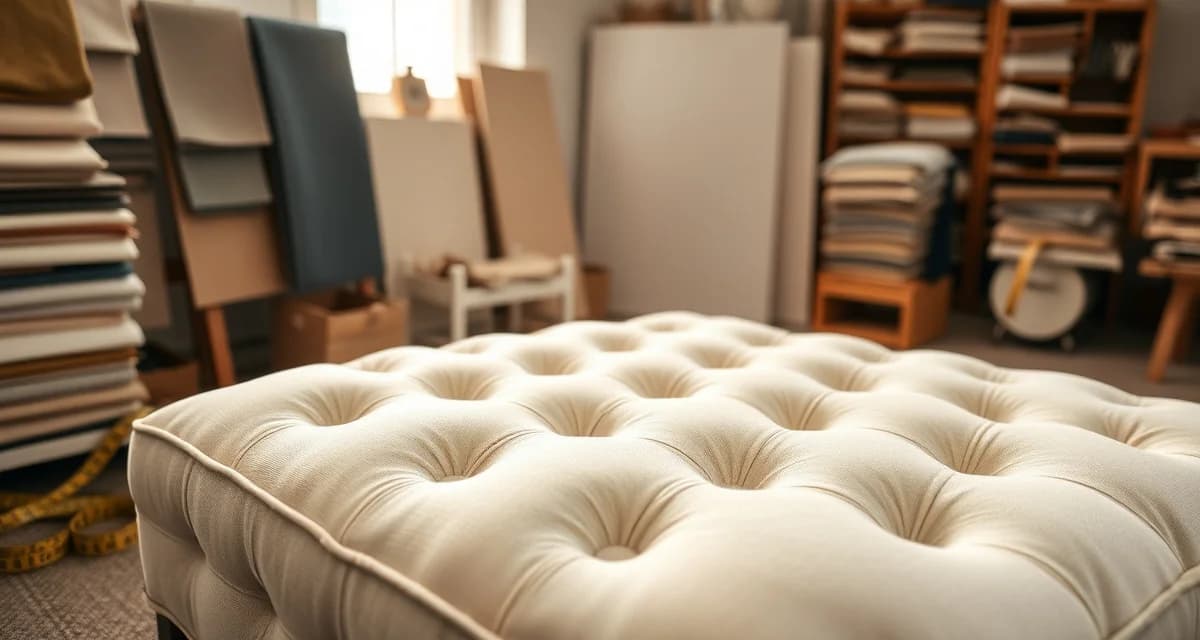
Tufted Ottoman Fabric Yardage: Button Pull Waste Calculator
A plain ottoman is one of the simplest yardage calculations in upholstery. A tufted ottoman is not. The button pull waste on a large tufted ottoman can add 20 to 30% to your base yardage, and on a big piece like a coffee table ottoman with a 5x5 button grid, that's 2.5 to 3 extra yards you need to account for before you order.
Shops that estimate tufted ottomans the same way they estimate flat ottomans consistently run short. Here's how to get this right.
TL;DR
- Tufted Ottoman yardage depends on fabric width, construction details, pattern repeat, and nap direction.
- Plain 54-inch fabric requires a baseline calculation plus 10-15% waste allowance for a standard tufted ottoman job.
- Patterned fabric adds 20-35% to base yardage depending on repeat size and the number of cutting zones that must align.
- Directional fabrics add 15-25% over plain fabric because layout optimization is restricted by nap direction.
- Always verify fabric width before finalizing yardage; COM fabric often comes in non-standard widths.
- Calculating yardage at the quote stage, not mid-job, eliminates reorders and protects your profit margin.
Why Tufted Ottoman Yardage Is Different
The base yardage for an ottoman covers the top face, four sides, and an optional bottom panel. That's your starting point.
Button tufting changes the top face calculation entirely. When you push a button through the top fabric and anchor it to the foam beneath, the surrounding fabric gathers toward that button point. The fabric doesn't disappear, it folds in on itself. That folded, gathered fabric is still using surface area from your original cut. You're compressing fabric, not eliminating it.
The more buttons, the more compression, the more fabric you need in the top panel to accommodate all that gathering and still reach the edges and drop over the sides.
Button Grid Waste by Grid Size
These figures assume a standard residential tufted ottoman top. Fabric is 54-inch solid with standard button pull depth (approximately 0.75 to 1 inch).
| Button Grid | Top Panel Add-on | Base Top Yardage | Total Top |
|---|---|---|---|
| 2x2 (4 buttons) | 8-10% | ~1.0 yard | ~1.1 yards |
| 3x3 (9 buttons) | 12-15% | ~1.2 yards | ~1.4 yards |
| 4x4 (16 buttons) | 18-22% | ~1.5 yards | ~1.8 yards |
| 5x5 (25 buttons) | 25-30% | ~1.8 yards | ~2.3 yards |
Large tufted ottomans with a 5x5 button grid use 2.5 to 3 yards more than the same size plain ottoman. On a 30x52 inch coffee table ottoman, the base top panel is already 1.6 yards. Add 25% for a 5x5 grid and that panel alone needs 2 yards. Then add sides, welt, and base. You're looking at 5 to 6 yards for a piece that a shop might casually estimate at 3 to 4 yards.
Calculating Tufted Ottoman Yardage Step by Step
Step 1: Calculate the base ottoman yardage (flat)
For a rectangular ottoman:
- Top face: (length + 4") × (width + 4") ÷ fabric width = fractional yards, then × depth of drop for pull-down
- Four sides: two side panels at ottoman length × height, two side panels at ottoman width × height
- Bottom: optional, often cambric or decking fabric
Step 2: Apply the tufting multiplier to the top face only
The tufting affects the top panel, not the sides. Take your top panel yardage and multiply by the appropriate factor from the table above. A 3x3 grid adds 12 to 15%, so multiply top panel yardage × 1.15.
Step 3: Add drop allowance at the tufted perimeter
Where the tufted top meets the side panels, there's often a decorative border or boxed edge. Tufted tops need more fabric at the perimeter because the gathering pulls inward, reducing the apparent top area. Add at least 2 to 3 inches to each edge of the top panel beyond normal seam allowance.
Step 4: Calculate welt
Perimeter welt at the top edge: measure the ottoman perimeter and add 10% for seam waste. Bottom edge welt if applicable. Convert linear inches to yardage.
Step 5: Sum all panels and add 10% cutting waste
Ottoman Size Reference: Top Panel Measurements
| Ottoman Size | Top Dimensions | Flat Top Yardage (54" fabric) |
|---|---|---|
| Small accent (18x18) | ~22x22 | 0.6 yards |
| Standard square (24x24) | ~28x28 | 0.8 yards |
| Standard rectangle (22x36) | ~26x40 | 1.0 yards |
| Coffee table (24x48) | ~28x52 | 1.3 yards |
| Large coffee table (30x54) | ~34x58 | 1.6 yards |
Apply your tufting multiplier to these top panel figures. The sides, welt, and base add approximately 0.75 to 1.5 yards depending on ottoman height and perimeter.
Tufted Round Ottomans
Round and oval ottomans add a wrinkle: the top panel needs to be cut as a circle or oval from rectangular fabric. That means you're paying for the corner waste in your cut piece regardless of tufting.
For a 36-inch diameter round tufted ottoman:
- You need a 40 to 42-inch square of fabric for the top (36" diameter + tufting allowance + seam allowance)
- The corner cutouts from a 40-inch square are notable waste, roughly 30% of the square cut goes to waste
- Then add your tufting multiplier on top of the circular cut
Round tufted ottomans are among the least fabric-efficient pieces you'll work on. Budget generously.
What Fabric Works Best for Tufted Ottomans?
Velvet is the classic choice for tufted ottomans. The pile creates visual depth at the button points, making the tufting stand out. Budget nap direction waste (10 to 15%) in addition to tufting waste.
Performance weaves work well for high-traffic ottomans. Flat weaves don't show pile direction waste, and many performance fabrics have enough body to hold the tufted form without excessive softening at the button points.
Leather on tufted ottomans is beautiful but requires a hide-count calculation rather than yardage. The pull depth on leather tufting is typically shallower than fabric, which reduces the percentage waste somewhat, but leather has its own hide-level waste (belly, brand) to account for.
Fabrics to avoid: Loosely woven fabrics like linen slubs or open-weave textures. These can fray or distort at the button insertion points, creating an untidy appearance around each button.
Common Tufted Ottoman Mistakes
Applying a flat ottoman estimate. The 20 to 30% tufting adder on the top panel is real. Never skip it.
Forgetting the perimeter drop. Tufting pulls the top inward. If your top panel doesn't have enough fabric at the perimeter edges, the tufted top will appear to "float" or will pull away from the side panels.
Underestimating button count. A 5x5 grid sounds like 25 buttons, but some clients want a denser grid. Count the actual planned button positions in your mockup before calculating.
Not accounting for button depth. Deeper button pull = more fabric gathering = more top panel yardage. Ask your client about the desired tuft depth before you calculate.
Using the Ottoman Fabric Yardage Calculator
The ottoman calculator has a tufting mode. Select your button grid size and the calculator adjusts the top panel yardage automatically. For tufting calculations on other piece types, the guide on Fabric Yardage for Tufted Upholstery covers button density and pull waste across sofas, headboards, and chairs.
How much fabric for a tufted ottoman?
A plain ottoman typically needs 2 to 4 yards. A tufted ottoman of the same size needs 2.5 to 6 yards depending on grid density and ottoman size. A large 5x5-grid tufted coffee table ottoman can need 5 to 7 yards.
How many yards does button tufting add to an ottoman?
Tufting adds 20 to 30% to the top panel yardage. On a large ottoman where the top panel is 1.5 to 2 yards, that's 0.3 to 0.6 extra yards just in the top panel. Across a complete tufted ottoman job, the net addition over a flat version is typically 1 to 3 yards.
What is the best fabric for a tufted ottoman?
Velvet is traditional and shows tufting beautifully. Performance weaves are practical for everyday use. Leather is luxurious but requires hide-count calculation. Avoid loosely woven fabrics that may distort or fray around button insertion points.
What is the biggest factor in yardage variation for this piece?
Pattern repeat is the biggest source of yardage variation. On plain fabric, the baseline calculation plus a 10-15% waste buffer is usually sufficient. Add a 13-inch pattern repeat and you may need 15-20% more. Add a 27-inch pattern repeat and the additional yardage can be 25-35% over the plain fabric calculation. Nap direction is the second-largest factor, typically adding 15-25% over plain fabric because layout optimization is restricted.
What should I do if I run short on fabric mid-job?
Stop cutting immediately when you realize you may run short. Calculate exactly how much additional fabric you need before contacting the supplier or client. If reordering from the same dye lot is possible, do so as quickly as possible because dye lots change. If a dye lot match is not available, contact the client before proceeding; visible dye lot differences on the same piece are unacceptable and must be disclosed. Document the situation and response in writing.
FAQ
Sources
- National Upholstery Association
- Association of Master Upholsterers and Soft Furnishers (AMUSF)
- Upholstered Furniture Action Council (UFAC)
- Furniture Today (trade publication)
Get Started with StitchDesk
Getting yardage right on yardage tufted ottoman jobs is the difference between a profitable quote and an expensive reorder. StitchDesk's fabric calculator accounts for all the variables that cause errors: pattern repeat by zone, nap direction, fabric width, and cushion configuration. Start a free trial and see how accurate yardage calculation affects your bottom line.