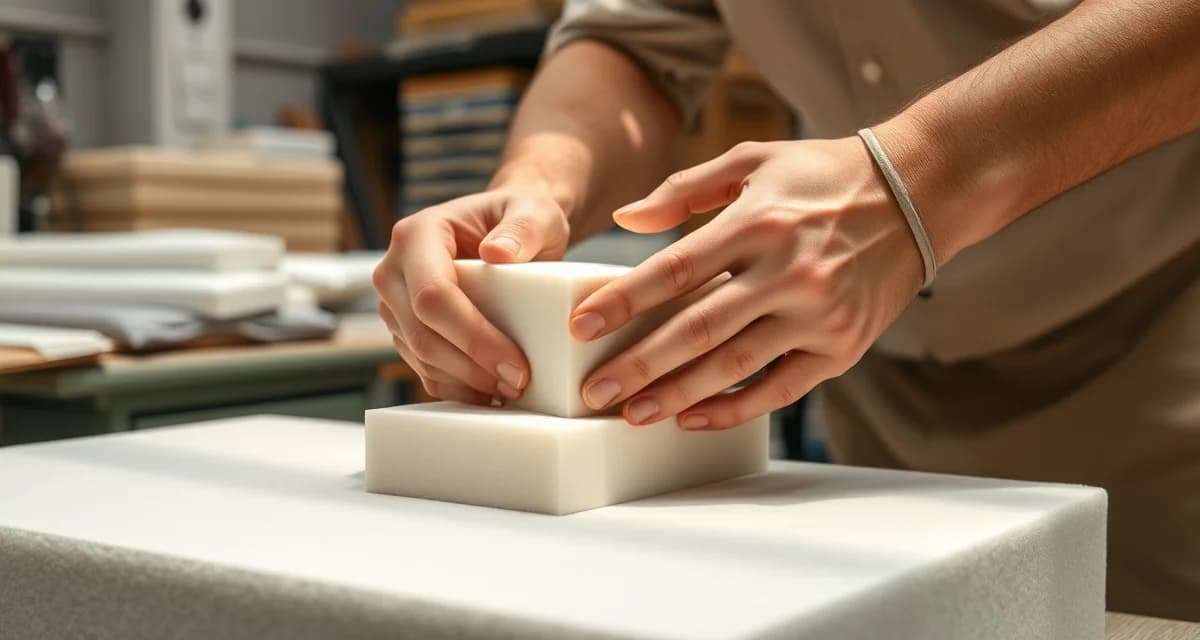
When to Replace Upholstery Foam: Assessment Guide for Every Piece
Shops that always replace foam add $50 to $200 per job unnecessarily. A proper assessment saves clients money and builds trust. Foam that still passes a 3-test assessment doesn't need to be replaced, and clients who find out you saved them $75 on foam they didn't need remember that.
This guide gives you the 3-test foam assessment framework so you can make accurate recommendations, not automatic replacements.
TL;DR
- A well-managed upholstery shop tracks every job from intake to delivery with documented status at each stage.
- Fabric management, including ordering, receiving, storing, and allocating by job, is operationally the most complex part of running an upholstery shop.
- Client communication (status updates, completion photos, delivery scheduling) reduces inbound calls and increases repeat business.
- Shops that document their workflow can train new employees faster and maintain consistent quality during growth periods.
- Measuring key metrics (jobs per week, average ticket, fabric waste rate) is the foundation of informed business decisions.
- Professional shop management tools pay for themselves through reduced errors and faster quoting, typically within the first quarter.
The 3-Test Foam Assessment
Test 1: Compression Test
This is the primary test. It tells you whether the foam still has its load-bearing capacity.
How to perform: Press firmly on the foam surface with your palm. Apply pressure equivalent to sitting weight, approximately 80-100% of what a seated person would exert. Hold for 3-5 seconds.
Pass: The foam compresses, then springs back to full height within 2-3 seconds of releasing pressure. No permanent set remains.
Fail: The foam compresses and either stays compressed (no spring-back), springs back very slowly (over 5+ seconds), or springs back to only 60-70% of original height.
For seat foam: Fail if it compresses to within 1.5 inches of the frame. Pass if more than 2 inches of useful foam remains after compression.
For back foam and pillow-fill: Lower standards apply. Back foam that compresses slowly but still returns to 70-80% is often acceptable for back cushions where load is lower.
Test 2: Shape Memory Check
This test identifies permanent set, the condition where foam has taken on the shape of repeated compression without recovering.
How to perform: Remove the foam from the cushion cover if possible (or assess from above for attached cushions). Look for:
- Visible indentations in the shape of a person's sitting position
- Visible sagging in the center vs edges
- Uneven height across the foam surface
Pass: Foam surface is even or very nearly even across its full surface. No visible body impressions.
Fail: Visible permanent body impressions, center sag of 1 inch or more, or notable height variation between seat center and edges.
Marginal: Some compression pattern visible but less than 1/2 inch of center sag. May be acceptable for light-use pieces or budget reupholstery. Discuss with client.
Test 3: Hygiene Assessment
This test is non-negotiable for health reasons. Foam that fails hygiene assessment is replaced regardless of mechanical condition.
How to perform: Remove the fabric cover (this is usually done during tear-down anyway). Inspect the bare foam for:
- Visible mold or mildew (any visible mold = automatic replacement)
- Dark staining that extends through the foam body (surface staining may be cleanable; through-staining indicates saturation)
- Persistent odor when the fabric is removed (urine, smoke, mold, biological odor)
Pass: Clean foam with no odor, no mold, no through-staining.
Fail: Any mold, notable odor, or extensive staining. Replace immediately.
For pet urine: Test by pressing firmly on suspected areas and holding near your face. Urine odor in foam is often undetectable until pressure is applied. This is the "sniff test" upholsterers use and it works. Foam with urine contamination cannot be cleaned, replace.
Pass/Fail Decision by Furniture Type
| Furniture Type | Replace If... | Can Reuse If... |
|---|---|---|
| Sofa seat cushions | Test 1 fail, center sag 1"+, any mold/odor | All 3 tests pass, less than 5 years old |
| Chair seat | Test 1 fail, compressed more than 50% | Passes compression, minimal shape memory |
| Back cushions | Notable shape memory, any odor | Passes compression, no hygiene issues |
| Ottoman | Test 1 fail, visible compression pattern | Passes compression, good surface condition |
| Dining chair seat (fixed) | Compressed within 1" of frame | Still provides adequate support |
| Headboard foam | Rarely fails, light use | Almost always reusable if no hygiene issues |
Communicating the Assessment to Clients
When foam passes: "The foam is still in good condition. Replacing it would add $[amount] to your quote but I don't think it's necessary based on what I'm seeing. Happy to replace it if you prefer, but I'd recommend saving the cost."
When foam fails: "The foam on this seat is [describe the specific finding: compressed, has permanent set, has an odor]. Replacing it will add $[amount] to the quote but it'll make a notable difference in comfort."
When it's marginal: "The foam is borderline, it still has some life but it's showing its age. Replacing it would cost $[amount] and it would considerably improve the finished piece. It's your call."
These specific conversations take 90 seconds and build trust. The client who knows you gave them an honest assessment instead of automatically billing for unnecessary work comes back and sends referrals.
For foam selection guidance when replacement is needed, the upholstery foam selection guide covers density, ILD, and use-case matching. The how to reupholster a sofa guide covers foam installation in the full sofa reupholstery sequence.
Frequently Asked Questions
How do I know if upholstery foam needs replacing?
Use the 3-test assessment: compression test (does it spring back fully within 2-3 seconds?), shape memory check (any visible permanent body impressions or center sag over 1 inch?), and hygiene assessment (any mold, persistent odor, or through-staining?). Foam that passes all three tests doesn't need to be replaced. Foam that fails any one of the three tests should be replaced, with hygiene failure being the most urgent.
Can I reuse the old foam when reupholstering?
Yes, if the foam passes the 3-test assessment. This is particularly common for back cushions and headboards, which see lower compression cycling than seat foam. Seat foam in heavily-used sofas and chairs fails more often than back foam. Document the foam assessment on your intake form so there's no dispute later about whether foam was tested.
What is the lifespan of upholstery foam?
High-resilience foam (2.0-2.5 density) in seat cushions lasts 8-12 years under daily use. Standard foam (1.5-1.8 density) lasts 4-7 years. Back cushion foam lasts longer, 10-15 years typically, because it sees lower compression forces. Outdoor foam in proper drainage construction lasts 8-12 years. These are general ranges; actual lifespan depends on use intensity, foam quality, and environmental conditions.
How do I track multiple jobs at different stages simultaneously?
A job tracking system, whether paper-based or software-based, should give you a clear view of every active job's current stage at a glance. The minimum useful stages are: intake received, fabric ordered, fabric received, work in progress, quality check, ready for pickup/delivery, completed. Software that shows all active jobs on a single dashboard with current stage and due date eliminates the mental overhead of tracking multiple jobs manually.
Related Articles
Sources
- National Upholstery Association
- Association of Master Upholsterers and Soft Furnishers (AMUSF)
- Upholstered Furniture Action Council (UFAC)
- Furniture Today (trade publication)
Get Started with StitchDesk
A well-run upholstery shop is built on consistent processes, accurate information, and clear client communication. StitchDesk gives you the tools to manage all three from intake to delivery, without the overhead of paper systems or generic software that does not understand the trade. Start a free trial and see how StitchDesk fits your workflow.